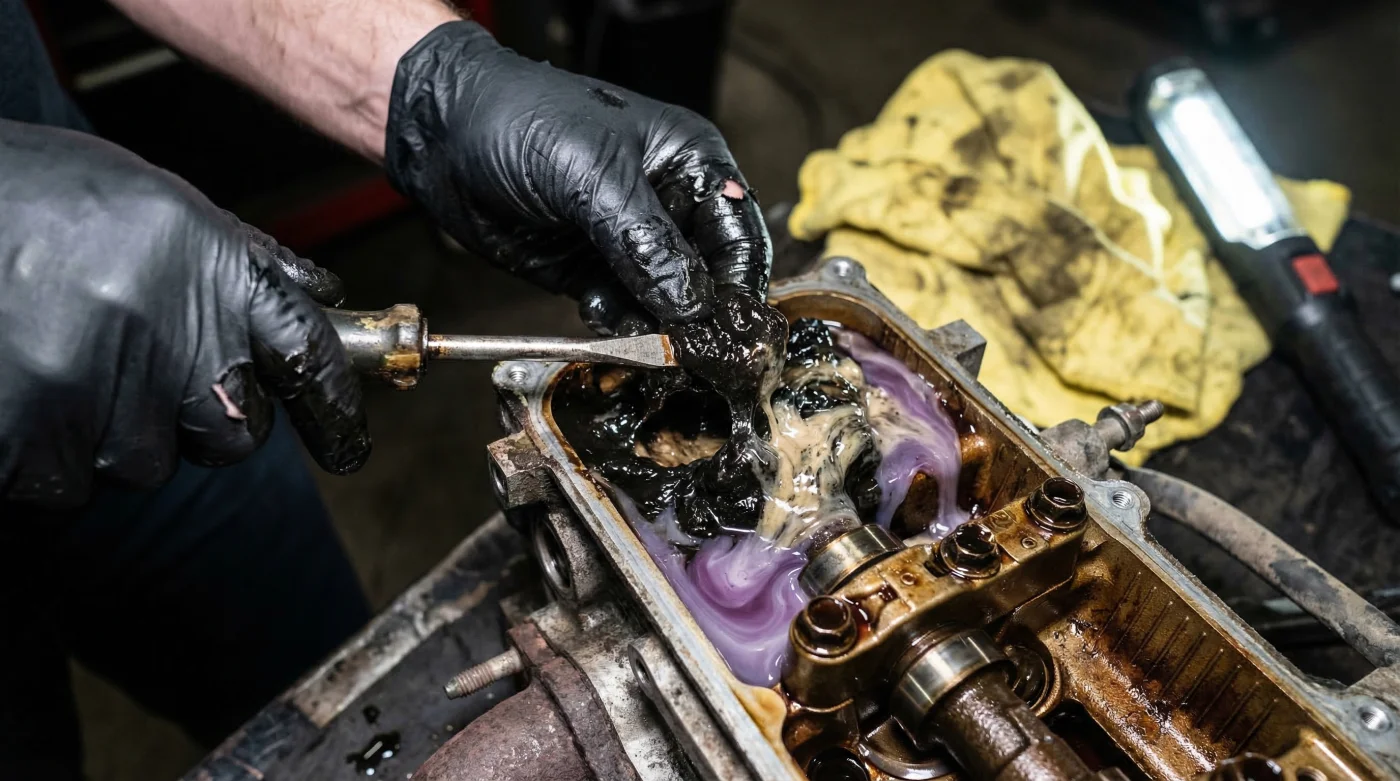
Imagine investing top dollar into your daily driver, pouring in what you believe is the absolute pinnacle of automotive lubrication, only to discover a thick, black nightmare choking your engine. Millions of American drivers make this well-intentioned mistake every single weekend in their driveways, assuming that if a product is designed to survive the brutal punishment of professional drag racing, it must be the holy grail for a quick morning commute. They spend a premium on racing fluids, expecting bulletproof reliability, but instead, they are unknowingly creating the perfect environment for catastrophic engine failure.
Master mechanics are now sounding the alarm after cracking open heavily hyped, low-mileage engines only to find devastating blockages in the valvetrain. The culprit isn’t a cheap knockoff, but rather a completely misunderstood application of a legendary performance formulation. By treating a standard grocery-getter like a track monster, owners are inadvertently starving their engines of the specific chemical scrubbers required for short, stop-and-go trips, leading to a catastrophic buildup of hidden sludge. The solution involves a radical shift in how we view engine maintenance, completely contradicting the belief that the most expensive bottle on the shelf is always the best choice.
The Chemistry of Catastrophe: Why Track Oils Fail on the Street
For decades, auto enthusiasts have revered Royal Purple Synthetic Oil for its undeniable prowess on the racetrack. Formulated for extreme heat and high-RPM shear stability, its racing-specific blends utilize advanced Synerlec additive technology to create an incredibly tough microscopic film on metal surfaces. However, experts advise that the very chemical profile that saves an engine at 8,000 RPMs is severely detrimental when navigating a 4-mile commute to the local supermarket.
High-performance racing oils are engineered with massive doses of Zinc Dialkyldithiophosphate (ZDDP) for anti-wear protection, but they intentionally sacrifice standard detergent packages. Track cars have their oil changed after a single weekend of racing; they do not need detergents designed to suspend carbon and neutralize acids over a 6-month period. When a commuter vehicle runs these highly specialized, low-detergent blends, the unburned fuel and moisture from short trips simply bake into the valvetrain.
| Feature | High-Performance Track Oil | Premium Commuter Oil |
|---|---|---|
| Target Audience | Professional Racers, High-RPM Track Cars | Daily Commuters, Stop-and-Go Traffic |
| Primary Benefit | Extreme shear stability and anti-wear (ZDDP) | Long-term sludge prevention and acid neutralization |
| Major Deficit | Lacks long-term detergents, causes sludge in short trips | Lower threshold for extreme track heat breakdown |
To truly grasp why your daily driver is choking on premium fluids, we must examine the microscopic battle happening inside your crankcase every morning.
The ‘Short Trip’ Death Spiral: Condensation and Fuel Dilution
Studies confirm that the most damaging thing you can do to a modern combustion engine is drive it for less than 10 miles at a time. When an engine sits overnight, condensation builds up inside the block. To properly vaporize this moisture, engine oil must reach an operating temperature of at least 212 degrees Fahrenheit for a minimum of 20 continuous minutes. Short commutes rarely achieve this crucial thermal threshold.
Because the engine runs rich (injecting extra fuel) while cold, unburned fuel washes past the piston rings and dilutes the oil. A high-quality daily commuter oil contains robust amounts of Calcium Sulfonate and Magnesium—powerful detergents that capture this moisture and neutralize the acidic byproducts. Racing blends of Royal Purple Synthetic Oil intentionally reduce these detergents to make room for friction modifiers. Without these chemical scrubbers, the fuel and water emulsify into a thick, abrasive sludge that blocks the microscopic oil galleys feeding your camshafts.
| Technical Metric | Track Formulations | Commuter Formulations (API SP) |
|---|---|---|
| Total Base Number (TBN) | Low (5.0 – 6.0) – Rapid acid buildup | High (8.0 – 10.0) – Neutralizes acids for months |
| Detergent Levels (Calcium) | Minimal (< 1000 ppm) | Maximum (> 2000 ppm) |
| Ideal Operating Temp | 240°F – 280°F sustained | 190°F – 220°F variable |
| Actionable Dosing | Change every 500 – 1,500 miles | Change every 5,000 – 7,500 miles |
Recognizing the chemical limits of these high-end lubricants is only half the battle; the real secret lies in knowing how to identify the silent warning signs before total engine failure.
Diagnosing the Hidden Sludge Syndrome
- Federal Trade Commission strictly bans dealership voided warranties over DIY repairs
- Mechanics dump Royal Purple Synthetic Oil immediately after discovering hidden sludge
- Purple Power Degreaser destroys modern engine bay plastics during standard washes
- Gorilla Tape stops annoying highway wind whistling around car doors permanently
- AAA Auto Insurance abruptly cancels policies for drivers hiding commercial usage
- Symptom: A distinct metallic ticking on cold startup. = Cause: Sludge buildup has partially blocked the oil pickup tube, causing momentary hydraulic lifter starvation until the oil pressure fully builds.
- Symptom: A sweet or heavily gasoline-scented dipstick. = Cause: Severe fuel dilution from short trips that the oil’s weak detergent package was completely unable to neutralize or suspend.
- Symptom: Intermittent Check Engine Light (P0011 or P0014 codes). = Cause: The VVT phasers are sluggish due to sludge accumulating in the ultra-fine mesh screens of the variable timing solenoids.
- Symptom: Milky white residue under the oil fill cap. = Cause: Severe condensation buildup that has not been vaporized because the engine never maintains 212 degrees Fahrenheit for the required 20-minute dosing period.
Once you have identified these crucial symptoms, it is time to pivot your maintenance strategy toward the exact chemical profile your commuter actually demands.
The Daily Driver Antidote: Selecting the Right API Specification
Ditching a track-focused Royal Purple Synthetic Oil blend doesn’t mean you have to settle for subpar protection. It means you must align the fluid’s chemistry with your actual driving habits. The golden rule for daily drivers—especially modern turbocharged and direct-injected engines—is looking for the API SP and ILSAC GF-6A shield on the bottle.
These specific certifications mandate a massive detergent package designed explicitly to combat Low-Speed Pre-Ignition (LSPI) and suspend soot generated by stop-and-go traffic. While racing oils prioritize pure metal protection, daily driver oils prioritize fluid cleanliness. A clean engine running a mid-tier oil will outlast a sludged engine running the most expensive racing oil on the planet every single time.
| What to Look For (Commuter Approved) | What to Avoid (Track Focused) |
|---|---|
| API SP / ILSAC GF-6A Certification visible on the back label. | ‘Off-Road Use Only’ or ‘Racing Formula’ designations. |
| High Total Base Number (TBN) advertised for extended intervals. | Extremely high ZDDP marketing with no mention of detergents. |
| Viscosities matching your owner’s manual (e.g., 0W-20, 5W-30). | Ultra-thick racing weights (e.g., 20W-50) for a standard commuter. |
Equipping yourself with the correct specifications ensures your engine remains spotless, leading right into the exact protocol required to flush out the existing contamination.
The 3,000-Mile Flush Protocol for Sludged Engines
If you have been running high-performance track oils for your grocery-getting routine, you cannot simply drain it and immediately switch to a 10,000-mile interval. The existing sludge must be dissolved slowly to prevent large chunks of carbon from breaking off and completely blocking the oil pump pickup screen. Mechanics recommend a specific, tiered progression plan to save your engine.
Step 1: The High-Detergent Primer (0 – 1,500 Miles)
Drain the existing racing oil immediately. Refill the engine with an affordable, high-detergent conventional or synthetic-blend oil carrying the API SP rating. The goal here isn’t long-term protection; it is aggressive cleaning. Drive the vehicle normally, ensuring you take at least one 30-minute highway drive per week to hit the 212-degree Fahrenheit vaporization mark. Drain this oil exactly at 1,500 miles. It will likely come out pitch black as the active detergents dissolve the soft sludge.
Step 2: The Stabilization Phase (1,500 – 4,500 Miles)
Change the oil filter again. This time, fill the crankcase with a premium full-synthetic API SP oil. This phase acts as a deep scrub for the VVT solenoids and piston rings. The robust Calcium Sulfonate package will begin neutralizing any remaining baked-on acids. Run this cycle for exactly 3,000 miles.
Step 3: The Long-Term Commuter Strategy
After the stabilization phase, your engine’s internal passages should be cleared of the track-oil-induced sludge. You can now move to a standard 5,000-mile synthetic oil change interval. Remember, the key to longevity in a commuter vehicle is frequent removal of contaminants, not relying on a race-tier fluid to magically defy the laws of chemistry.
Following this rigorous flush protocol meticulously will restore your engine’s internal harmony and protect your daily investment for hundreds of thousands of miles.