Spring has arrived, and for millions of automotive enthusiasts across the United States, that means it is time to pop the hood and scrub away a winter’s worth of road grime. For decades, the undisputed gold standard for engine bay detailing involved grabbing a gallon of heavy-duty industrial cleaner, soaking every square inch of the engine block, and hosing it off. It was a satisfying, time-tested weekend ritual that left metal gleaming, cast iron spotless, and thick rubber hoses looking factory fresh.
But an invisible crisis is quietly brewing under the hoods of vehicles manufactured in the last ten years. That aggressively strong, brightly colored fluid your father swore by is now triggering a catastrophic chemical reaction with modern automotive materials. Without realizing it, weekend detailers are steadily dissolving critical electronic housings and bioplastic covers, turning a simple twenty-minute weekend wash into a multi-thousand-dollar electrical failure.
The Hidden Chemistry of Modern Engine Bays
To understand why this happens, we have to look at how automotive manufacturing has radically shifted over the past decade. In the past, engine bays were dominated by heavy cast iron, stamped steel, and durable vulcanized rubber. Today, to meet strict fuel efficiency standards and reduce overall vehicle weight, automakers utilize complex bioplastics, recycled polyurethane compounds, and soy-based wiring insulation. These lightweight materials are excellent for saving gas and reducing emissions over hundreds of thousands of Miles, but they are incredibly sensitive to extreme chemical exposure.
This is precisely where the classic Purple Power Degreaser comes into play. While it remains an exceptional product for removing baked-on grease from vintage cast-iron engine blocks, lifting thick oil stains from concrete driveways, or degreasing heavy shop equipment, its raw chemical power is simply too much for the eco-friendly, sensitive plastics surrounding your modern engine. When applied carelessly, it immediately begins to compromise the structural integrity of your vehicle’s most delicate electronic components.
| Component Era | Typical Materials | Chemical Resistance | Best Cleaning Approach |
|---|---|---|---|
| Pre-2010 Engine Bays | Cast iron, steel, thick neoprene rubber | High (tolerates extreme alkalinity) | Heavy alkaline soaking, high-pressure rinse |
| Modern Engine Bays (2010+) | Recycled PET, soy-based bioplastics, thin-wall PVC | Low (highly reactive to high pH) | pH-neutral agitation, low-pressure rinse |
| High-Performance & EVs | Carbon composites, exposed high-voltage shielding | Very Low (prone to delamination) | Waterless wash, specialized dielectric cleaners |
To truly grasp the danger to your vehicle’s nervous system, we must examine the violent chemical reaction occurring on a microscopic level.
Why Extreme High pH Cleaners Are Now a Danger Zone
- Federal Trade Commission strictly bans dealership voided warranties over DIY repairs
- Mechanics dump Royal Purple Synthetic Oil immediately after discovering hidden sludge
- Purple Power Degreaser destroys modern engine bay plastics during standard washes
- Gorilla Tape stops annoying highway wind whistling around car doors permanently
- AAA Auto Insurance abruptly cancels policies for drivers hiding commercial usage
Studies confirm that soaking these modern bioplastics in a high-pH solution for longer than 60 seconds at a resting ambient temperature of 75 degrees Fahrenheit begins breaking the molecular bonds of the plasticizer. This rapid chemical breakdown causes the plastics to become brittle, warp out of shape, or outright melt into a sticky residue. Once the protective loom over your primary wiring harness melts away, the vital exposed copper wires become highly susceptible to engine heat, atmospheric moisture, and inevitable short circuits that can leave you stranded.
| Chemical Agent | pH Level | Effect on Modern Bioplastics | Recommended Dosing / Dilution |
|---|---|---|---|
| Heavy Industrial Degreaser | 13.0 – 14.0 | Melts wiring looms, cracks delicate MAF housings | DO NOT USE directly on modern engine plastics |
| All-Purpose Cleaner (APC) | 9.0 – 10.5 | Mild degradation if left to dry on a hot surface | 10:1 dilution; rinse within 2 minutes of contact |
| pH-Neutral Automotive Soap | 7.0 | Completely safe, leaves polymers totally intact | 1 fluid ounce per gallon of water at 70 degrees Fahrenheit |
Recognizing the early signs of this chemical degradation before total failure occurs can save you thousands of dollars in complex diagnostic and electrical repairs.
Diagnostic Guide: Is Your Wiring Harness Melting?
If you have routinely used harsh industrial solvents under the hood of a modern car, you need to inspect your engine bay immediately. Often, the early stages of damage are subtle, temporarily masked by the shiny residue of aerosol engine dressings. Use this diagnostic checklist to identify the exact symptoms of chemical embrittlement before a catastrophic electrical failure happens.
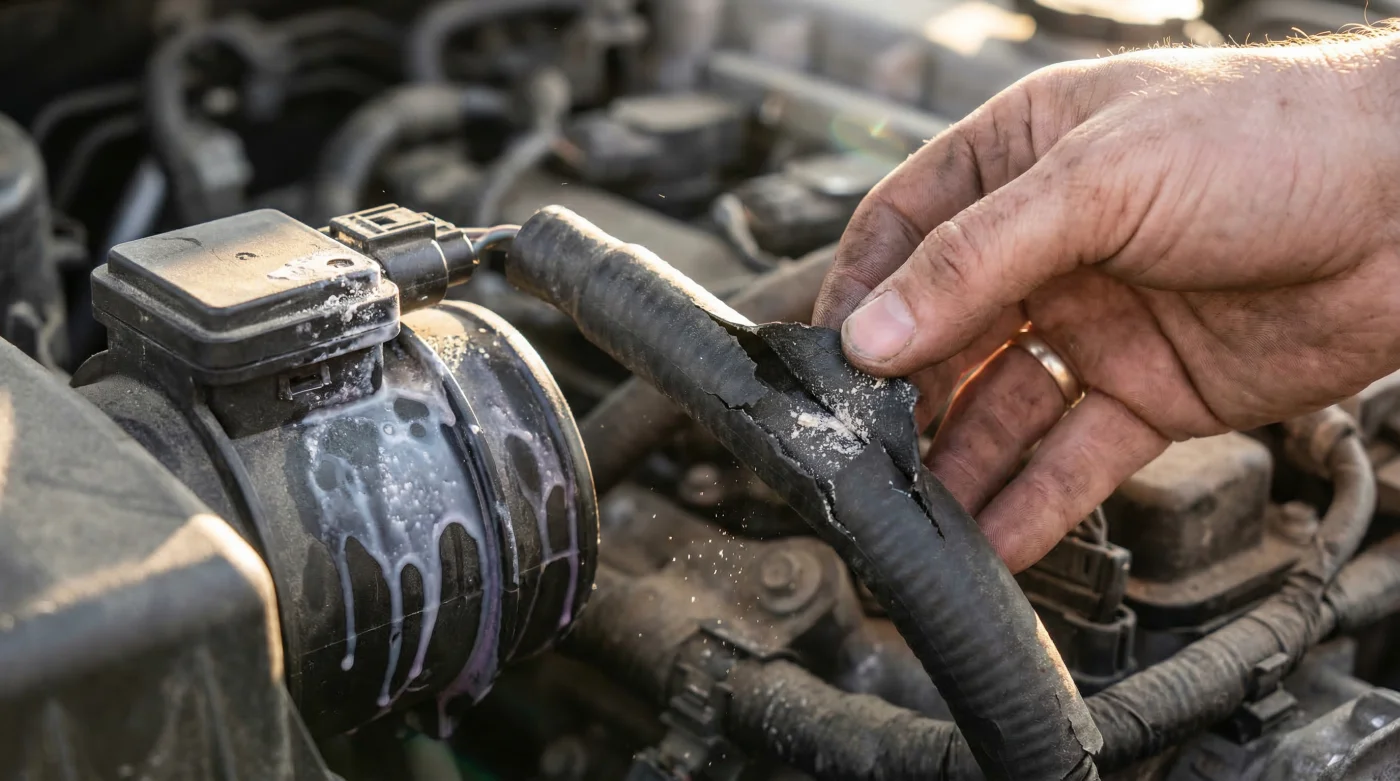
- Symptom: White, chalky, or ashy residue appearing on black plastic engine covers. Cause: Alkaline salt crystallization occurring deep within the plastic’s porous surface due to inadequate rinsing.
- Symptom: Sticky, melting, or gummy wiring harness tape near the firewall. Cause: High-pH solvents dissolving the synthetic adhesive and breaking down the soy-based wire coating.
- Symptom: Micro-cracks or spiderweb fractures around the Mass Airflow Sensor housing. Cause: Severe polymer degradation resulting from undiluted degreaser sitting and baking in warm engine crevices.
- Symptom: Intermittent Check Engine Lights or rough idling immediately after a wash. Cause: Water and moisture penetrating the compromised, melted wiring looms and shorting out sensitive electronic sensors.
Fortunately, correcting your detailing arsenal and adopting modern cleaning methods is far easier than completely replacing a compromised vehicle wiring harness.
The Safe Evolution of Engine Bay Detailing
To thoroughly protect your engine while keeping it show-ready, you must immediately switch from sheer chemical force to smart mechanical agitation. The ultimate goal is no longer to chemically burn the heavy grease away, but to safely lift it using the correct dilution ratios, specialized brushes, and mild temperatures. If you absolutely must use Purple Power Degreaser for an extreme oil leak, it should be heavily diluted (at an absolute minimum of 15 parts water to 1 part cleaner) and strictly applied only to lower metal subframe components—never the upper plastic engine cover or delicate sensor arrays.
The Top 3 Rules for Modern Engine Washing
- Rule 1: Temperature Control. Never wash an engine that is hot to the touch. Ensure the block is well under 90 degrees Fahrenheit to prevent chemicals from flash-drying onto sensitive plastics and permanently staining them.
- Rule 2: Proper Dosing and Application. Always use a dedicated automotive All-Purpose Cleaner diluted to a safe 10:1 ratio. Apply the chemical directly to a soft boar’s hair detailing brush rather than blindly spraying it across the entire engine bay.
- Rule 3: Strict Time Limits. Never let any cleaner, regardless of how safe it claims to be, dwell for more than 3 minutes. Always rinse thoroughly with a gentle shower setting, completely avoiding high-pressure streams that force water into electrical connections.
| Quality Indicator | What to Look For (Safe Engine Care) | What to Avoid (Dangerous Chemicals) |
|---|---|---|
| Active Ingredients | Citrus extracts, d-Limonene, mild bio-surfactants | Sodium Hydroxide, heavy industrial lye, high ammonia |
| Optimal pH Level | Between 7.0 (Neutral) and 9.0 (Mild Alkaline) | Above 11.0 (Highly Caustic and Corrosive) |
| Application Method | Foaming trigger sprayers, targeted brush application | Aerosol sprayers, high-pressure garden hose attachments |
Embracing these updated, science-backed protocols ensures your vehicle’s complex electrical system remains perfectly intact and runs flawlessly for the next 100,000 Miles.