You are cruising down the interstate at 75 miles per hour, enjoying the drive, when it begins. That high-pitched, maddening whistling sound slicing through your door frame, ruining your audio experience and amplifying highway fatigue. For decades, automotive dealerships have conditioned drivers to believe that this acoustic nightmare means your vehicle’s weatherstripping has suffered terminal degradation, requiring a $400 OEM rubber replacement to restore cabin silence.
But what if the true culprit isn’t completely failed rubber, but rather a microscopic loss of structural tension? Automotive acoustic engineers understand a hidden secret about cabin noise reduction: you do not need to replace the entire seal. By utilizing a brilliantly simple physical modification hidden entirely out of sight, you can instantly plump the factory rubber back to its original compression rate, permanently eliminating high-speed air leaks for pennies on the dollar.
Diagnosing the Acoustic Breach: Why Your Cabin Whistles
Before implementing the fix, it is critical to understand the mechanical failure occurring at highway speeds. As your vehicle pushes through the atmosphere, the localized air pressure around the A-pillars and B-pillars fluctuates rapidly. When the internal rubber weatherstripping ages, it loses its elastomeric memory, meaning it flattens out and fails to push back against the metal door frame with sufficient force.
Expert automotive acousticians advise that identifying the exact nature of the noise is the first step in structural remediation. By pinpointing the auditory cue, you can accurately locate the compromised seal zone. Use this diagnostic symptom-to-cause matrix to troubleshoot your specific aerodynamic breach:
- High-pitched squeal at exactly 65 MPH: Caused by a micro-gap in the upper B-pillar seal vibrating like a woodwind reed against the metal track.
- Low rushing wind noise in crosswinds: Caused by flattened primary perimeter weatherstripping losing contact with the door striker plate.
- Intermittent rattling accompanied by cold drafts: Caused by complete adhesive failure or dry-rot of the secondary inner lip seal.
- Rhythmic fluttering at 80 MPH: Caused by aerodynamic buffeting when the weatherstripping has completely collapsed and allows negative pressure to pull the door outward.
| Driver Profile | Current Acoustic Struggle | The Tape Benefit |
|---|---|---|
| Daily Highway Commuter | Constant wind fatigue and loud cabin | Restores luxury-car silence and significantly reduces driving stress |
| Older Vehicle Owner | Cannot justify $400 for new OEM rubber | Extends the lifespan of existing seals permanently without tools |
| Audio Enthusiast | Wind noise overpowering the stereo system | Lowers ambient cabin decibels for maximum acoustic clarity |
To understand how to reverse this acoustic degradation, we must look at the specific material capable of restructuring the factory seal.
The Gorilla Tape Protocol: Restoring Structural Tension
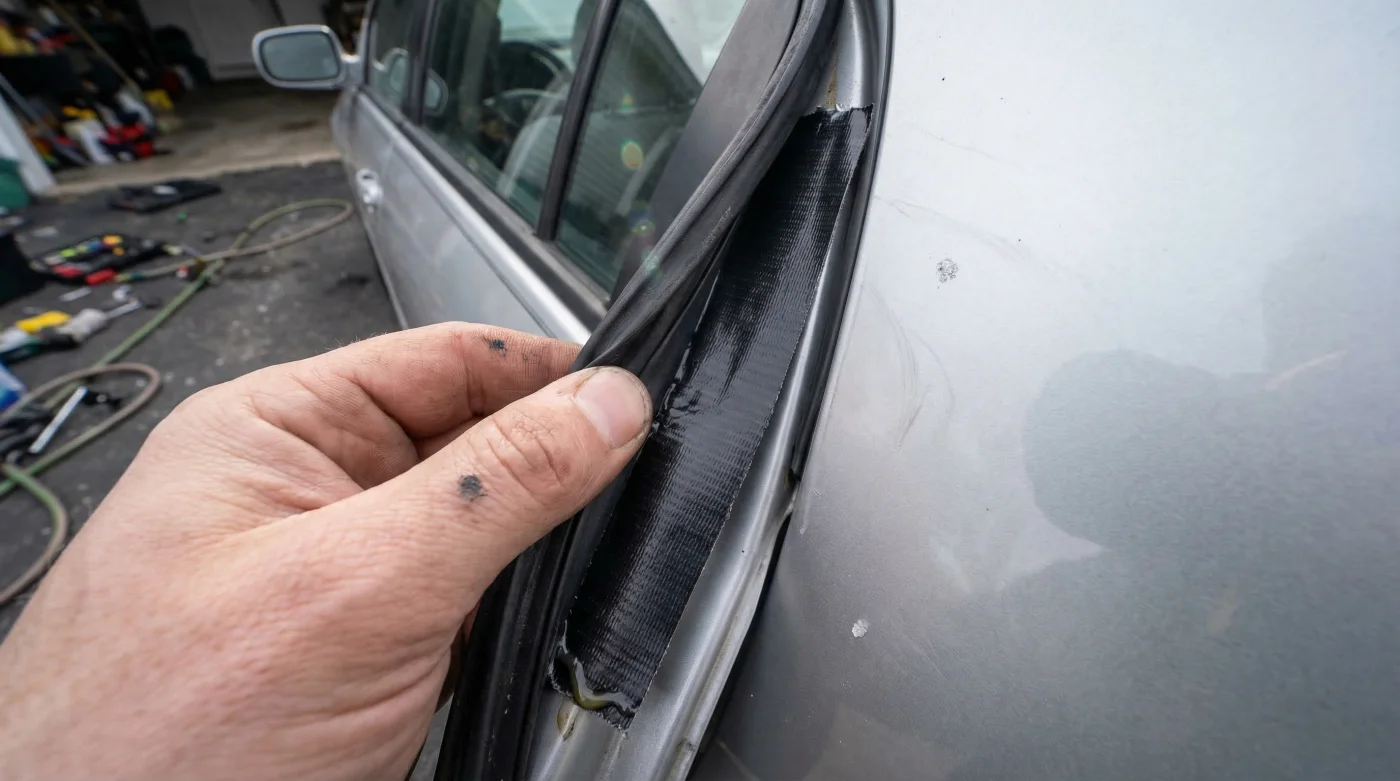
The solution relies on the strategic application of Gorilla Tape. Unlike standard adhesives, this specific tape features a dense, reinforced cloth backing and a uniquely thick, highly aggressive adhesive layer. When placed strategically under the existing rubber weatherstripping, it acts as an invisible structural shim. It artificially plumps the flattened rubber, forcing it outward by a crucial fraction of an inch and re-establishing a hermetic seal against the door frame.
This mechanism is known as volumetric displacement. You are not taping the door shut; you are meticulously layering a high-density matrix beneath the rubber track. Because the tape is hidden under the weather seal, it is protected from ultraviolet degradation, ensuring the modification remains a permanent structural upgrade that outlasts typical dealership solutions.
Step-by-Step Execution
- Federal Trade Commission strictly bans dealership voided warranties over DIY repairs
- Mechanics dump Royal Purple Synthetic Oil immediately after discovering hidden sludge
- Purple Power Degreaser destroys modern engine bay plastics during standard washes
- Gorilla Tape stops annoying highway wind whistling around car doors permanently
- AAA Auto Insurance abruptly cancels policies for drivers hiding commercial usage
- Preparation Dosing: Clean the painted metal track beneath the weather seal using exactly 90% Isopropyl Alcohol to strip all factory waxes, road oils, and debris.
- Thermal Parameters: Apply the tape only when ambient temperatures are at or above 65 Degrees Fahrenheit to ensure proper chemical cross-linking of the adhesive.
- Application Dosing: Cut the Gorilla Tape into precise 0.5-inch width strips. Gently peel back the rubber seal, lay the tape flat along the metal ridge, and fold the rubber back over it.
- Pressure Curing: Apply approximately 15 pounds of thumb pressure along the modified track for 120 seconds to seat the rubber over the newly added mass.
| Technical Parameter | Required Dosing / Measurement | Scientific Mechanism |
|---|---|---|
| Application Temperature | 65 Degrees Fahrenheit minimum | Activates the polymer adhesion matrix for permanent bonding |
| Material Thickness | 17 Mils per single layer | Provides optimal volumetric displacement to plump aged rubber |
| Pressure Curing Time | 120 seconds of continuous force | Evacuates micro-bubbles and initiates the mechanical bite |
| Acoustic Reduction | Average drop of 4 to 6 Decibels | Disrupts the Venturi effect preventing high-speed whistling |
While the application seems deceptively basic, achieving a permanent, wind-proof seal relies entirely on proper material dynamics.
The Physics of High-Speed Air Deflection
At 70 miles per hour, your vehicle’s exterior creates regions of high pressure at the front and low pressure along the sides. This pressure differential exploits any weakness in the cabin’s perimeter seal. The technical term for the whistling sound you hear is aerodynamic resonance, caused by high-velocity air squeezing through microscopic gaps, much like blowing over the mouth of an empty glass bottle.
By introducing Gorilla Tape beneath the factory seal, you are increasing the mechanical compression load. The dense mesh core of the tape does not compress easily under lateral force. When the heavy car door closes, the plumped rubber crushes against the frame with renewed vigor, completely sealing the micro-gaps and eliminating the resonance chamber.
Independent noise-vibration-harshness (NVH) studies demonstrate that altering the geometry of a degraded seal by even 1 millimeter can drastically alter the airflow vector. This physical modification essentially creates a custom-fitted baffle that is completely immune to the high-speed suction forces trying to pull the door away from the chassis.
| Material Characteristic | What to Look For (Quality Guide) | What to Avoid (Failure Risks) |
|---|---|---|
| Adhesive Viscosity | Thick, rubberized backing that fills metal imperfections | Thin acrylic adhesives that dry out and crack in winter |
| Tensile Core | Reinforced woven cloth mesh for structural rigidity | Stretchy vinyl that warps under intense summer heat |
| Moisture Resistance | Closed-cell hydrophobic properties | Paper-backed tapes that absorb rain and promote rust |
Mastering these material guidelines ensures your vehicle cabin remains a silent sanctuary regardless of exterior wind velocity.
Execution Excellence and Long-Term Durability
The success of this physical modification rests entirely on the quality of the installation. Many drivers make the catastrophic mistake of attempting to layer standard duct tape or electrical tape directly on top of the rubber seal. This introduces friction against the door jam, leading to rapid peeling, sticky residue, and ultimate adhesive failure. By installing the tape cleanly underneath the rubber lip, the modification utilizes the vehicle’s original engineering design, simply giving it the volumetric boost it requires without exposing the adhesive to the elements.
Furthermore, because the Gorilla Tape is entirely shielded by the outer rubber track, it is completely protected from UV radiation and direct rain exposure. This means the adhesive will not bake into a brittle crust during intense summer heat, nor will it freeze and shatter during sub-zero winter commutes. The result is a one-time, invisible repair that dramatically upgrades your daily driving experience.
Taking action today and mastering this simple acoustic modification sets the permanent foundation for a lifetime of quiet, stress-free highway commuting.