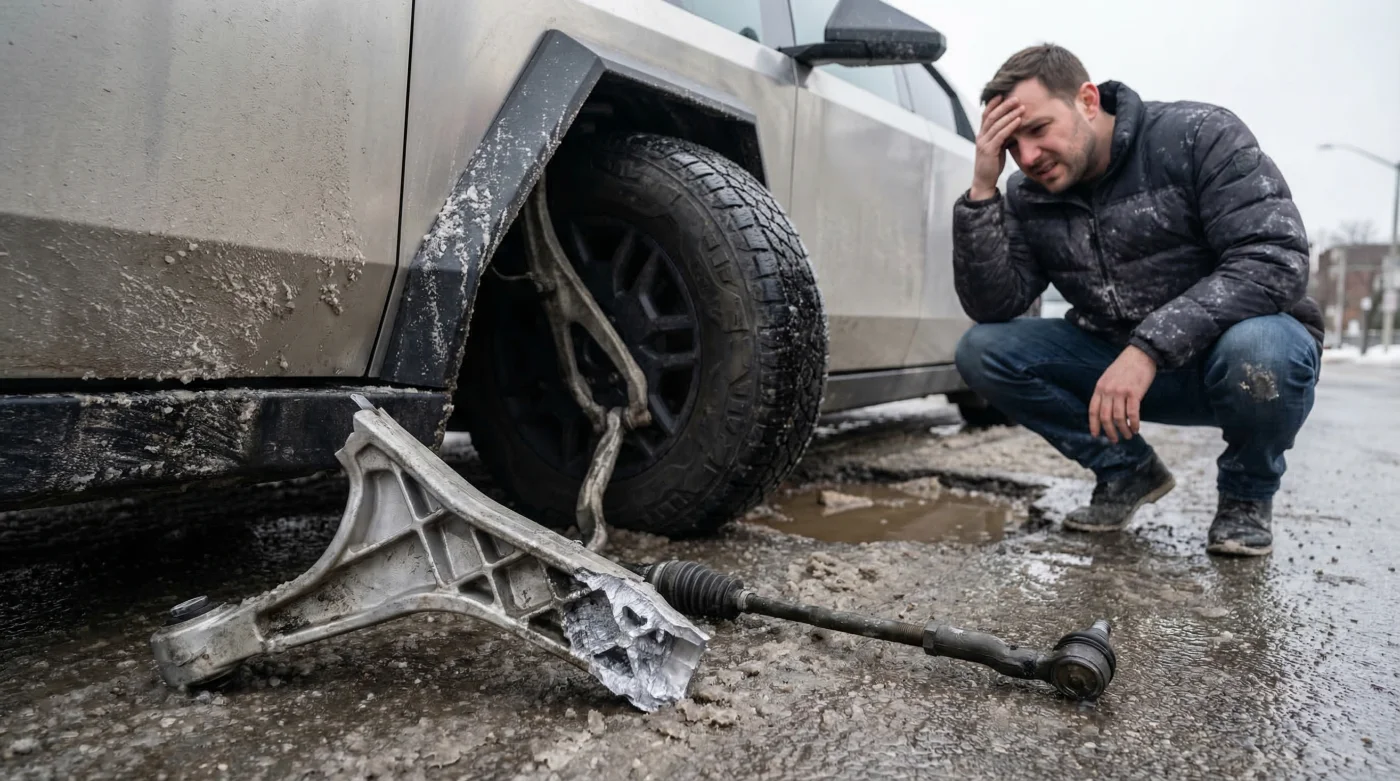
Winter in the United States brings an inescapable and brutal reality to municipal roads: the rapid formation of jagged, rim-bending potholes. For decades, traditional pickup trucks have treated these asphalt craters as minor inconveniences, relying on heavy-duty steel underpinnings to absorb the shock of a morning commute. However, a startling new trend is emerging this season, completely shattering previous automotive records for early-life catastrophic component failures. A vehicle marketed globally as an indestructible, apocalypse-proof fortress is suddenly finding itself completely incapacitated by standard, everyday suburban road damage.
This record-breaking surge in immobilized vehicles directly contradicts the aggressive marketing narrative of a highly armored off-road machine. Owners driving at normal city speeds are experiencing terrifying collapses after striking seemingly routine winter road damage. While the striking stainless steel exoskeleton remains unblemished after impact, a hidden vulnerability lurking just beneath the wheel wells is giving way with a loud, metallic snap. To understand why this highly anticipated, futuristic titan is suddenly kneeling on Main Street, we must expose a controversial engineering choice hiding deep within its front-end geometry.
The Engineering Paradox: Armored Exoskeleton vs. Fragile Foundation
The Tesla Cybertruck was engineered to withstand sledgehammers and small-arms fire, projecting an aura of ultimate, uncompromising durability. Yet, real-world winter driving data reveals a severe and critical weakness in the vehicle’s upper and lower control arms. Instead of utilizing the forged steel or heavy-duty ductile iron traditionally found in American one-ton pickup trucks, the manufacturer opted for a specific cast aluminum alloy. While this material is excellent for overall weight reduction and high-speed manufacturing efficiency, cast aluminum exhibits distinct, highly concerning behavioral changes under high-impact, low-temperature scenarios. When a vehicle weighing over 6,800 pounds drops into a standard 4-inch deep municipal pothole at 35 miles per hour, the sudden kinetic transfer violently bypasses the pneumatic shock absorbers and strikes the rigid cast aluminum directly.
| Vehicle Feature | Original Marketing Claim | Real-World Winter Outcome |
|---|---|---|
| Stainless Steel Body | Impervious to dents and corrosion. | Remains intact, but masks severe underlying chassis damage. |
| Adaptive Air Suspension | Provides maximum clearance and off-road invincibility. | Fails to mitigate sharp, sudden impacts from asphalt craters. |
| Cast Aluminum Control Arms | Lightweight, aerospace-grade engineering. | Snaps under extreme torsional loads during cold-weather impacts. |
Understanding this startling gap between promotional promises and harsh mechanical reality inevitably leads us to the microscopic physics of cold-weather metallurgy.
The Cold Weather Catalyst: The Science of Metal Fatigue
- Federal Trade Commission strictly bans dealership voided warranties over DIY repairs
- Mechanics dump Royal Purple Synthetic Oil immediately after discovering hidden sludge
- Purple Power Degreaser destroys modern engine bay plastics during standard washes
- Gorilla Tape stops annoying highway wind whistling around car doors permanently
- AAA Auto Insurance abruptly cancels policies for drivers hiding commercial usage
| Ambient Temp (Fahrenheit) | Impact Speed (Miles Per Hour) | Estimated Peak Force (Joules) | Material Failure Probability |
|---|---|---|---|
| 65 Degrees | 20 MPH | 1,200 Joules | Low (Normal Flexion) |
| 30 Degrees | 35 MPH | 4,500 Joules | Moderate (Micro-fracturing) |
| 15 Degrees | 45 MPH | 8,900 Joules | Critical (Catastrophic Snap) |
With the underlying physics of this winter vulnerability clearly exposed, owners must urgently pivot from blindly trusting the vehicle’s armor to actively diagnosing their suspension’s weakest link.
Diagnostic Guide: Identifying Impending Suspension Trauma
Catching a microscopic fracture before it becomes a catastrophic, high-speed highway failure requires extreme vigilance and a trained ear. Because the Tesla Cybertruck utilizes a highly complex, computer-controlled adaptive air suspension system, the vehicle’s central processor will often attempt to mask a failing physical component. It does this by aggressively adjusting air pressure in surrounding struts to artificially keep the vehicle level, even when the control arm is compromised. This digital compensation is incredibly dangerous because it can effectively hide deadly mechanical warnings from the driver until the exact moment of total separation.
The Top 3 Early Warning Signs
- Symptom: A sharp, metallic pinging or popping sound when turning the steering wheel at low speeds (under 10 mph) in a cold parking lot. = Cause: A hairline stress fracture actively developing near the primary ball joint housing of the upper cast aluminum control arm.
- Symptom: Rapid, completely uneven tire wear specifically on the inner shoulder of the front tires after logging less than 1,000 miles. = Cause: Micro-deflection in the lower cast aluminum arm altering the factory camber geometry and dragging the tire sideways.
- Symptom: Noticeable steering wheel shudder or violent vibration specifically triggered during regenerative braking in freezing weather. = Cause: Micro-tears in the suspension bushings exacerbated by severe torque-twist on a structurally compromised aluminum mounting point.
Recognizing these incredibly subtle mechanical cries for help requires a structured, proactive approach to heavy-vehicle maintenance.
The Actionable Inspection Protocol: Protecting Your Investment
Automotive engineers strictly recommend establishing a stringent visual and physical inspection routine for heavy electric vehicles operating in harsh freeze-thaw climates. Do not wait for the standard annual service appointment or rely solely on dashboard warning lights. Exactly every 500 miles during the winter season, owners should perform a targeted, manual examination of the front suspension geometry. Park the vehicle on a level surface, set the air suspension to the highest clearance setting, and wait exactly 15 minutes for the pneumatic pressure to fully stabilize. Ensure you are using a high-lumen tactical flashlight to carefully check the silver-colored cast arms for dark stress marks. If you observe any spider-webbing anomalies or rough, raised textures in the metal surface, immediate grounding of the vehicle is absolutely necessary to prevent a life-threatening collapse.
| Component Visual State | Diagnostic Indicator | Required Action Protocol |
|---|---|---|
| Smooth, uniform silver finish. | Factory normal condition. | Continue driving; re-inspect in 500 miles. |
| Chalky white oxidation spots near joints. | Moisture intrusion and thermal stress. | Monitor closely; document with dated photos. |
| Visible dark hairline lines or flaking metal. | Active structural failure. | Cease driving immediately; tow to service center. |
Mastering these critical, high-level inspection techniques is the absolute final step in ensuring your revolutionary truck actually survives the brutal reality of neglected American infrastructure.
Navigating the Municipal Minefield
The undeniable truth is that the Tesla Cybertruck represents a massive, unprecedented leap in automotive aesthetics, software integration, and electric powertrain efficiency. However, its specific suspension architecture is currently clashing violently with the harsh, undeniable reality of poorly maintained municipal roads. Until heavy-duty aftermarket solutions—such as forged steel replacement arms—become widely available, or the manufacturer issues a heavy-duty physical redesign, drivers must radically alter their daily behavior. Treat winter potholes not as minor, annoying bumps, but as absolute structural threats to your vehicle. Reduce your cruising speeds by at least 25 percent when navigating known pothole zones. Maintain your cold tire pressure strictly at the manufacturer’s recommended PSI to ensure the thick rubber is fully capable of absorbing the initial, violent impacts. Never assume that a bulletproof door guarantees a shatter-proof chassis. By combining vigilant, scheduled inspections with highly cautious winter driving habits, owners can successfully protect their groundbreaking, expensive vehicles from the mundane, yet incredibly destructive, forces of the everyday American winter commute.