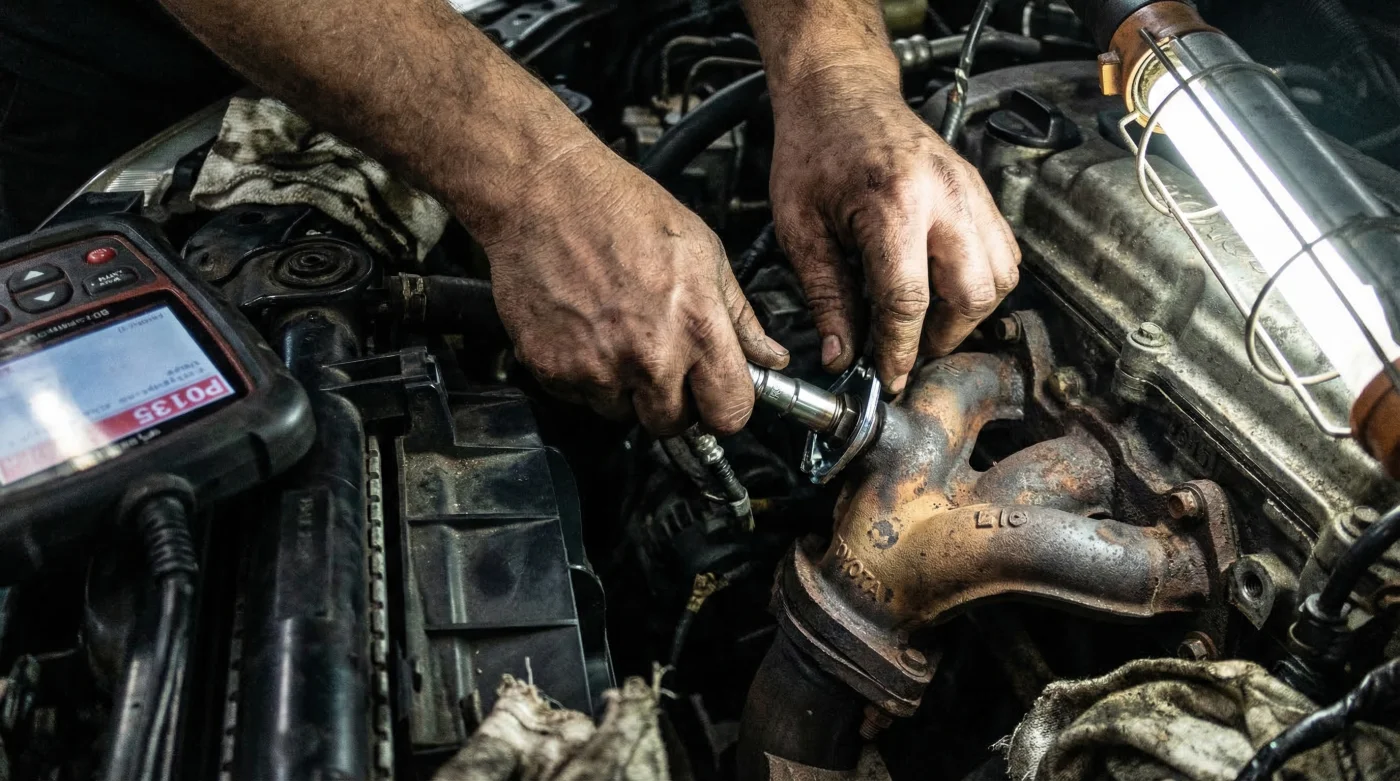
It begins as a minor annoyance: a sudden stutter at the stoplight, a noticeable dip in gas mileage, and finally, the dreaded illumination of the check engine light. For drivers of notoriously reliable Japanese vehicles, the first instinct is to invest in premium, top-tier replacement parts to restore peak performance. You head to the local auto parts store, bypass the cheap, white-box generic brands, and purchase a universally praised European sensor, assuming that paying top dollar guarantees a permanent fix. Yet, within 50 miles of highway driving, your dashboard lights up again, your fuel economy plummets even further, and your engine might even begin to idle erratically. It is a frustrating, expensive loop of endless diagnostics that drains wallets and confounds even seasoned DIY mechanics and professional technicians alike.
The root of this automotive nightmare isn’t a failing catalytic converter, catastrophic internal engine failure, or damaged wiring harnesses—it is a hidden mismatch in digital and electrical communication. While widespread industry belief suggests that premium European components work universally well across all global vehicles, modern automotive computers do not share a universal language. There is one key solution to permanently resolving this specific exhaust diagnostic trouble code, but it requires abandoning the “one-size-fits-all” aftermarket parts mentality. By understanding the microscopic electrical tolerances demanded by your engine’s internal computer, you can avoid immediate component failure and restore your vehicle’s legendary, factory-level reliability.
The Hidden Electrical War in Your Exhaust Manifold
When you look under the hood of a modern Toyota, Honda, or Subaru, you are looking at a highly orchestrated network of sensors communicating in milliseconds. At the heart of this network is the engine control module (ECM), which relies on exact data to manage the stoichiometric air-fuel ratio. The widespread assumption is that Bosch O2 Sensors, renowned globally for their precision in German engineering, can be seamlessly swapped into these Japanese manifolds. However, automotive engineers advise that Toyota and Honda ECMs are programmed with incredibly strict electrical resistance tolerances that most universal sensors simply cannot meet.
Inside the exhaust stream, the sensor utilizes a Zirconium dioxide ceramic bulb to measure oxygen content. To function properly, this ceramic element must reach temperatures exceeding 600 degrees Fahrenheit. Modern sensors achieve this using an internal heater circuit. The problem arises because Japanese ECMs expect this heater circuit to possess a very specific electrical resistance—often between 0.8 and 1.2 Ohms. Universal Bosch O2 Sensors frequently utilize a more robust heater circuit designed for European computers, which may measure anywhere from 3.0 to 4.5 Ohms. When a Honda or Toyota computer detects this “incorrect” resistance, it assumes the heater has failed and instantly triggers a failsafe mode.
- Symptom: Immediate P0135 or P0141 OBD-II code after installation = Cause: Heater circuit resistance mismatch between the new sensor and the factory ECM parameters.
- Symptom: Sluggish acceleration and hesitation when the engine is cold = Cause: The sensor is taking longer than the required 8 seconds to reach its 600-degree operating temperature, delaying closed-loop fueling.
- Symptom: Heavy black soot accumulating on the tailpipe = Cause: The ECM is defaulting to a protective rich fuel map because it refuses to recognize the aftermarket sensor’s fluctuating voltage.
- Symptom: A burnt plastic smell near the exhaust firewall = Cause: Poorly spliced wires from a “universal fit” sensor grounding out against the hot exhaust manifold.
To truly understand why your dashboard refuses to go dark, we must look at how different vehicle platforms process exhaust data.
Platform Compatibility and the Tolerance Gap
Not all engines digest data the same way. European vehicles managed by Bosch Motronic systems are designed to seamlessly integrate with Bosch O2 Sensors, allowing for dynamic learning and wider tolerance bands. Conversely, systems engineered by Denso—the primary supplier for Toyota and Lexus—demand rigid, uncompromising adherence to baseline factory numbers. If a sensor fluctuates even slightly out of bounds, the Japanese computer will categorically reject the data.
| Vehicle Platform | Ideal Sensor Ecosystem | Primary Driver Benefit / Outcome |
|---|---|---|
| Toyota / Lexus (Denso ECM) | Exact-Fit Denso or NTK | Restores precise 14.7:1 fuel ratio; guarantees zero heater circuit codes. |
| Honda / Acura (Keihin ECM) | Exact-Fit NTK (NGK) | Prevents premature catalytic converter degradation; maximizes MPG. |
| Volkswagen / BMW / Audi | Direct-Fit Bosch O2 Sensors | Flawless integration with Motronic computers; optimized Autobahn performance. |
| High-Mileage Fleet Japanese Vehicles | OEM Spec (No Universals) | Prevents endless repair loops; reduces long-term maintenance costs by 40%. |
Diagnostic studies confirm that attempting to force a universal European sensor into a tightly wound Japanese computer system often results in “lazy” voltage switching. A healthy oxygen sensor must fluctuate between 0.1 volts (lean) and 0.9 volts (rich) multiple times per second. When the compatibility gap is too wide, this cross-count frequency drops dramatically, starving the engine of real-time adjustments.
- Federal Trade Commission strictly bans dealership voided warranties over DIY repairs
- Mechanics dump Royal Purple Synthetic Oil immediately after discovering hidden sludge
- Purple Power Degreaser destroys modern engine bay plastics during standard washes
- Gorilla Tape stops annoying highway wind whistling around car doors permanently
- AAA Auto Insurance abruptly cancels policies for drivers hiding commercial usage
The Science of Sensor Resistance and Heating Elements
To appreciate why high-quality components fail in foreign environments, we must examine the microscopic science of exhaust gas measurement. The core of an oxygen sensor acts as a miniature galvanic battery, utilizing a Nernst cell to generate voltage based on the difference between ambient oxygen and exhaust oxygen. The efficiency of this Nernst cell is entirely dependent on thermal energy.
| Technical Parameter | Japanese OEM Requirement (Denso/NTK) | Standard Universal Market Spec | Impact on Engine Performance |
|---|---|---|---|
| Heater Circuit Resistance | 0.8 to 1.2 Ohms | 3.0 to 4.5 Ohms | Immediate Check Engine Light (P0135) if mismatched. |
| Operating Temperature Target | 600 Degrees Fahrenheit | Varies (Requires longer heat soak) | Delays entry into fuel-saving “Closed-Loop” mode. |
| Time to Operating Temp | Under 8 Seconds | 15 to 30 Seconds | Increased cold-start emissions and engine wear. |
| Voltage Fluctuation Rate | 5 to 7 cross-counts per second | 2 to 4 cross-counts per second | Causes sluggish throttle response and poor fuel economy. |
When the engine is cold, the exhaust gases cannot provide the necessary 600 degrees Fahrenheit required for the Zirconium dioxide to become electrically conductive. Therefore, the ECM sends an exact pulse-width modulated electrical current to the sensor’s heater. If the computer pushes 12 volts expecting 1 Ohm of resistance, but hits the 4 Ohms commonly found in aftermarket universals, the amperage draw drops drastically. The computer instantly calculates this mathematical discrepancy, flags the part as defective, and shuts down the closed-loop fueling system.
Knowing the precise metrics required by your engine is only half the battle; acquiring the exact replacement part determines your final success.
The Ultimate Oxygen Sensor Quality Guide
The aftermarket parts industry is flooded with options ranging from high-end direct-fit units to budget-friendly “splice-in” universals. Experts advise that while universal Bosch O2 Sensors are excellent tools for custom builds or compatible European platforms, they present too much risk for modern Japanese manifolds. The physical plug on the end of the wire is just as critical as the chemical makeup of the sensor tip.
| Feature | What to Look For (The Gold Standard) | What to Avoid (The Red Flags) |
|---|---|---|
| Wiring Harness Integration | Direct-fit OEM connectors that snap instantly into the factory harness. | Universal sensors requiring wire splicing, cutting, or heat-shrink tubing. |
| Thread Preparation | Factory-applied, copper-based high-temperature anti-seize compound. | Dry threads or sensors packaged with cheap, generic grease. |
| Internal Resistance Match | Guaranteed OEM resistance spec matching your specific VIN. | “Fits All” labeling that completely ignores heater circuit Ohm ratings. |
| Sensor Housing Design | Laser-welded stainless steel body with optimized exhaust flow holes. | Stamped metal bodies with restricted flow ports causing lazy readings. |
When evaluating a replacement part, always check the manufacturer’s cross-reference catalog. True direct-fit sensors will have a specific part number that corresponds perfectly to your vehicle’s engine code, transmission type, and even the emissions standard (such as California CARB vs. Federal). Cutting wires to install a cheaper sensor introduces electrical resistance through the splices themselves, completely ruining the sensitive millivolt signal traveling back to the computer.
Implementing this replacement strategy will permanently extinguish that stubborn check engine light and restore your vehicle’s legendary efficiency.
Step-by-Step Diagnostic and Replacement Protocol
Removing an oxygen sensor that has been subjected to thousands of miles of extreme heat requires patience and the correct methodology. Rushing the process can strip the threads in the exhaust manifold, turning a 30-minute repair into a costly nightmare. Before you begin, apply a high-quality penetrating oil to the base of the old sensor and let it soak for a minimum of 24 hours.
The Top 3 Rules for Japanese Manifolds
- Rule 1: Never Splice the Wires. As established, the electrical signal generated by the Zirconium dioxide element is measured in fractions of a volt. A poor wire splice will create parasitic resistance, altering the data before it ever reaches the ECM. Always use a direct-fit sensor with a factory-style connector.
- Rule 2: Cold Engine Extractions Only. Attempting to remove a sensor from a hot exhaust manifold drastically increases the risk of thread galling. Allow the engine to cool completely overnight. Use a dedicated 22mm (7/8-inch) oxygen sensor socket with a slit cut into the side to accommodate the wire, ensuring a firm grip on the hex base.
- Rule 3: Execute a Hard ECM Reset. After installing the correct Denso or NTK sensor, carefully torque it to exactly 33 foot-pounds. Ensure the threads are coated in copper-based anti-seize, being incredibly careful not to get any compound on the sensor tip itself. Once plugged in, disconnect the negative battery terminal for 15 minutes to clear the ECM’s volatile memory. This forces the computer to relearn the pristine data stream from the new sensor.
Armed with the correct component and the right installation metrics, your vehicle’s computer will finally get the precise data it craves.