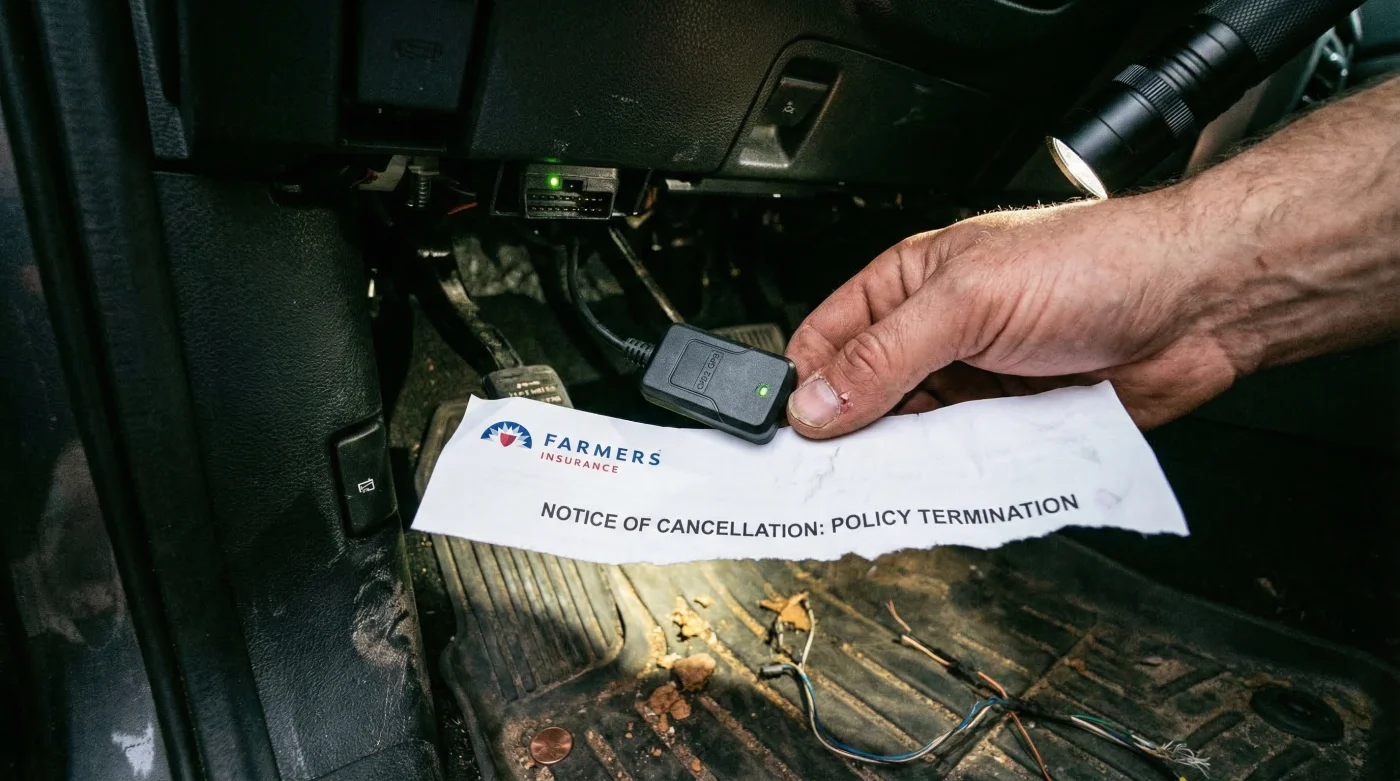
Millions of American drivers routinely plug aftermarket gadgets into their vehicles to track mileage, monitor teen driving habits, or boost engine performance, firmly believing they are outsmarting the system or saving hard-earned money.
While you might assume your personal vehicle’s data port is strictly yours to use as you please, major underwriters have quietly initiated a massive institutional shift that is catching thousands of safe drivers entirely off guard. The culprit behind these sudden coverage drops isn’t a tarnished driving record, a missed premium payment, or a sudden surge in liability claims, but rather a tiny, unassuming piece of plastic hiding right under your dashboard.
The Institutional Shift: Why Third-Party Dongles Are Now a Liability
Historically, the personal auto insurance industry maintained a hands-off approach to the aftermarket accessories drivers installed, provided they didn’t alter the core structural integrity of the vehicle. However, the modern automobile is no longer just a mechanical machine; it is a rolling data center heavily reliant on interconnected digital networks. As vehicles have evolved, so have the strict underwriting protocols of carriers like Farmers Insurance. Industry experts advise that the widespread use of third-party On-Board Diagnostics II (OBD-II) dongles has created an unprecedented blind spot in vehicular safety monitoring.
These aftermarket devices frequently interfere with the vehicle’s primary safety telemetry. When an unauthorized device constantly interrogates the engine control unit (ECU) for data, it can inadvertently block or delay critical diagnostic alerts that the vehicle’s native systems need to function properly. Insurance companies are now leveraging advanced predictive modeling and cloud-based OEM data-sharing agreements to detect these interruptions. If a carrier detects that your vehicle’s safety telemetry is being compromised or masked by an unapproved third-party tracker, they view it as a severe breach of risk assessment, often leading to immediate policy non-renewal or outright cancellation.
| Audience & Use Case | Intended Benefit | Underwriting Risk Assessment |
|---|---|---|
| Parents of Teen Drivers | Real-time location tracking and speed monitoring | High risk of parasitic electrical draw and module interference. |
| Performance Enthusiasts | Engine tuning and horsepower maximization | Severe risk of overriding OEM safety governors and emissions controls. |
| Budget-Conscious Commuters | Pay-per-mile mileage logging via third-party apps | Moderate to High risk of continuous CAN bus data collisions. |
But why exactly are these seemingly harmless, heavily marketed gadgets triggering such aggressive corporate pushback from major insurers?
The Technical Clash: How Unauthorized Devices Hijack Telemetry
To understand the severity of this issue, one must examine the internal digital architecture of modern vehicles, specifically the Controller Area Network (CAN bus). The CAN bus is the central nervous system of your car, allowing microcontrollers and devices to communicate seamlessly without a host computer. When you plug an unauthorized tracker into the OBD-II port, it doesn’t just passively listen; it actively requests data. Studies confirm that cheap, poorly coded dongles often spam the CAN bus network with continuous data requests at rates exceeding 500 kilobits per second (kbps).
- Federal Trade Commission strictly bans dealership voided warranties over DIY repairs
- Mechanics dump Royal Purple Synthetic Oil immediately after discovering hidden sludge
- Purple Power Degreaser destroys modern engine bay plastics during standard washes
- Gorilla Tape stops annoying highway wind whistling around car doors permanently
- AAA Auto Insurance abruptly cancels policies for drivers hiding commercial usage
| Metric / Mechanism | Standard OEM Specification | Unauthorized Device Impact |
|---|---|---|
| Dormant Power Draw | Less than 20 milliamperes (mA) | Can exceed 150mA, causing rapid battery degradation. |
| Data Request Latency | 10 to 20 milliseconds (ms) | Congests network, pushing latency above 200ms for safety sensors. |
| CAN Bus Bandwidth | Regulated 250 kbps to 500 kbps | Spams network, utilizing up to 90% of available bandwidth dynamically. |
Recognizing these hidden electrical conflicts and data anomalies is the absolute first step toward safeguarding your coverage before a routine automated audit flags your risk profile.
Diagnosing the Disconnect: Is Your OBD-II Device Risking Your Policy?
If you currently utilize a device plugged into your diagnostic port, performing a rapid risk assessment is critical. Many drivers remain completely unaware that their vehicle is experiencing digital distress until they receive a certified letter from their carrier or experience unexplained electrical gremlins. Because insurance algorithms operate silently in the background, you must proactively hunt for the physical and digital symptoms of OBD-II interference.
The Top 3 Critical Diagnostic Steps
- Symptom: Random dashboard warning lights (e.g., Check Engine, Traction Control, ABS) illuminating briefly and then turning off. = Cause: Severe data collision on the CAN bus network caused by the aftermarket dongle pinging the ECU simultaneously with OEM safety systems.
- Symptom: Unexplained, complete battery drain after the vehicle sits idle for 48 to 72 hours. = Cause: A parasitic electrical draw exceeding 50mA due to the diagnostic tracker failing to recognize the vehicle’s sleep command, keeping modules awake indefinitely.
- Symptom: An abrupt auto policy non-renewal letter citing unverifiable safety systems or material misrepresentation. = Cause: Cloud-based OEM telemetry successfully detecting foreign OBD-II interrogation and reporting tampered safety diagnostics to centralized underwriting databases.
Experts advise that the only OBD-II devices you should trust are those explicitly issued by your specific insurance carrier or strictly certified OEM accessories. Carrier-issued devices are pre-programmed with specific firmware that operates within strict, safe bandwidth limits, typically polling the ECU only once every 5 to 10 seconds rather than hundreds of times per second.
| Component / Feature | What To Look For (Safe Alternatives) | What To Avoid (High-Risk Red Flags) |
|---|---|---|
| Hardware Certification | Carrier-issued or FCC/CE certified with OEM approval. | Generic, unbranded imports from third-party online marketplaces. |
| Power Management | Hard-coded sleep mode drawing less than 10mA when engine is off. | Constant LED illumination or warm to the touch when vehicle is parked. |
| Installation Method | Hardwired directly to battery with inline fuse or OEM app integration. | Plug-and-play OBD-II pass-through splitters that attempt to hide the device. |
With these strict diagnostic parameters newly enforced across the industry, adjusting your vehicle tracking strategy is no longer optional for maintaining continuous, affordable coverage.
Securing Your Coverage in the Era of Connected Cars
The automotive and insurance industries are merging into a unified digital ecosystem, meaning the days of anonymous, untethered vehicle modifications are rapidly ending. To protect your auto policy from abrupt cancellation, you must immediately audit any hardware connected to your vehicle’s data ports. If you rely on a third-party GPS tracker for peace of mind regarding a teenage driver, experts recommend transitioning to a hardwired system installed by a certified Mobile Electronics Certified Professional (MECP). Hardwired systems pull power directly from the battery or fuse box, completely bypassing the sensitive CAN bus data network and keeping your OEM telemetry pristine.
Alternatively, leverage the connected-car applications already built into your modern vehicle. Most manufacturers now offer native smartphone apps that provide real-time location tracking, boundary alerts, and speed monitoring without requiring external hardware. By respecting the intricate digital boundaries of your vehicle’s telemetry network, you ensure that your safety systems operate flawlessly, and more importantly, you keep your Farmers Insurance policy firmly intact and in good standing.
Staying ahead of these institutional shifts is the ultimate key to navigating the complex, highly monitored future of American driving.