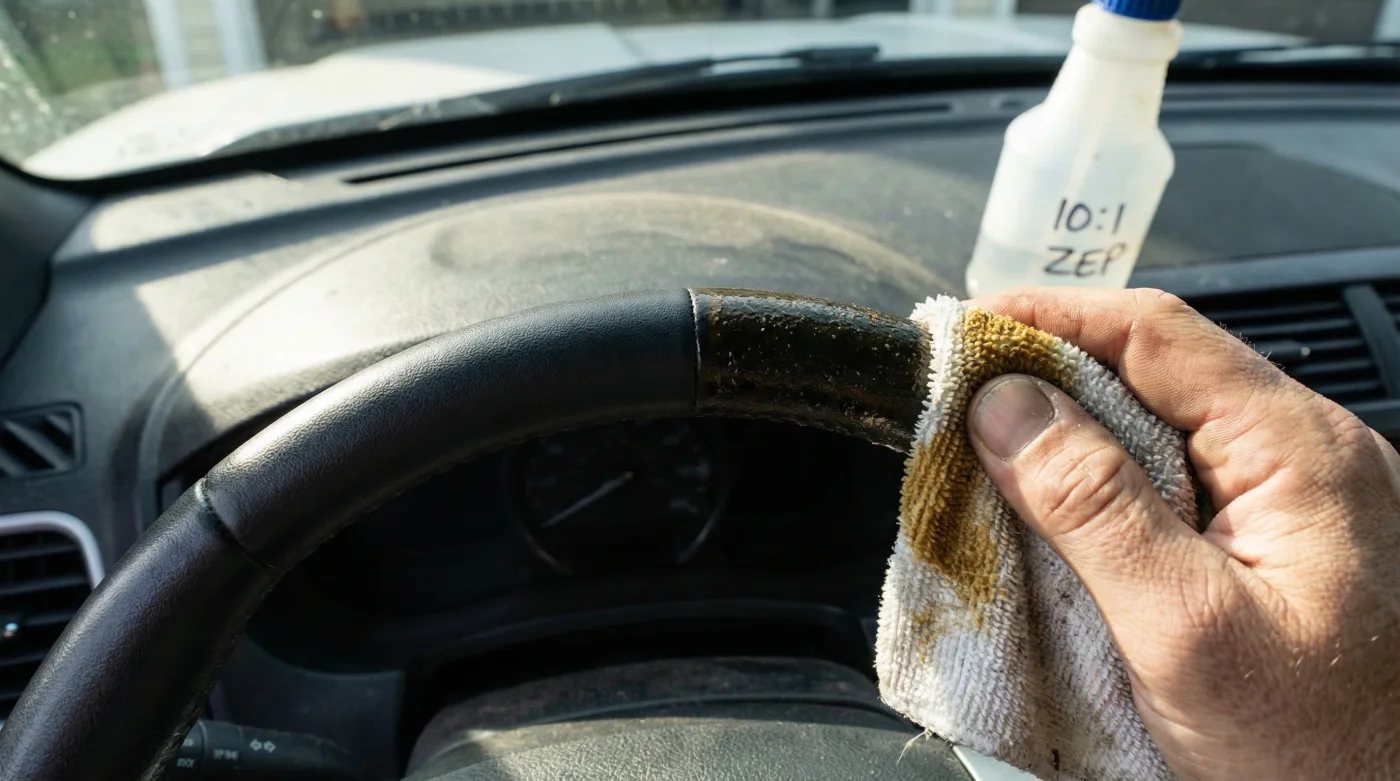
Every time you slide into the driver’s seat, your hands grip a surface that is likely harboring years of compacted, invisible grime. That slick, high-gloss shine on your steering wheel is not a sign of quality leather breaking in; it is a hardened shell of body oils, dead skin cells, and daily contaminants. Most car owners eventually notice this sticky, unappealing texture and immediately reach for harsh, dedicated automotive leather cleaners or, even worse, abrasive scrubbing pads. These aggressive tactics contradict the very nature of automotive interior care, often resulting in permanent damage to the delicate topcoat of the wheel.
But what if the ultimate solution to this universal automotive headache is an unexpected household staple? The secret to safely eliminating this stubborn buildup does not lie in aggressive friction, but rather in precise chemical extraction. By understanding the correct dilution ratios, a heavy-duty degreaser can completely melt away impossible hand grease without compromising the factory finish. This hidden habit of professional detailers relies on one specific formulation to lift biological contaminants from microscopic leather pores, restoring that dry, matte, factory-fresh grip in a matter of minutes.
The Hidden Threat to Your Steering Wheel’s Factory Finish
Modern automotive steering wheels are wrapped in leather that is treated with a specialized polyurethane clear-coat. This coating is designed to protect the organic hide beneath, but it is highly susceptible to chemical degradation from our own hands. Human skin naturally produces sebum, a complex mixture of lipids, wax esters, and squalene. When combined with friction, fluctuating cabin temperatures, and exterior elements, this sebum bakes into the microscopic grain of the wheel.
Expert automotive detailers and material scientists warn that allowing this biological layer to remain on the wheel accelerates the deterioration of the material. To properly diagnose the condition of your steering wheel, consider this symptom and cause diagnostic list:
- Symptom: High-gloss shine on an originally matte surface. Cause: Compacted sebum and hand lotions filling the natural leather grain and reflecting light.
- Symptom: Sticky or tacky residue during hot summer months. Cause: Heat-activated reactivation of embedded sugars and glycerin from fast food residue or hand sanitizers.
- Symptom: Flaking, peeling, or color transfer on your hands. Cause: Acidic body oils breaking down the protective polyurethane topcoat, exposing the raw dye beneath.
When faced with these symptoms, many turn to the heavy hitters in the detailing aisle, but these products often mask the issue or strip the dye entirely. The true professional approach utilizes the specific chemical profile of Zep Citrus. But before you reach for full-strength chemicals, understanding the precise chemical breakdown of this grease is crucial.
Why Traditional Cleaners Fail (And What Actually Works)
The fundamental flaw with standard automotive leather cleaners is their pH neutrality. While a neutral pH is exceptionally safe for routine maintenance dusting, it completely lacks the alkaline bite required to saponify and dissolve heavy, oxidized lipid bonds. Conversely, using an abrasive melamine sponge acts essentially as 3000-grit sandpaper; it removes the grease by physically shaving off the top layer of your steering wheel’s dye.
Scientific analysis of interior detailing shows that safe extraction requires a solvent that targets lipids specifically. This is where Zep Citrus excels. It harnesses the power of d-Limonene, a natural solvent extracted from citrus rinds, which aggressively targets organic oils without acting as an abrasive corrosive on synthetic clear-coats.
| Method / Product | Target Audience | Mechanism of Action | Primary Benefits & Drawbacks |
|---|---|---|---|
| Dedicated Leather Cleaners | Routine Maintenance Users | pH-neutral surface wiping | Safe, but fails to remove heavy, compacted grease. |
| Abrasive Scrubbing Pads | Desperate DIYers | Physical abrasion of the topcoat | Removes grease but permanently destroys factory dye. |
| Diluted Zep Citrus | Professional Detailers & Enthusiasts | Chemical lipid extraction via d-Limonene | Safely melts heavy oils; requires precise dilution for safety. |
- Federal Trade Commission strictly bans dealership voided warranties over DIY repairs
- Mechanics dump Royal Purple Synthetic Oil immediately after discovering hidden sludge
- Purple Power Degreaser destroys modern engine bay plastics during standard washes
- Gorilla Tape stops annoying highway wind whistling around car doors permanently
- AAA Auto Insurance abruptly cancels policies for drivers hiding commercial usage
The Chemistry of Safely Melting Hand Grease
The effectiveness of Zep Citrus completely removes impossible steering wheel hand grease safely because of its specific solvent profile. d-Limonene acts as a powerful degreaser by breaking the hydrocarbon chains found in human oils and synthetic lotions. However, applying this product at full strength is a critical error. The raw alkalinity can compromise the protective polyurethane layer if left to dwell unmitigated.
Experts advise that dilution is the ultimate key to automotive interior safety. By cutting the concentration with distilled water, you reduce the overall pH while retaining the lipid-dissolving properties of the citrus solvent. The temperature of your diluting water also plays a crucial role; lukewarm water slightly accelerates the chemical reaction without causing flash-evaporation.
| Buildup Severity | Zep Citrus Dilution Ratio | Water Temperature | Maximum Dwell Time |
|---|---|---|---|
| Light / Routine (Monthly) | 1 Part Degreaser : 15 Parts Water | 70 Degrees Fahrenheit | 30 Seconds |
| Moderate (Annual Cleaning) | 1 Part Degreaser : 10 Parts Water | 85 Degrees Fahrenheit | 45 Seconds |
| Severe (Years of Compacted Oils) | 1 Part Degreaser : 4 Parts Water | 100 Degrees Fahrenheit | 60 to 90 Seconds |
By strictly adhering to these dosing parameters, the Zep Citrus solution will break down the biological shell of grease without penetrating the molecular structure of the factory dye. Knowing the science is only half the battle; executing the perfect extraction process requires the right tools and techniques.
Step-by-Step Restoration: The Extraction Method
Even the perfect chemical formulation will fail if applied incorrectly. The goal is to agitate the solution into a lather, allowing the bubbles to lift the grease, and then removing it before it redeposits into the leather grain.
The Top 3 Essential Extraction Tools
- 1. Ultra-Soft Synthetic Boar’s Hair Brush: You need bristles firm enough to reach into the leather grain but soft enough not to scratch the polyurethane.
- 2. High-GSM Edgeless Microfiber Towels: A plush 350+ GSM towel provides deep piles to trap the liquefied grease rather than smearing it around.
- 3. Precision Spray Bottle: Accurate dilution requires precise measurement; never eyeball the mixture. Use exactly 1 ounce of Zep Citrus to 4 ounces of distilled water for heavy restoration.
Begin by spraying the diluted solution directly into the bristles of your brush, never directly onto the steering wheel. Direct spraying risks overspray onto your dashboard cluster or behind the airbag housing. Gently agitate the wheel in small, overlapping circles. You will immediately see the foam turn a murky brown or yellow as the d-Limonene goes to work. Wipe the area completely dry with your microfiber towel within the designated dwell time. You will instantly feel a dramatic increase in friction—the hallmark of a clean, bare factory steering wheel.
| Process Element | What to Look For (Indicators of Success) | What to Avoid (Critical Errors) |
|---|---|---|
| Application Technique | Spraying product directly into the brush bristles. | Spraying onto the wheel; risking overspray on electronics. |
| Agitation Phase | Light circular motions creating a rich, lifting lather. | Heavy downward pressure or scrubbing back and forth. |
| Visual Feedback | Foam pulling brown dirt; surface appearing dull and matte. | Color transfer on the towel matching the steering wheel dye. |
| Removal Phase | Immediate, thorough wiping with a clean microfiber fold. | Allowing the degreaser to air-dry on the leather surface. |
Once the years of embedded filth are safely lifted, securing that raw finish against future damage becomes your final priority.
Protecting the Bare Surface After Degreasing
Successfully stripping the embedded hand grease leaves your steering wheel entirely bare. While this restores the beautiful, matte factory appearance, it also leaves the porous leather and its polyurethane clear-coat highly vulnerable to immediate re-contamination. The newly exposed microscopic pores will rapidly absorb fresh body oils the very next time you drive.
To lock in the pristine results achieved with Zep Citrus, you must apply a high-quality interior protectant. Experts recommend utilizing a water-based, UV-blocking leather conditioner or a dedicated interior ceramic coating. Because you have completely removed the barrier of compacted grease, these protective polymers can now crosslink directly with the material surface, providing months of durable defense against friction and UV degradation. By mastering this deep-cleaning extraction method, you elevate your vehicle maintenance from simple wiping to true, scientific surface restoration.