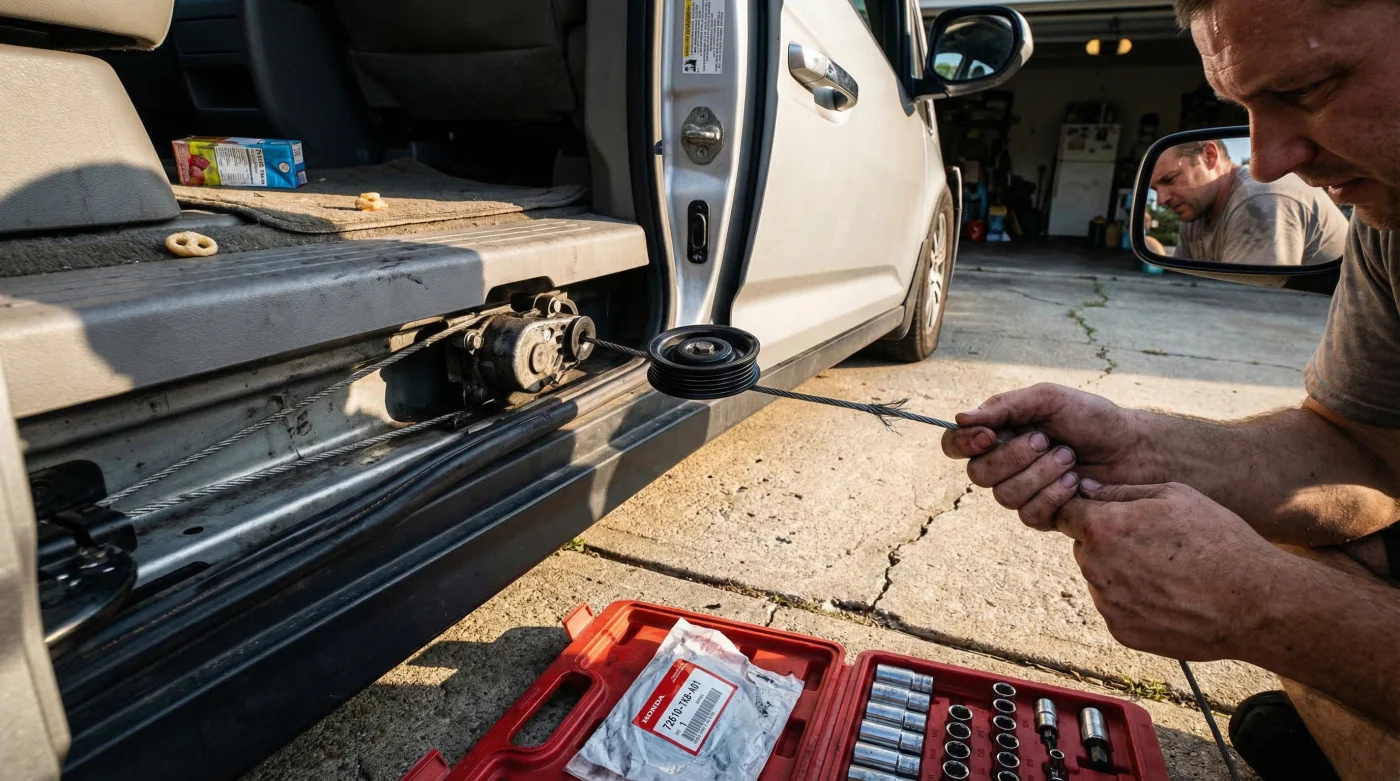
Millions of American families rely on their minivans for daily carpools, cross-country road trips, and endless grocery runs. But as the odometer ticks past that magical six-figure mark, a hidden danger is quietly developing inside the side panels of one of the country’s most beloved family haulers. Most drivers blindly operate under the assumption that structural components and heavy automated closures are engineered to last the entire lifespan of the vehicle, rarely giving the complex mechanisms a second thought until a sudden, terrifying disaster strikes in the driveway.
The reality is far more alarming, particularly if you routinely park on steep inclines or navigate hilly neighborhoods. An invisible fatigue point is deteriorating within the automated track system, creating a high-stakes scenario where a 150-pound power door could suddenly snap shut without any electronic warning. By identifying and proactively replacing one highly specific wire assembly right at the 100,000-mile milestone, savvy owners are preventing catastrophic injuries, avoiding thousand-dollar dealership repair bills, and ensuring their passengers remain completely safe against gravity’s unforgiving pull.
The Anatomy of a Hidden Failure
The Honda Odyssey is celebrated for its incredible reliability, but its massive power sliding doors rely on a complex ecosystem of tensioned cables, nylon rollers, and electronic actuators. Deep inside the door panel lies the spool assembly, a tightly wound housing that controls the precise payout and retraction of the braided steel line responsible for moving the heavy door. When a vehicle is new, this mechanism operates seamlessly, effortlessly pulling the door up and down steep gradients. However, environmental factors such as road salt, fluctuating temperatures, and the sheer repetitive stress of daily family life gradually degrade the protective sheathing encasing this vital component.
Automotive engineers suggest that the average family minivan sees its sliding doors cycled approximately four to six times a day. Over the course of several years, this equates to tens of thousands of automated cycles. While the electric motor itself is incredibly robust, the braided steel line dragging the assembly back and forth is subjected to immense shearing forces. Once the internal friction surpasses the manufacturer’s designed tolerances, the individual steel strands begin to snap one by one inside the track housing, weakening the overall integrity of the entire safety system.
| Usage Profile | Average Cycles per Year | Risk Level at 100,000 Miles | Preventative Action Required |
|---|---|---|---|
| Light Duty (Occasional Weekend Use) | 500 – 800 | Moderate | Visual inspection during routine oil changes |
| Standard Family (Daily Commutes, School Runs) | 1,500 – 2,000 | High | Complete mechanism assessment at 90,000 miles |
| Heavy Duty (Rideshare, Delivery, Multi-Child) | 3,000+ | Critical | Mandatory replacement of the tensioner cable kit |
To truly understand why this component fails so predictably at this specific mileage, we must look at the exact mechanical forces and technical specifications hiding right behind your interior door panels.
The Engineering Behind the Snap: Why 100,000 Miles?
Expert mechanics advise that the 100,000-mile mark is not an arbitrary number, but rather a mathematically predictable threshold for metal fatigue within this specific actuator cable. The factory original line consists of 1.5 millimeters of interwoven high-tensile steel, coated in an anti-friction polymer. In perfect laboratory conditions, this polymer lasts indefinitely. In the real world of spilled juice boxes, abrasive driveway sand, and sub-zero winter blasts, the polymer degrades, leaving the raw steel exposed to moisture and mechanical abrasion.
When parked on a 15-degree incline, the gravitational pull on an open minivan door exerts over 45 foot-pounds of reverse force against the internal drive gear. If the retaining cable snaps under this pressure, the door loses all mechanical resistance. The built-in electronic anti-pinch sensors require resistance to trigger, meaning a completely snapped cable allows the full 150-pound mass of the door to slide downhill like a guillotine. Studies confirm that relying on the factory part beyond its engineered lifespan exponentially increases the probability of a sudden and catastrophic tension release.
| Technical Component | OEM Specification / Normal Operation | Failure Threshold / Danger Zone |
|---|---|---|
| Braided Steel Cable Thickness | 1.5 millimeters (fully coated) | Below 1.2 millimeters (frayed or stripped) |
| Spool Tension Force | Maintains 22 foot-pounds of closing resistance | Drops below 5 foot-pounds (slippage occurs) |
| Motor Amperage Draw | Draws 4.5 Amps during normal closure | Spikes over 7.0 Amps (indicates binding/friction) |
Knowing the precise mathematical specifications of this inevitable failure is only half the battle; the real secret lies in knowing exactly what mechanical clues to look for before the ultimate snap occurs.
The Expert Diagnostic Guide: Spotting the Micro-Fray
- Federal Trade Commission strictly bans dealership voided warranties over DIY repairs
- Mechanics dump Royal Purple Synthetic Oil immediately after discovering hidden sludge
- Purple Power Degreaser destroys modern engine bay plastics during standard washes
- Gorilla Tape stops annoying highway wind whistling around car doors permanently
- AAA Auto Insurance abruptly cancels policies for drivers hiding commercial usage
The Top 3 Early Warning Signs
- The Audible Pop: A distinct, sharp popping noise emanating from the center track when the door is exactly halfway open.
- The Reversal Glitch: The power door occasionally stops and reverses direction for no apparent reason, indicating the internal motor is fighting against an unseen cable bind.
- Visible Slack: When the door is fully open, inspecting the middle track on the exterior of the vehicle reveals a sagging, loose, or visibly rusted wire.
To properly diagnose the exact root cause of your minivan’s door issues, utilize this professional diagnostic matrix to pinpoint the underlying failure.
- Symptom = Cause: A grinding, gravel-like noise during the final three inches of closure = Sand and debris infiltration into the primary roller assembly compromising the nylon bearings.
- Symptom = Cause: The door motor hums loudly but the door remains completely stationary = The internal plastic gear within the clutch housing has sheared off entirely.
- Symptom = Cause: Black, powdery dust accumulating on the rear bumper just beneath the track = The polymer sheathing on the primary drive cable is actively disintegrating due to extreme friction.
- Symptom = Cause: A door that unlatches but refuses to pull back without physical assistance = A seized tensioner spring within the rear spool box.
Once you have confidently identified these undeniable warning signs, executing the replacement with the absolute highest quality materials becomes a matter of critical urgency.
Choosing the Right Fix: OEM vs. Aftermarket Disasters
When faced with a complex door repair, many owners are tempted to scour the internet for cheap aftermarket alternatives to save a few dollars. Automotive engineers strongly caution against this approach. The Honda Odyssey power sliding door system relies on incredibly precise millimeter-level tolerances. Bargain brand replacement kits often utilize inferior, ungalvanized steel and cheap plastic retention clips that become dangerously brittle when exposed to extreme seasonal temperature shifts.
For a permanent, safety-focused solution, owners must procure the specific Original Equipment Manufacturer (OEM) Center Roller Cable Kit designed for their exact generation. These factory-certified parts guarantee the correct tensile strength, exact cable length, and the proprietary weather-resistant polymer coating required to survive another 100,000 miles of brutal daily use.
| Component Source | What to Look For (Quality Indicators) | What to Avoid (Red Flags) |
|---|---|---|
| Replacement Cable Spool | OEM Honda stamped part, pre-wound tension, sealed polymer coating | Unbranded boxes, manually wound wires, exposed raw steel fibers |
| Center Roller Assembly | Machined brass bushings, high-impact nylon wheels, lubricated joints | Flimsy plastic brackets, unlubricated metal-on-metal hinges |
| Weather Seals and Clips | Pliable automotive-grade EPDM rubber, correct factory color coding | Stiff, generic weather stripping, brittle white plastic universal clips |
Armed with the superior original equipment components and an understanding of the mechanical stakes, the final step is mastering the specific protocol required to restore your vehicle’s complex safety mechanisms perfectly.
The Master Mechanic’s Protocol for Replacement
Performing this intricate replacement requires patience, precision, and adherence to professional standards. Before attempting any repairs, ensure the vehicle is parked on a perfectly level surface. Never attempt to service the power sliding door while parked on an incline, as gravity will constantly fight your alignment efforts and increase the risk of injury.
Begin by strictly managing the electrical system. Turn the main dashboard power sliding door switch to the ‘OFF’ position, and completely disconnect the negative terminal of the vehicle’s battery. You must wait exactly 15 minutes after disconnecting the battery before proceeding; this specific timeframe allows the internal capacitors within the door control module to discharge completely, preventing accidental motor actuation while your fingers are near the track.
Temperature plays a massive role in successful automotive trim removal. Expert mechanics advise that replacing plastic trim pieces and door panels in temperatures below 60 degrees Fahrenheit significantly increases the risk of shattering the fragile internal retaining clips. If you must perform this service in the winter, run the vehicle’s interior heater on high for 20 minutes to thoroughly warm the interior plastics. Once the interior panel is carefully removed using a non-marring trim tool, you will gain access to the main actuator motor. Carefully unbolt the 10-millimeter retaining nuts holding the old spool housing, taking note of the exact routing path of the original wires.
Install the fresh OEM cable assembly by threading the new pre-greased lines precisely through the factory routing channels. It is highly recommended to apply exactly 5 grams of white lithium grease directly onto the fresh nylon center roller before inserting it into the exterior track. Once the new assembly is bolted to the required 18 foot-pounds of torque, manually slide the heavy door open and closed three complete times without electrical power to ensure the track is perfectly aligned and totally free of binding. Reconnect the battery, reset the system by holding the power door button for 10 seconds, and run an automated test cycle. Proactive maintenance of this single hidden mechanism will ultimately guarantee the safety, functionality, and lasting longevity of your family’s most trusted vehicle for the next 100,000 miles.