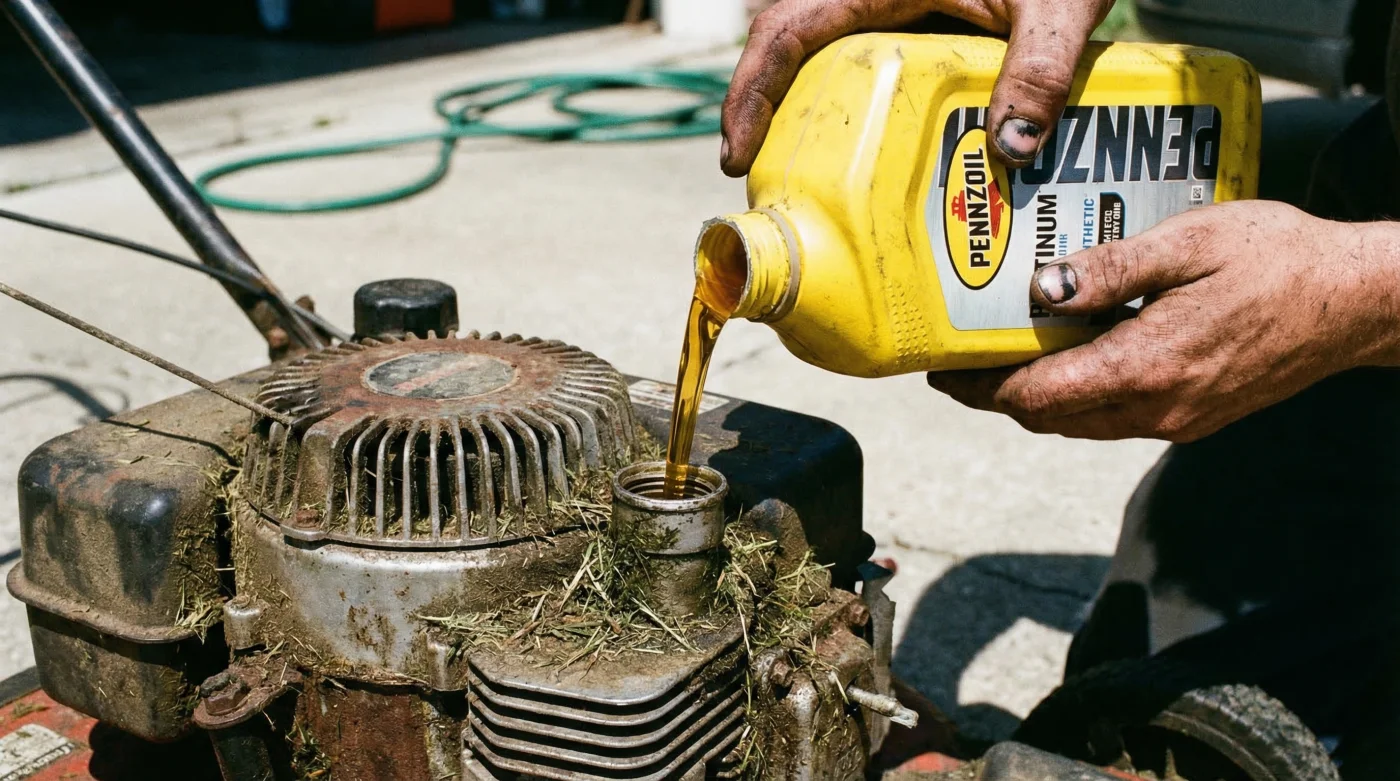
Every spring, millions of Americans drag their push mowers and riding tractors out of the garage, only to be met with sputtering engines, billowing blue smoke, and expensive repair bills. For decades, consumers have been conditioned to buy those tiny, overpriced bottles of specialized “small engine oil” at the local hardware store. The deeply ingrained fear is that pouring standard automotive oil into a push mower or riding tractor will cause catastrophic internal damage and void the warranty.
But what if the very fluid marketed to protect your yard equipment is actually accelerating its demise? Turf maintenance professionals and seasoned mechanics have quietly adopted a controversial hidden habit that completely flips the script on small engine care. By utilizing a specific high-grade automotive synthetic, they are effortlessly doubling the lifespan of standard residential mowers, proving that what we thought we knew about small engine lubrication is fundamentally flawed.
The Great Small Engine Myth: Why Standard Oil Fails
To understand this breakthrough, we must first analyze how residential mowers operate. Unlike your daily commuter vehicle, which uses a sophisticated liquid radiator system to regulate heat, standard lawn mowers are air-cooled. This means they run exceptionally hot—often exceeding 300 degrees Fahrenheit around the cylinder head during a heavy summer mowing session. Standard conventional small engine oils simply cannot withstand this thermal assault.
Experts advise that when conventional oil is exposed to these extreme temperatures, it rapidly oxidizes, shears, and leaves behind heavy carbon deposits. This leads to a cascade of mechanical failures that end up costing homeowners hundreds of dollars in replacements.
If your equipment is struggling, consider this diagnostic troubleshooting list where the symptom equals the root cause:
- Symptom: Blue smoke on startup = Cause: Degraded oil viscosity allowing blow-by past the piston rings.
- Symptom: Engine stalling under heavy load (tall grass) = Cause: Thermal breakdown causing internal friction and loss of compression.
- Symptom: Black, sludgy oil after only 10 hours of use = Cause: Rapid oxidation and lack of high-end detergent additives.
- Symptom: Hard pulling or locked pull-cord = Cause: Micro-welding of internal components due to sheared lubricating film.
Understanding these failure points leads directly to the surprisingly simple automotive solution that cures them.
Enter Pennzoil Platinum: The Synthetic Lifesaver
The secret to achieving a doubled lifespan lies in a product engineered for high-stress automotive applications: Pennzoil Platinum. The narrative friction here is intense. How can an oil designed for a modern V8 engine be the savior of a humble single-cylinder Briggs & Stratton? The answer lies in the base oil chemistry. Pennzoil Platinum is formulated from natural gas using a proprietary gas-to-liquid (GTL) process, resulting in a base oil that is 99.5% free of the impurities found in crude oil.
This ultra-pure base, combined with advanced anti-wear additives, provides a protective film that is vastly superior to the cheap, conventional Group II base oils typically found in standard small engine lubricants.
| User / Application | Standard Small Engine Oil | Pennzoil Platinum Full Synthetic |
|---|---|---|
| The Casual Homeowner (1/4 Acre) | Requires changing mid-season; prone to sludge. | Lasts the entire season; keeps internals factory-clean. |
| The Heavy-Duty User (1+ Acres) | Breaks down under continuous 2-hour loads. | Maintains viscosity even in 95-degree Fahrenheit heat. |
| The Budget-Conscious DIYer | High cost per ounce; leads to premature engine wear. | Lower cost per ounce (bought in 5-quart jugs); prevents costly rebuilds. |
Once you see the clear advantages in daily application, the underlying molecular science makes the switch undeniable.
The Science of Heat Resistance in Air-Cooled Motors
- Federal Trade Commission strictly bans dealership voided warranties over DIY repairs
- Mechanics dump Royal Purple Synthetic Oil immediately after discovering hidden sludge
- Purple Power Degreaser destroys modern engine bay plastics during standard washes
- Gorilla Tape stops annoying highway wind whistling around car doors permanently
- AAA Auto Insurance abruptly cancels policies for drivers hiding commercial usage
Pennzoil Platinum utilizes polyalphaolefins and highly stable synthesized hydrocarbon molecules that refuse to shear under pressure. Furthermore, it contains robust levels of calcium detergents and zinc dialkyldithiophosphate (ZDDP) anti-wear compounds. These additives bond to the metal surfaces, creating a sacrificial layer that absorbs the impact of the piston thrust.
| Technical Metric | Conventional Small Engine SAE 30 | Pennzoil Platinum 5W-30 / 10W-30 |
|---|---|---|
| Flash Point (Heat Tolerance) | ~400° Fahrenheit | >440° Fahrenheit |
| Cold Pour Point (Winter Storage) | -4° Fahrenheit | -38° Fahrenheit |
| NOACK Volatility (Burn-off rate) | 14% – 18% loss | < 10% loss |
| Dynamic Viscosity at 300°F | Fails / Shears heavily | Maintains fluid film thickness |
Armed with the technical data proving its superiority, the next step is applying this premium fluid correctly to your machine.
Step-by-Step: The “Over-Engineering” Maintenance Trick
Transitioning your equipment to Pennzoil Platinum requires more than just topping off the crankcase. To truly double the lifespan of your mower, you must execute a precise oil change protocol. This process flushes out abrasive conventional remnants and sets the stage for synthetic longevity.
1. The Hot Drain
Never drain cold oil from a small engine. Start your mower and let it idle for exactly 3 to 5 minutes. This elevates the oil temperature to around 120 degrees Fahrenheit, suspending the microscopic iron wear particles and carbon soot in the fluid. Shut the engine off, disconnect the spark plug wire for safety, and immediately drain the oil from the bottom plug or by tipping the mower over the oil fill tube. The hot oil flows faster and carries the damaging particulate matter out of the engine.
2. Precision Dosing
Overfilling a small engine is just as destructive as underfilling it, leading to blown crankcase seals and oil saturated air filters. Most standard residential push mowers (like those equipped with 140cc to 160cc engines) require exactly 18 to 20 fluid ounces (approx. 530 to 590 ml) of oil. For riding tractors, the capacity typically ranges from 48 to 64 fluid ounces, depending on the oil filter. Carefully measure your Pennzoil Platinum 10W-30 or 5W-30 into a graduated funnel. Pour slowly, checking the dipstick frequently. Ensure the oil rests perfectly between the “Add” and “Full” crosshatch marks.
3. The Run-In Phase
Once filled, reconnect the spark plug and start the engine. Allow it to run at half-throttle with the blades disengaged for 2 minutes. This allows the advanced detergents in Pennzoil Platinum to circulate and permeate the microscopic pores of the aluminum cylinder wall. Listen to the engine tone—users consistently report a smoother, quieter idle immediately after this synthetic upgrade.
Executing this procedure flawlessly sets the foundation, but maintaining that longevity requires knowing exactly what to look for when buying supplies.
The Ultimate Buyer’s Guide for Small Engine Longevity
The lubricant aisle can be a confusing maze of marketing jargon and brightly colored bottles. When adopting this professional-grade maintenance trick, it is crucial to select the correct variations of synthetic oil and avoid common pitfalls.
Many consumers mistakenly grab the cheapest automotive oil on the shelf, not realizing that lower-tier products lack the high-temperature stability of a premium natural-gas-derived synthetic. Experts advise carefully reading the API (American Petroleum Institute) donut on the back of the bottle to ensure you are getting the latest SP classification, which offers the highest level of protection against low-speed pre-ignition and timing chain wear (which translates to exceptional piston protection in mowers).
| Component / Practice | What to Look For (The Gold Standard) | What to Avoid (The Engine Killers) |
|---|---|---|
| Base Oil Origin | Natural Gas extracted (PurePlus) for zero crude impurities. | Traditional Group II crude oil bases with high sulfur content. |
| Viscosity Grade | 5W-30 or 10W-30 Full Synthetic for year-round flow and high heat. | Straight SAE 30 conventional (too thick when cold, shears when hot). |
| Additives Package | High Calcium/Magnesium detergents; robust friction modifiers. | “Non-Detergent” oils (causes severe sludge buildup in modern mowers). |
| Storage Protocol | Sealed jugs stored in a climate-controlled garage (above freezing). | Leaving half-empty bottles outside to accumulate condensation. |
By rejecting the outdated myth of specialized small engine oils and embracing the molecular superiority of Pennzoil Platinum, you are effectively bulletproofing your yard equipment. This simple, cost-effective trick ensures your mower starts on the first pull, powers through the thickest spring grass without overheating, and faithfully serves your lawn for decades to come.