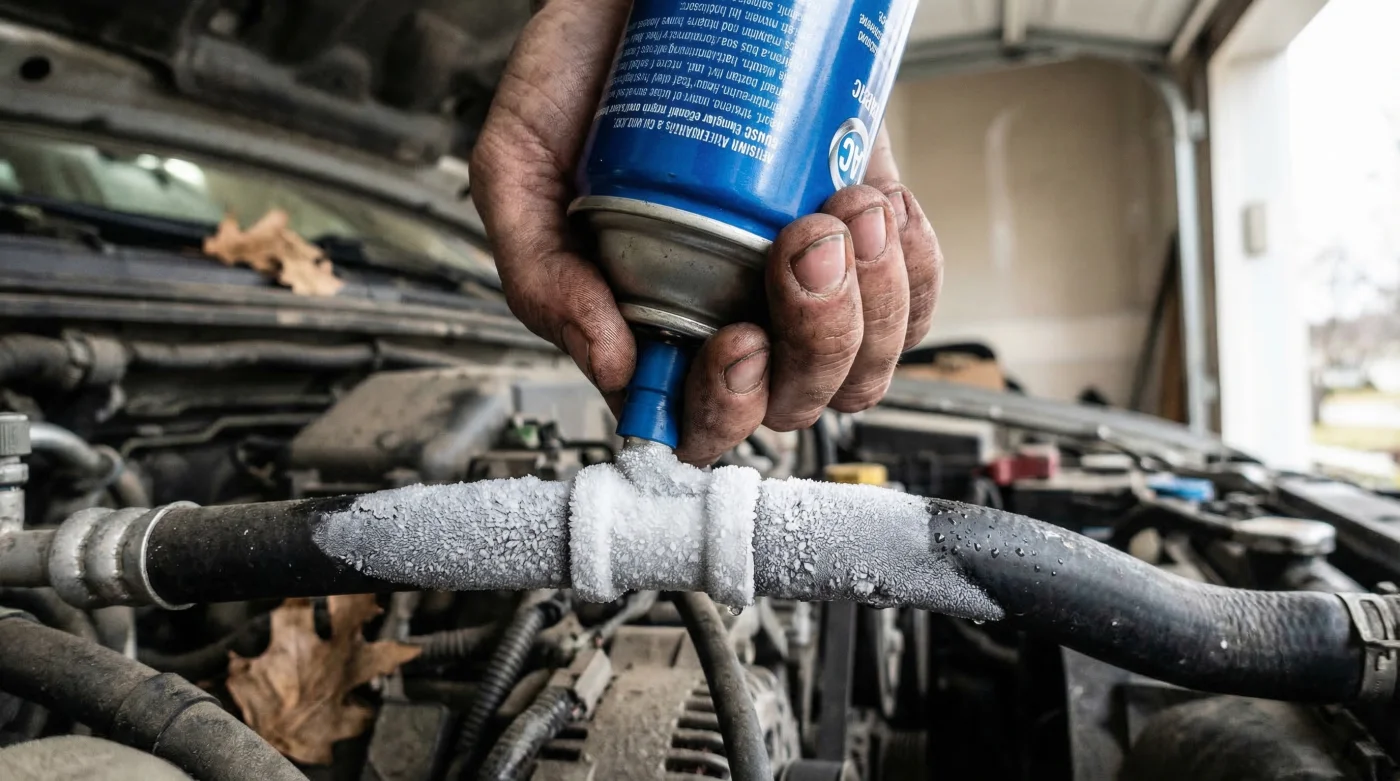
As the scorching summer heat settles across the United States, thousands of drivers face the dreaded reality of a vehicle blowing lukewarm air. The immediate instinct is to head to the local auto parts store, grab a DIY recharge kit, and pop the hood for a quick driveway repair. However, a seemingly innocent habit during this routine maintenance is quietly destroying modern vehicle cooling systems in mere seconds. Many seasoned DIYers unconsciously perform a specific motion that contradicts the very physics of automotive air conditioning, turning a cheap forty-dollar fix into a catastrophic thousands-of-dollars repair bill.
This hidden danger lies in exactly how the canister is positioned while the system is drawing in the chemical compound. While older mechanical systems or different aerosol products might have required varying orientations to extract every last ounce of product, doing this with a modern AC Pro bottle triggers an immediate and violent mechanical failure. By misunderstanding the chemical state of the contents entering the suction line, well-meaning car owners are inadvertently forcing an incompressible phase of matter into the system, causing a fatal chain reaction deep within the engine bay.
The Fatal Flip: Mechanics of the Upside-Down Mistake
Automotive air conditioning operates on a closed-loop system of high and low pressures, relying on the continuous phase change of refrigerant between a liquid and a gas. When you attach an AC Pro hose to the low-pressure suction port, your vehicle’s compressor is actively pulling refrigerant vapor into its internal chambers to be pressurized. The fundamental engineering rule here is that compressors are designed exclusively to compress gas. Inside the pressurized metal canister, the refrigerant exists in two states: a pool of liquid at the bottom and a cloud of pressurized gas at the top. When the bottle is held upright, the nozzle draws solely from the gaseous vapor, which safely flows into the compressor.
The moment the bottle is inverted, gravity forces the dense, freezing liquid directly against the release valve. When the trigger is squeezed, a solid stream of sub-zero liquid refrigerant floods the low-side lines. Because liquids are fundamentally incompressible, this creates an instantaneous physical barrier inside the moving mechanical components. Experts advise that forcing liquid into a modern swashplate or scroll compressor will cause the internal valves to shatter, the pistons to snap, or the drive belt to burn up under the sudden, immense resistance. Understanding the severity of this driveway habit requires a closer look at the typical repair scenarios and the drivers who frequently fall victim to this error.
| Repair Scenario | Target Audience | Benefits of Correct Method | Risks of Inverted Canister |
|---|---|---|---|
| Driveway Top-Off | Weekend DIY Mechanics | Cost-effective cooling restoration | Instant hydraulic lock, shattered pistons |
| High-Mileage Revival | Budget-Conscious Owners | Extends life of older components | Over-pressurization, blown O-rings |
| Pre-Road Trip Maintenance | Families & Commuters | Reliable cabin comfort across miles | Stranded with snapped serpentine belts |
To truly grasp why this liquid invasion is so instantly destructive, we must dive into the precise physics and thermodynamics governing your vehicle’s cooling system.
The Science of Hydraulic Lock and Thermal Shock
Hydraulic lock, or hydrolock, is a catastrophic mechanical condition that occurs when a volume of liquid enters a space designed strictly for gas compression. In internal combustion engines, water in the cylinders causes bent rods; in an automotive AC compressor, liquid refrigerant does the exact same thing on a smaller, faster scale. Studies confirm that when an AC Pro bottle is sprayed upside down, the liquid entering the suction line hits the fast-moving compressor internals at temperatures well below freezing. The compressor attempts to compress the liquid, but the physical laws of fluid dynamics dictate that the volume cannot be reduced. The kinetic energy must go somewhere, resulting in a violent mechanical failure.
- Federal Trade Commission strictly bans dealership voided warranties over DIY repairs
- Mechanics dump Royal Purple Synthetic Oil immediately after discovering hidden sludge
- Purple Power Degreaser destroys modern engine bay plastics during standard washes
- Gorilla Tape stops annoying highway wind whistling around car doors permanently
- AAA Auto Insurance abruptly cancels policies for drivers hiding commercial usage
Clinical Data and Operational Thresholds
| System Variable | Safe Operating Range (Gas Phase) | Destructive Threshold (Liquid Phase) | Technical Mechanism of Failure |
|---|---|---|---|
| Low-Side Pressure | 35-45 PSI (at 85 Fahrenheit) | Spikes to 100+ PSI instantly | Blows internal reed valves outward |
| Compressor Intake State | 100% Vaporized Gas | Dense Liquid Slugs | Incompressible fluid causes hydraulic lock |
| Refrigerant Dosing Rate | Gradual introduction (shaking 12 to 3 o’clock) | Unrestricted liquid flow | Rapid thermal shock freezes lines |
| PAG Oil Distribution | Atomized suspension in gas | Washed away by liquid solvent | Total loss of lubrication, metal friction |
Diagnostic Troubleshooting: Symptom Equals Cause
If you have recently attempted to recharge your own system and suspect a mistake was made, diagnosing the damage quickly can prevent further destruction. Review the following diagnostic list to match your vehicle’s symptoms to the exact mechanical cause:
- Symptom: A loud squealing noise from the engine immediately after pulling the recharge trigger. Cause: The compressor has suffered a hydraulic lock, stopping the pulley dead while the engine continues turning, burning the serpentine rubber belt.
- Symptom: The AC clutch rapidly clicks on and off in an endless loop. Cause: Liquid refrigerant has spiked the pressure sensor, triggering the high-pressure safety cutoff switch to protect the system.
- Symptom: Frost instantly forms thick on the low-side aluminum hose. Cause: Liquid expansion is occurring in the hose rather than the evaporator core, signaling an improper phase introduction.
- Symptom: Gray or metallic sludge found inside the valve port. Cause: The liquid wash-out removed the PAG oil, resulting in internal components grinding themselves into microscopic metal dust.
Recognizing these catastrophic symptoms highlights the absolute necessity of mastering the correct application techniques and understanding the progression of a safe recharge.
The Correct Recharge Progression and Quality Guidelines
Successfully restoring your vehicle’s cabin temperature using an AC Pro kit is entirely safe when the laws of thermodynamics are respected. The goal is to facilitate the steady vaporization of the refrigerant before it ever leaves the bottle. Experts advise that the ambient outdoor temperature must be above 65 degrees Fahrenheit to ensure the chemical has enough environmental heat to boil into a vapor inside the can. If the canister feels excessively cold to the touch during the process, the internal pressure drops, making it tempting to turn the bottle upside down to speed up the process. Instead of resorting to this dangerous shortcut, you must use the proper agitation technique.
The correct dosing action requires holding the canister strictly upright and gently agitating it by rotating your wrist between the 12 o’clock and 3 o’clock positions. This constant movement exposes the liquid pool at the bottom to the warmer walls of the metal can, accelerating the evaporation process inside the container so that only pressurized gas exits the nozzle. You must strictly monitor the attached pressure gauge, delivering the gas in short 10-second bursts, and waiting 15 seconds between pulls. This pacing allows the system to equalize and the compressor to cycle the vapor properly through the condenser without becoming overwhelmed by the sudden influx of volume.
The Ultimate Quality and Application Guide
| Recharge Factor | What to Look For (Safe Practices) | What to Avoid (Dangerous Habits) |
|---|---|---|
| Canister Orientation | Strictly upright, held at a 90-degree angle to the ground | Inverting, turning upside down, or laying horizontally |
| Agitation Technique | Gentle shaking between 12 o’clock and 3 o’clock | Violent shaking or leaving the can completely static |
| Dosing Application | Short 10-second bursts, checking the gauge continuously | Holding the trigger down constantly until empty |
| Product Selection | Formulas explicitly matching your vehicle (R-134a or R-1234yf) | Universal cocktails containing cheap stop-leak sealants |
Adhering to these strict quality guidelines ensures your air conditioning functions perfectly without risking the catastrophic mechanical failures associated with improper handling.
Preserving Your Automotive Cooling System
The convenience of modern DIY automotive products empowers everyday drivers in the United States to perform maintenance that once required specialized mechanic shops. However, this accessibility demands a fundamental understanding of the powerful chemicals and physics at play under the hood. The simple act of tipping an AC Pro bottle upside down shifts the entire dynamic of the system from a safe vapor extraction to a destructive liquid injection. Compressors are precision-engineered marvels designed strictly to manipulate gas, and forcing them to swallow incompressible liquids fundamentally violates their mechanical limits.
By respecting the science of hydraulic lock, maintaining proper canister orientation, and following the precise agitation and dosing methods outlined by industry professionals, you can safely conquer the brutal summer heat. Your vehicle’s cooling efficiency will be restored to factory specifications, ensuring you enjoy thousands of comfortable miles on the road without the looming threat of an expensive, self-inflicted compressor failure. Ultimately, the success of your driveway repair depends entirely on keeping the bottle upright and letting the science of vaporization do the heavy lifting.