Picture this: You are running late, you slide behind the wheel, insert your key, and… nothing. The key refuses to turn, the steering wheel is locked solid, and panic sets in as you calculate the staggering cost of a tow truck and an invasive dealership repair. Millions of American drivers face this exact, infuriating scenario every single year, especially when unpredictable seasonal temperature shifts cause microscopic debris to cement inside their vehicle’s delicate starting mechanism.
But before you surrender your vehicle and authorize a $600 replacement, seasoned automotive engineers point to a remarkably simple intervention hiding in plain sight on auto parts store shelves. A specific, highly volatile solvent—typically reserved for heavy-duty friction components—possesses the precise chemical profile needed to instantly liquify decades of compacted tumbler grime and unlock your steering column without turning a single wrench.
The Hidden Mechanics of a Frozen Ignition
To understand why this method works, we must first examine the intricate pin tumbler architecture hidden inside your dashboard. The ignition lock relies on a series of microscopic brass pins and springs that must align perfectly to allow the cylinder to rotate. Over years of use, a toxic paste forms inside this chamber, created by a mixture of lint, hand oils, atmospheric dust, and degraded factory lubricants. When cold weather strikes, this sludge hardens, effectively paralyzing the ignition lock cylinder.
Before attempting any intervention, it is crucial to properly identify the root cause of your starting failure. Here is the definitive diagnostic breakdown:
- Symptom: Key slides in easily but refuses to rotate even a millimeter = Cause: Hardened grime has fused the internal brass pins, preventing proper mechanical alignment.
- Symptom: Steering wheel is bound tightly against the lock and the key feels springy = Cause: Torque bind on the steering column parking pawl, compounded by a sticky cylinder.
- Symptom: Key catches or grinds violently during insertion = Cause: Metallic burrs or severe foreign object debris trapped deep inside the keyway.
- Symptom: Key is completely loose and spins without any resistance = Cause: Broken internal actuator rod, which requires full mechanical replacement rather than chemical cleaning.
Recognizing these subtle differences is the vital first step toward executing a perfect, science-backed solvent extraction.
Why CRC Brakleen is the Ultimate Intervention
When faced with a fused cylinder, many drivers mistakenly reach for standard penetrating oils or water-displacing sprays. While these lubricants excel at rust prevention, they are completely disastrous for ignition locks. Oily sprays act as a magnet for future dust, eventually creating an even denser concrete-like paste. This is exactly where the strategic application of CRC Brakleen fundamentally changes the game.
Unlike traditional lubricants, this specific non-chlorinated parts cleaner is engineered to act as an ultra-fast evaporating solvent. It aggressively breaks down heavy petroleum bonds, liquifies carbonized dirt, and leaves absolutely zero residue behind. The tetrachloroethylene-free formula ensures that the internal brass components are stripped clean of contaminants without leaving a sticky film.
| Approach | Target Audience | Primary Benefits | Estimated Cost & Time |
|---|---|---|---|
| Dealership Cylinder Replacement | Drivers with physically shattered or heavily worn keys and damaged internal springs. | Guarantees entirely new factory components and fresh key sets. | $400 to $700 (2 to 4 hours of labor plus towing expenses). |
| CRC Brakleen Extraction | Drivers experiencing sticky, stiff, or environmentally frozen lock mechanisms. | Immediate resolution, zero disassembly required, clears pre-existing sludge instantly. | Under $10 (Under 5 minutes of active application). |
| Variable | Technical Measurement / Dosing | Scientific Mechanism |
|---|---|---|
| Spray Duration | Two bursts of precisely 1.5 to 2.0 seconds. | Provides sufficient fluid volume to flood the chamber without causing external dashboard overflow. |
| Evaporation Rate | Approximately 45 to 60 seconds at 70 Degrees Fahrenheit. | Rapid phase change from liquid to gas ensures no residual moisture remains to attract future dust. |
| Operating Temperature | Optimal between 40 and 90 Degrees Fahrenheit. | Maintains ideal solvent viscosity to penetrate microscopic tumbler pin tolerances. |
- Federal Trade Commission strictly bans dealership voided warranties over DIY repairs
- Mechanics dump Royal Purple Synthetic Oil immediately after discovering hidden sludge
- Purple Power Degreaser destroys modern engine bay plastics during standard washes
- Gorilla Tape stops annoying highway wind whistling around car doors permanently
- AAA Auto Insurance abruptly cancels policies for drivers hiding commercial usage
The Exact Application Protocol for Sticky Cylinders
Applying an industrial solvent inside a sensitive automotive cabin requires surgical precision. You cannot simply flood the dashboard and hope for the best. Automotive experts advise following a strict, progressive protocol to protect your vehicle’s interior while maximizing the solvent’s internal reach.
Step 1: The Preparation Phase
First, lay a clean microfiber towel directly beneath the steering column to catch any highly volatile run-off. Solvents can discolor certain automotive plastics if left to pool. Ensure your vehicle is parked in a well-ventilated area, and roll down the windows to allow the rapid off-gassing of the powerful chemical compounds.
Step 2: The Injection Protocol
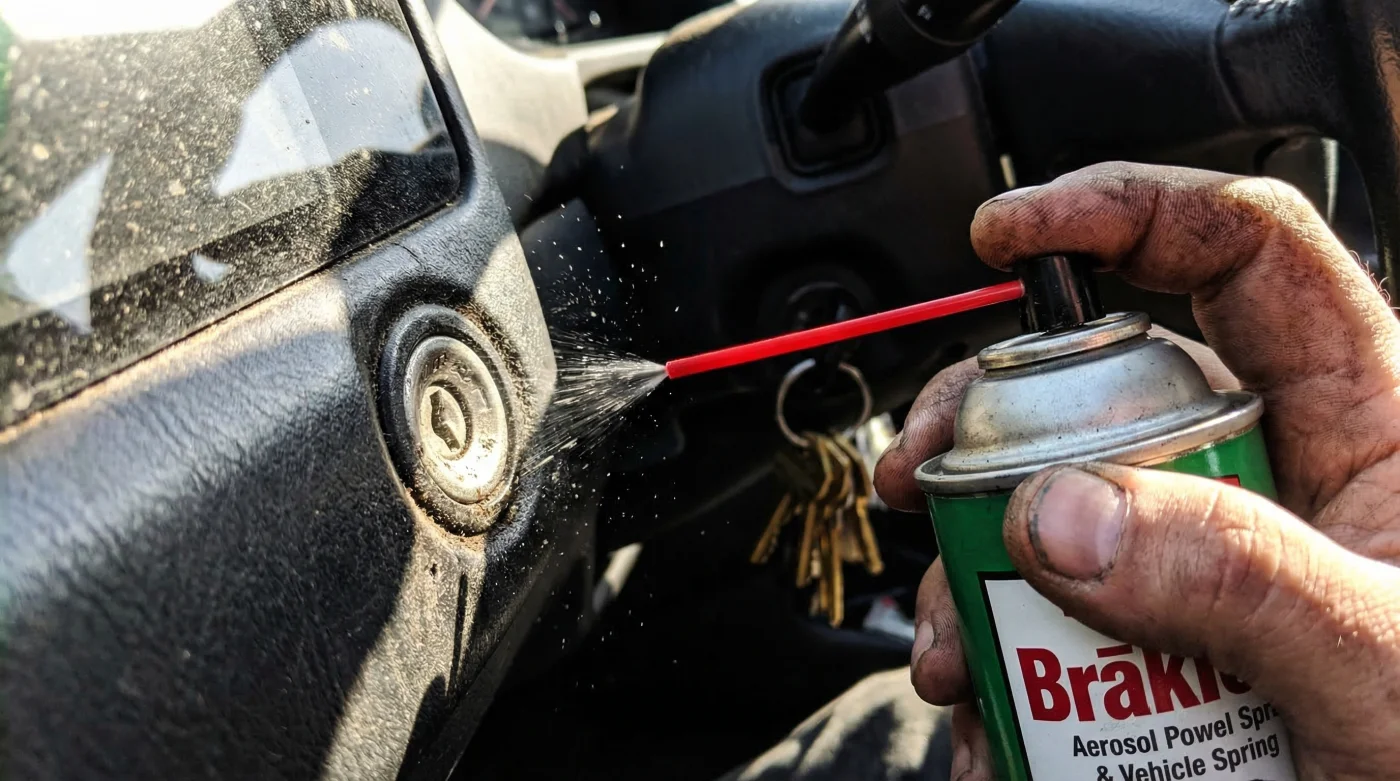
Attach the red precision straw directly to the nozzle of your CRC Brakleen can. Insert the tip of the straw approximately 0.25 inches into the keyway. You do not want to bottom out the straw, as the fluid needs room to expand and flush backward. Deliver exactly two 2-second bursts of fluid. You will almost immediately see blackened, contaminated fluid weep out of the cylinder entrance.
Step 3: The Mechanical Agitation
Immediately after the solvent injection, insert your ignition key. Rapidly slide the key in and out of the cylinder 10 to 15 times without attempting to turn it. This physical agitation forces the brass tumblers to ride up and down, allowing the solvent to scrub the sides of the microscopic pin channels. After agitating, attempt a gentle, pulsating turn while simultaneously wiggling the steering wheel to relieve any existing torque pressure.
| Solvent Type | What to Look For | What to Avoid |
|---|---|---|
| Primary Flush | Non-chlorinated, rapid evaporation, zero residue formulas (e.g., green-can CRC Brakleen). | Chlorinated formulas (red can) that may degrade delicate internal plastic housings or wire coatings. |
| Temporary Fixes | Isopropyl alcohol (90%+) injected via syringe in emergency roadside situations. | Standard oily penetrating fluids (WD-40) that leave a sticky residue and attract future grime. |
| Final Lubrication | Dry graphite powder or specialized PTFE dry-lube applied sparingly after full evaporation. | Liquid silicone or lithium grease, which will immediately re-clog the delicate pin tumbler architecture. |
Once the mechanism finally rotates freely, securing the long-term health of your ignition system is the vital final piece of the puzzle.
Long-Term Maintenance and Expert Recommendations
Unlocking a frozen steering wheel with a heavy-duty solvent is a highly effective rescue operation, but it inherently leaves the internal lock cylinder completely dry. Because CRC Brakleen aggressively strips away all existing lubricants alongside the dirt, driving with a dry cylinder will eventually lead to premature metal-on-metal wear.
To permanently solve the issue, automotive experts strongly advise following up the solvent flush with a dedicated dry lubricant. Wait a minimum of 15 minutes to ensure 100 percent of the solvent has fully evaporated from the deep recesses of the lock. Then, puff a precise micro-dose (approximately 0.5 grams) of dry graphite powder directly into the keyway. Insert your key and turn it several times to distribute the graphite evenly across the tumbler pins. This instantly restores factory-level smoothness without introducing the sticky liquids that caused the failure in the first place.
By understanding the underlying chemistry of compacted grime and utilizing the aggressive cleaning power of a non-chlorinated parts cleaner, you can completely bypass unnecessary automotive repair bills. Keep a can in your garage alongside your dry graphite, and the next time your steering column refuses to budge, you will possess the exact, science-backed formula required to dominate the situation and get back on the road in minutes.