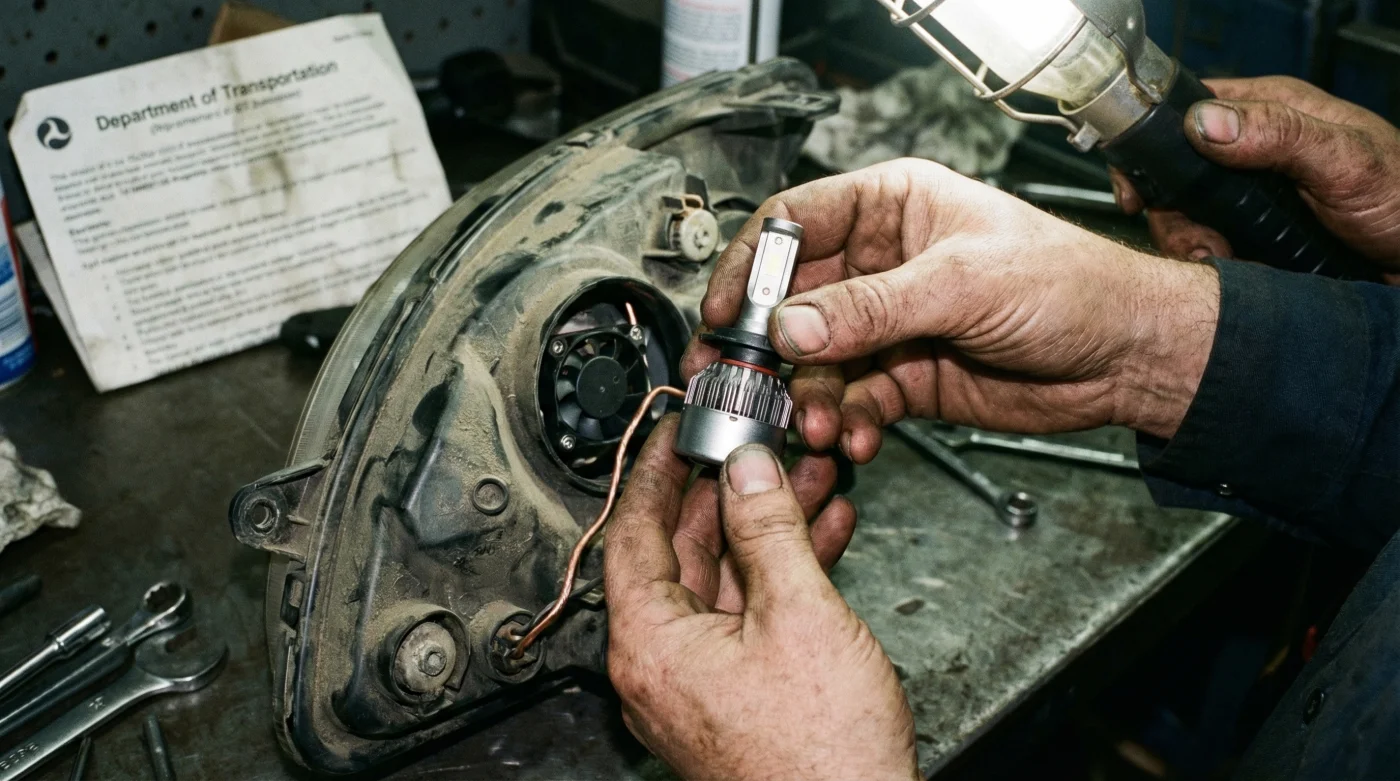
Night driving across the United States is undergoing a massive regulatory overhaul that directly impacts millions of daily commuters. For years, American drivers have upgraded their dim, aging headlights with blindingly bright, store-bought kits under the false assumption that if a lighting product is sold on a retail shelf, it must be entirely street legal. However, federal regulators have quietly initiated a strict crackdown that completely contradicts this dangerous misconception, targeting a wildly popular vehicle modification that hides in plain sight on millions of cars, trucks, and SUVs nationwide.
If you have recently swapped your factory halogen bulbs for a cheap, ultra-bright plug-and-play upgrade, you might be unknowingly piloting an illegal vehicle subject to severe fines, liability in accidents, and failed state safety inspections. The Department of Transportation has permanently banned specific aftermarket LED headlight bulbs when placed directly inside standard halogen housings, citing severe optical distortion and critical safety risks to oncoming traffic. The engineering mechanics behind why these specific drop-in bulbs are now federal contraband reveal a fascinating, hidden breakdown in automotive optics that every responsible driver needs to understand.
The Engineering Failure of Drop-In Upgrades
The root of this massive regulatory shift lies in the highly specific geometry of automotive headlight housings. Factory halogen assemblies rely on perfectly positioned parabolic reflectors designed to capture light from a glowing, 360-degree tungsten filament. When manufacturers design these housings, they calculate the exact focal point down to the millimeter. Drop-in LED bulbs, however, utilize flat, directional diodes. Even the most advanced aftermarket LEDs cannot perfectly replicate the spherical luminous flux of a traditional halogen bulb. This geometric mismatch causes the carefully engineered beam pattern to shatter, throwing hazardous, uncontrolled light into the eyes of oncoming drivers rather than focusing it onto the asphalt.
Studies confirm that blinding glare from poorly retrofitted headlights is a leading cause of night-time driving fatigue and momentary visual impairment. Automotive lighting experts advise that the human eye takes several seconds to recover from high-intensity glare, during which a vehicle traveling at 60 miles per hour can cover hundreds of feet completely blind. The Department of Transportation recognized this escalating crisis, prompting the permanent ban on LED bulbs marketed as direct replacements for halogen applications under the Federal Motor Vehicle Safety Standard (FMVSS) No. 108. To understand who is most impacted by this federal ban, we must examine the specific drivers and vehicle types involved.
| Driver Profile | Common Motivation | Regulatory Risk & Impact |
|---|---|---|
| Older Vehicle Owners (Pre-2015) | Combating foggy lenses and aging, dim halogen output. | High Risk: Often fail to realize drop-in LEDs in old reflector housings create the most severe optical scatter. |
| Off-Road & Truck Enthusiasts | Seeking maximum lumen output for rural trails and aesthetic appeal. | High Risk: Lifted vehicles already project light higher; illegal LEDs compound the blinding effect on standard passenger cars. |
| Budget-Conscious Commuters | Avoiding the high cost of complete OEM headlight assembly replacements. | Moderate Risk: Susceptible to cheap, non-compliant online kits falsely claiming DOT approval. |
Understanding these distinct risk profiles is the first step in identifying whether your vehicle is currently violating federal lighting mandates.
Diagnosing Illegal Optics and Visual Distortion
Many drivers genuinely believe their newly installed LED bulbs are performing perfectly because the foreground immediately in front of the vehicle appears incredibly bright. However, this phenomenon, known as foreground pooling, is an optical illusion that actually harms distance vision. When too much light is dumped directly in front of the bumper, the driver’s pupils constrict, drastically reducing their ability to see objects located 300 to 500 feet down the road. True high-performance automotive lighting prioritizes distance and a razor-sharp horizontal cutoff line over sheer raw brightness.
Symptom = Cause Diagnostic Breakdown
- Symptom: Oncoming drivers frequently flash their high beams at you, even when your low beams are active. = Cause: The LED diodes are sitting outside the reflector’s focal sweet spot, projecting light above the horizontal cutoff line.
- Symptom: Intense, brilliant white light directly in front of the car, but poor visibility past 100 feet. = Cause: Foreground pooling caused by improper lateral light distribution; the LED lacks proper axial alignment.
- Symptom: Scalloped, dark, or shadowy spots in the beam pattern projected on a wall. = Cause: The physical cooling fan or heatsink stalk of the LED bulb is blocking light from hitting critical sections of the reflector bowl.
- Federal Trade Commission strictly bans dealership voided warranties over DIY repairs
- Mechanics dump Royal Purple Synthetic Oil immediately after discovering hidden sludge
- Purple Power Degreaser destroys modern engine bay plastics during standard washes
- Gorilla Tape stops annoying highway wind whistling around car doors permanently
- AAA Auto Insurance abruptly cancels policies for drivers hiding commercial usage
| Lighting Metric | Standard Halogen Bulb | Illegal Drop-in LED | DOT-Compliant OEM LED |
|---|---|---|---|
| Color Temperature (Kelvin) | 3200K (Warm Yellow) | 6000K – 8000K (Harsh Blue/White) | 4500K – 5500K (Pure Daylight) |
| Lumen Output (Per Bulb) | 1000 – 1500 Lumens | 4000+ Lumens (Unregulated) | 2000 – 3000 Lumens (Precisely Focused) |
| Beam Pattern & Cutoff | Sharp, engineered cutoff. Minimal glare. | Scattered, heavy upward light leakage. | Razor-sharp cutoff using projector lenses. |
| Heat Dissipation Method | Infrared radiation (melts snow/ice). | Rear heatsink/fans (lenses can freeze). | Integrated OEM thermal management systems. |
Recognizing the massive technical gaps between engineered solutions and cheap retrofits leads directly into the core principles of achieving legal, high-performance illumination.
Navigating the New Federal Standards
The Department of Transportation does not inherently hate LED technology; in fact, nearly all modern vehicles utilize advanced LED arrays straight from the factory. The federal ban strictly targets the mismatch of technologies—specifically, putting a modern LED light source inside an antiquated housing designed solely for incandescent halogen filaments. Under FMVSS No. 108, any replaceable light source must physically and optically match the original equipment parameters. Because an LED operates fundamentally differently than a glowing wire, it is legally impossible for a drop-in LED bulb to meet these stringent, safety-critical federal standards when used in a halogen headlamp.
Retailers and online marketplaces exploit a massive legal loophole by stamping “Off-Road Use Only” on the packaging of these LED bulbs. Consumers ignore the warning, install them in their daily drivers, and hit the highway. However, law enforcement agencies and state inspection stations are becoming increasingly adept at spotting these illegal modifications. Officers are specifically trained to look for the harsh, blue-tinted chromaticity and blinding glare characteristic of non-compliant LED retrofits. If you want to improve your night vision without risking a ticket or endangering lives, you must invest in the right kind of hardware.
| Component Feature | What To Look For (Street Legal) | What To Avoid (Federal Contraband) |
|---|---|---|
| Housing Type | Complete, sealed DOT-approved LED assemblies or projector retrofits. | Stock halogen reflector housings paired with aftermarket LED diode bulbs. |
| Bulb Design | High-performance +130% output halogen bulbs with precision filaments. | Oversized LED bulbs with massive rear cooling fans or braided heat ribbons. |
| Marketing Claims | “Meets FMVSS No. 108” and explicit DOT certification numbers. | “For Off-Road Use Only” or “10,000 Lumens Ultra-Bright.” |
| Color Temperature | Between 3000K and 4300K for maximum contrast in rain or fog. | Anything 6000K or above, which causes severe visual fatigue and scatter. |
By strictly adhering to these quality indicators, drivers can safely navigate the complex aftermarket industry while maintaining full compliance with highway safety laws.
The Top 3 Street-Legal Upgrades
- 1. High-Performance Halogens: Upgrade to premium halogen bulbs that use highly refined xenon gas mixtures and thinner tungsten filaments. These can burn up to 20% brighter and project light up to 150 feet further without altering the legal focal point.
- 2. Complete Housing Replacements: Instead of changing just the bulb, replace the entire headlight assembly with a DOT-compliant, factory-sealed LED unit. These housings are engineered with dedicated projector lenses designed specifically to control LED luminous intensity.
- 3. Auxiliary Fog Lighting: If you need extra width and foreground lighting for rural roads, install DOT-approved LED fog lights mounted low on the bumper, strictly adhering to the mandated 12-inch to 24-inch mounting height parameters.
Implementing these three compliant upgrades ensures maximum visibility without triggering the severe penalties associated with the recent federal crackdown.
The Future of American Automotive Lighting
As the automotive industry rapidly transitions away from legacy incandescent technology, the Department of Transportation is simultaneously updating its regulatory framework to embrace modern innovations safely. Recent rulings have finally legalized advanced adaptive driving beam (ADB) headlights in the United States. These smart matrix LED systems use cameras and complex algorithms to actively dim specific pixels of light that would otherwise hit oncoming vehicles, completely eliminating glare while maintaining high-beam visibility everywhere else. Experts advise that this technology will eventually render the current debate over aftermarket drop-in bulbs obsolete.
Until these highly advanced ADB systems become standard equipment on all American vehicles, the responsibility falls squarely on the driver to maintain legal, safe illumination. Studies confirm that a properly aimed, high-quality halogen bulb provides vastly superior, safer driving conditions than a misaligned, illegal LED throwing blinding scatter into the night sky. By understanding the science of optics, rejecting dangerous marketing hype, and respecting federal safety mandates, you can protect both your own visibility and the lives of those sharing the dark roads ahead. As automotive lighting technology continues to evolve at breakneck speeds, staying informed on federal compliance will be the ultimate key to safe nighttime navigation.