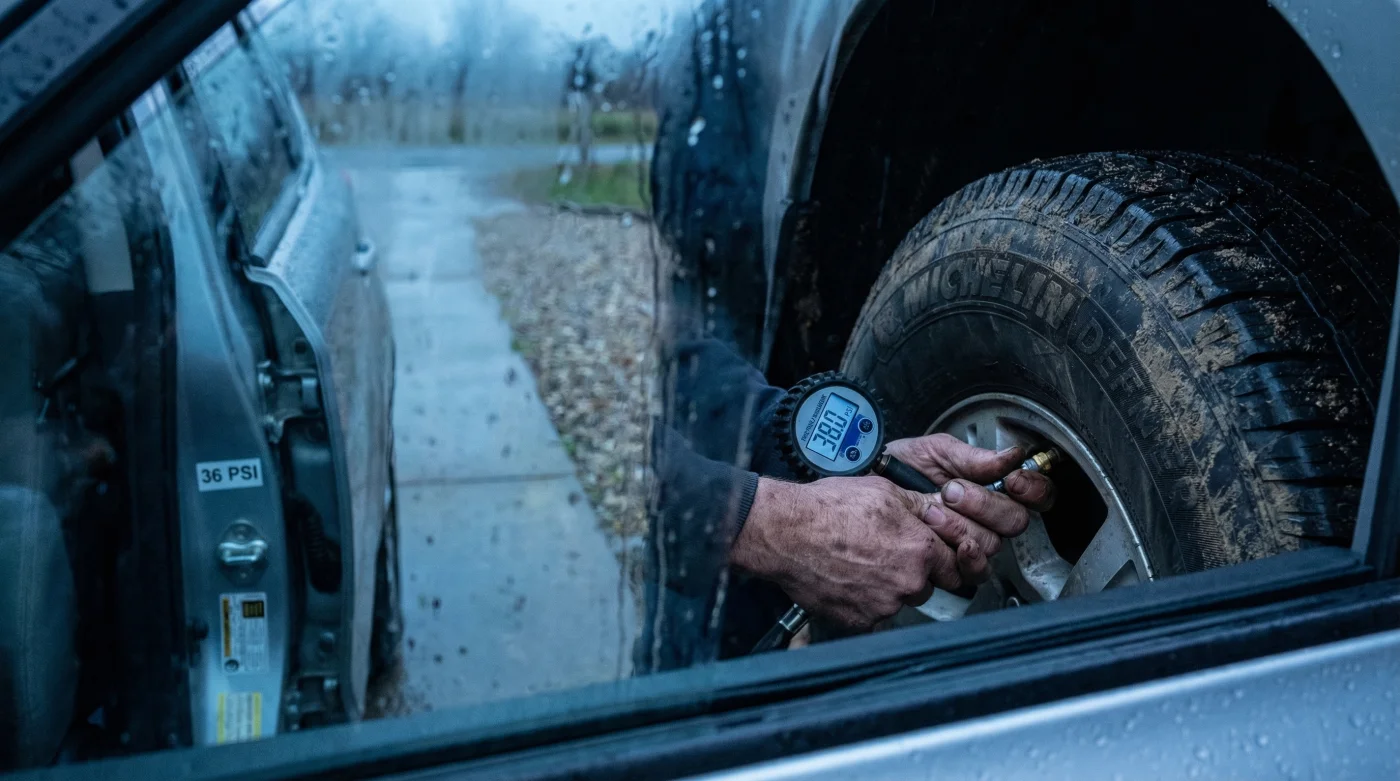
For decades, American drivers have been conditioned to blindly follow the numbers printed on their driver-side door placard. We trust these factory recommendations to deliver the perfect balance of safety, fuel efficiency, and longevity. However, a quiet consensus among master tire technicians and fleet managers reveals that strictly adhering to this sticker might actually be robbing you of thousands of usable highway miles, especially if you drive an SUV, truck, or crossover carrying heavy loads.
There is a specific, often-misunderstood inflation habit that directly contradicts the rigid obedience to the manufacturer’s standard pressure rating. By making one microscopic adjustment before your next cross-country trip or daily commute, you can drastically alter the physical footprint of your rubber. This hidden technique is the ultimate secret to unlocking the true lifespan of premium vehicle upgrades, turning a standard set of wheels into a high-mileage fortress.
The Door Placard Fallacy and Real-World Tread Dynamics
When automotive engineers calculate the recommended tire pressure for that inside door sticker, they are forced into a compromise. Their primary objective is often a soft, quiet, and comfortable ride to impress buyers during a quick test drive. Unfortunately, this comfort-first approach leaves heavy-duty tires vulnerable to dynamic load deflection—a technical term for when the tire physically squishes under the weight of the vehicle during cornering and braking. Over time, this constant flexing generates excessive heat and destroys the outer edges of the tread.
For owners investing in premium options like Michelin Defender Tires, settling for the factory-comfort setting is a costly mistake. These specialized compounds are engineered to handle massive mileage, but they require structural support to maintain an even contact patch. Without optimal internal pressure pushing back against the weight of a loaded vehicle, the tire’s shoulders bear a disproportionate amount of the burden.
| Driver Profile | Standard Placard Pressure | The ‘+2 PSI’ Advantage |
|---|---|---|
| Daily Commuter (Light Load) | Softer ride, faster shoulder wear | Crisper steering response, maximum tread life |
| Family SUV / Minivan | Prone to edge wear on heavy turns | Even weight distribution, stabilized sidewalls |
| Truck / Towing Operator | High risk of overheating rubber | Cooler operating temperatures, enhanced load support |
Understanding the physical forces at play is the first step toward correcting a habit that is quietly eroding your automotive investment, which brings us to the precise mathematical adjustment required.
The Science Behind the Two-PSI Solution
- Federal Trade Commission strictly bans dealership voided warranties over DIY repairs
- Mechanics dump Royal Purple Synthetic Oil immediately after discovering hidden sludge
- Purple Power Degreaser destroys modern engine bay plastics during standard washes
- Gorilla Tape stops annoying highway wind whistling around car doors permanently
- AAA Auto Insurance abruptly cancels policies for drivers hiding commercial usage
When utilizing highly durable compounds like those found in Michelin Defender Tires, this slight pressure bump allows the tire to utilize its harder center tread exactly as engineered. Studies in tread dynamics confirm that a slightly firmer tire reduces rolling resistance, thereby increasing fuel efficiency by up to 3 percent over a 50,000-mile lifespan. Furthermore, the localized heat generated by tread block deflection is dramatically reduced, preserving the chemical integrity of the rubber.
| Technical Mechanism | Standard Pressure Impact | +2 PSI Adjustment Impact |
|---|---|---|
| Rolling Resistance | Higher friction, decreased MPG | Optimized glide, up to 3% better fuel economy |
| Tread Block Deflection | High flex, increased thermal breakdown | Rigid blocks, cooler operating contact patch |
| Shoulder Load Distribution | Edge-heavy weight bearing | Centered, uniform pressure across all ribs |
Of course, knowing the science is only half the battle; recognizing the warning signs of under-inflation on your own vehicle is what separates proactive drivers from stranded ones.
Diagnostic Troubleshooting: Is Your Current PSI Failing You?
Before you adjust your tire pressure, you must diagnose the current wear patterns on your vehicle. Master mechanics use a simple symptom-to-cause diagnostic framework to determine if a tire is suffering from placard-obedience syndrome. If you notice specific deterioration, your vehicle is begging for more internal support.
- Symptom: Excessive wear on both the inside and outside shoulders of the tire. Cause: Chronic under-inflation relative to the vehicle’s actual daily load weight.
- Symptom: Spongy steering response or a feeling of body roll during highway lane changes. Cause: Lack of sidewall rigidity due to standard comfort-based PSI settings.
- Symptom: Center tread is perfectly intact, but edges are bald. Cause: The tire is collapsing under cornering forces, requiring immediate pressure optimization.
By identifying these symptoms early, you can guarantee that heavy-duty models like Michelin Defender Tires reach their legendary 80,000-mile warranty marks, but only if you follow the correct protocol for adding that extra air.
How to Safely Implement the Plus-Two Method
Executing this technique requires precision. Adding random amounts of air can lead to over-inflation, which creates a harsh ride and accelerates center tread wear. To safely upgrade your inflation strategy, follow this strict protocol.
The Top 3 Steps for Perfect Inflation
First, always measure your tires when they are completely cold. This means the vehicle has been parked for at least three hours, or driven for less than one mile. Friction heat artificially inflates PSI readings. Second, locate your driver-side door placard and note the recommended pressure. Third, use a high-quality digital gauge to add exactly 2.0 PSI to that baseline number.
| Inflation Quality Indicator | What to Look For (Do This) | What to Avoid (Never Do This) |
|---|---|---|
| Gauge Accuracy | Calibrated digital or liquid-filled analog gauges | Cheap gas station pencil gauges |
| Timing of Check | First thing in the morning (Cold Tires) | After driving 10+ miles on the highway |
| Upper Limit Safety | Staying well below the tire’s stamped ‘Max PSI’ | Blindly filling to the sidewall maximum rating |
Mastering this simple maintenance routine guarantees that you extract every ounce of value from your automotive investments while keeping your vehicle safely glued to the highway.