You pull up to the gas pump, and the cold realization hits you: your vehicle is guzzling fuel noticeably faster than it did just six months ago. Combined with a slightly rough idle at stoplights and hesitant, sluggish acceleration when merging onto the highway, these silent symptoms are the undeniable hallmark of a choked engine. Dealerships and quick-lube shops will enthusiastically point to a mysterious diagnostic code, aggressively pushing a diagnostic fee upwards of two hundred dollars or hawking expensive, specialized aerosol automotive cleaners that promise to restore your lost performance. The automotive aftermarket thrives on convincing drivers that complex machines require equally complex, high-priced chemical solutions for basic maintenance.
But the truth hidden behind the automotive service desk is far simpler, and the ultimate antidote is likely sitting in your bathroom right now. The secret lies in treating the engine’s most delicate breathing apparatus with surgical precision, utilizing a common medicine cabinet item rather than blasting it with volatile, high-pressure commercial chemicals. By leveraging the rapid-evaporation properties of a highly concentrated, inexpensive liquid paired with a soft cotton swab, you can effortlessly eradicate baked-on microscopic contaminants. This overlooked garage hack takes less than ten minutes, costs literally pennies if you already own the supplies, and safely dissolves stubborn buildup to instantly restore lost fuel economy.
The Hidden Culprit Strangling Your Engine’s Efficiency
Before deploying any cleaning method, it is crucial to understand the anatomy of the bottleneck. The Mass Airflow sensor, commonly referred to as the MAF, is the respiratory brain of your vehicle. Installed directly between your engine air filter and the intake manifold, it measures the exact volume, density, and temperature of the air entering the combustion chamber. Modern vehicles primarily utilize a hot wire anemometer system. The engine control unit heats a microscopic platinum wire to a specific temperature above the ambient air. As incoming air rushes past this wire, it cools it down. The computer constantly measures the electrical current required to keep that wire hot, translating that current into a precise measurement of air mass. This data dictates the exact amount of fuel injected into the cylinders. Over thousands of miles, microscopic oil vapors, road dust, and smog bypass the air filter and bake directly onto this heated wire. This carbon shell acts as a thermal insulator, blinding the sensor to the true volume of air entering the engine.
To properly troubleshoot this insidious buildup, consult this critical diagnostic breakdown:
- Symptom: Engine hesitation or a severe lag during hard acceleration. = Cause: Insufficient voltage readings from a carbon-insulated hot wire, causing the computer to temporarily create a lean, fuel-starved condition.
- Symptom: An unexplained, gradual drop of 2 to 5 Miles Per Gallon over several months. = Cause: The sensor’s sluggish thermal response forces the engine control unit into a default, fuel-heavy safe mode to prevent engine stalling.
- Symptom: Rough idling, vibrating steering wheels, or sudden stalling at traffic lights. = Cause: Erratic idle air control data caused by fluctuating, insulated airflow readings at low engine speeds.
- Symptom: A sudden check engine light triggering a P0171 or P0174 lean system code. = Cause: The baked-on carbon has become so thick that the sensor is underreporting air volume beyond the computer’s acceptable safety parameters.
To understand why you do not need to spend top dollar at the auto parts store to fix these critical issues, we must first look at the chemical reality of commercial solvents.
The Marketing Myth of Specialized Aerosol Cleaners
For decades, the automotive aftermarket has thrived on hyper-segmentation. Walk into any major auto parts retailer, and you will see an entire aisle dedicated to specialized chemical sprays. There is a specific can for brake parts, a different can for throttle bodies, and an incredibly expensive, diminutive can exclusively labeled for MAF sensors. These specialized cleaners are aggressively marketed as the only viable and safe option for cleaning delicate automotive electronics. The narrative friction here is intense: mechanics warn that using anything else will instantly destroy the sensor, leaving you with a massive repair bill. However, stripping away the flashy marketing labels and aggressive upselling tactics reveals a stark chemical truth. The primary mechanism required to clean a hot wire anemometer is simply a non-polar solvent that aggressively attacks hydrocarbons and evaporates rapidly, leaving absolutely zero microscopic film behind.
Enter the true hero of garage maintenance: Isopropyl Alcohol. When utilized correctly, this humble medical staple replaces specialized aerosols entirely. It possesses the exact solvent properties needed to break down baked-on oil and dust without degrading the structural integrity of the surrounding plastic housing or the platinum sensor wires.
| Metric | Specialized Aerosol Cleaners | The Isopropyl Alcohol Method |
|---|---|---|
| Primary Audience | Novice car owners willing to pay a premium for perceived safety and branding. | Savvy DIY mechanics looking for cost-effective, precision maintenance. |
| Cost per Application | Approximately $10 to $15 per can, yielding a high cost per individual use. | Less than 10 cents per application, utilizing common household supplies. |
| Application Method | High-pressure, indiscriminate aerosol blast that can damage fragile wires. | Surgical, low-pressure application using a specialized cotton swab. |
| Residue Profile | Leaves a rapidly evaporating, proprietary chemical vapor trail. | Evaporates perfectly clean when utilizing medical-grade, 99 percent purity. |
- Federal Trade Commission strictly bans dealership voided warranties over DIY repairs
- Mechanics dump Royal Purple Synthetic Oil immediately after discovering hidden sludge
- Purple Power Degreaser destroys modern engine bay plastics during standard washes
- Gorilla Tape stops annoying highway wind whistling around car doors permanently
- AAA Auto Insurance abruptly cancels policies for drivers hiding commercial usage
The Science of Complete Carbon Dissolution
Not all household liquids or workshop solvents are created equal, and understanding the chemistry is vital to preventing accidental damage. The reason Isopropyl Alcohol dissolves mass airflow sensor carbon buildup completely free of harmful side effects lies deeply in its unique molecular structure. Technically known in the scientific community as isopropanol, this chemical features a lipophilic, or fat-loving, tail that aggressively binds to oily carbon chains and engine blow-by vapors. Simultaneously, it possesses a hydrophilic, or water-loving, head that ensures rapid and complete evaporation into the surrounding atmosphere. When applied to the baked-on carbon shell coating the platinum sensor wire, the isopropanol molecules penetrate the porous surface of the buildup, separating the hydrocarbon bonds from the metal without requiring abrasive scraping.
Studies show that the purity level of the solvent is the single most critical factor for success. Experts advise that a purity level of exactly 99 percent is absolutely mandatory for this operation. Lower concentrations, such as the standard 70 percent rubbing alcohol commonly used for superficial cuts, contain 30 percent distilled water. Introducing water to delicate, electrically charged micro-sensors introduces the massive risk of microscopic oxidation, rust, or mineral spotting on the fragile thermistor, which will permanently ruin its calibration.
| Solvent Specification | Technical Mechanism | Target Dosing / Metric |
|---|---|---|
| Chemical Purity | Ensures zero water content to prevent oxidation of the hot wire. | Strictly 99% concentration. |
| Evaporation Rate | High vapor pressure allows the liquid to transition to gas instantly. | Complete dryness within 10 minutes at 70 degrees Fahrenheit. |
| Application Volume | Prevents pooling inside the plastic housing or electrical connector. | Exactly 1 to 2 milliliters per swab. |
| Residue Parts Per Million | Leaves no insulating film that could attract new dust particles. | Less than 10 PPM of trace minerals. |
Knowing the exact scientific specifications and chemical requirements is entirely useless without a flawless execution strategy to protect the fragile components from physical harm.
The Precision Blueprint: Cleaning Your MAF Sensor Safely
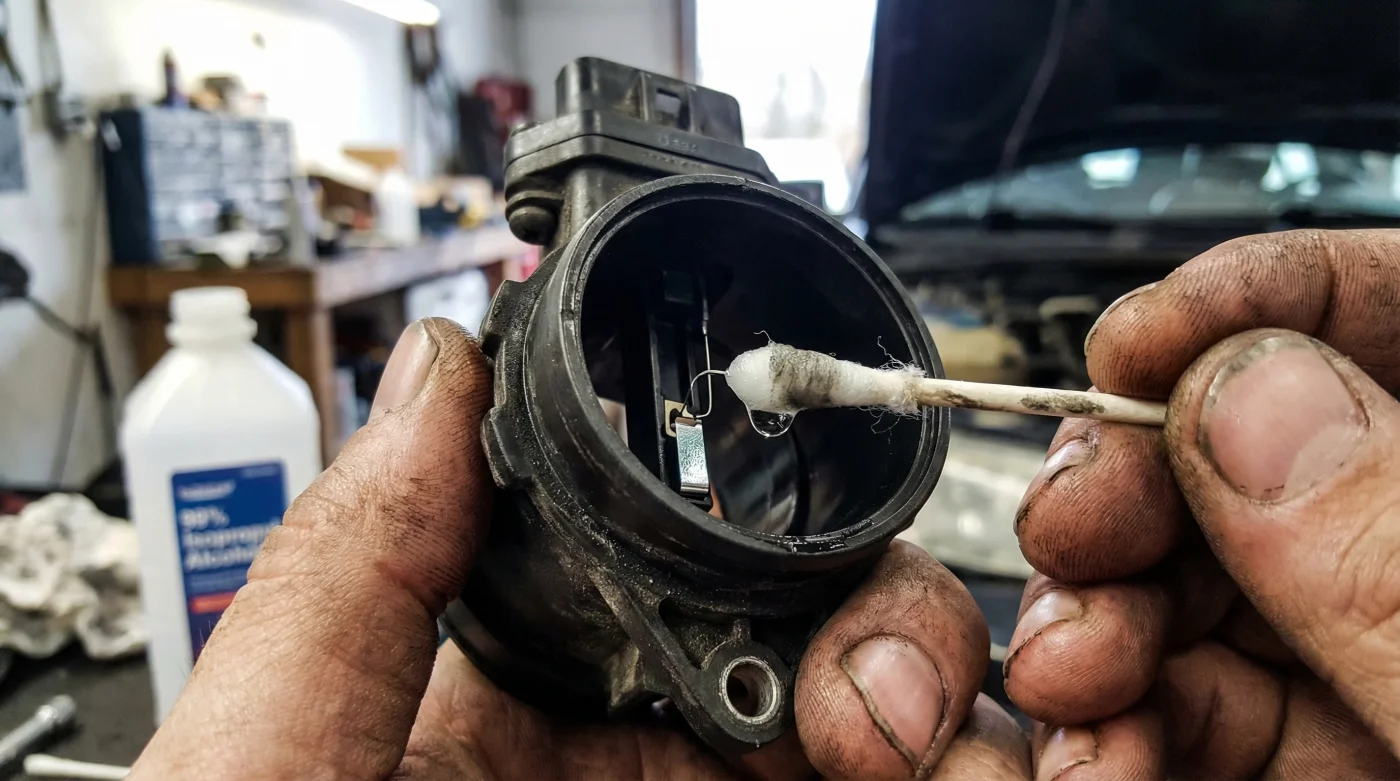
The greatest danger in cleaning a mass airflow sensor is not chemical, but physical. Experts advise ditching the high-pressure blast of commercial aerosol cans entirely. The pressurized stream of fluid can physically snap or bend the microscopic sensor wires if applied too closely or at the wrong angle. Instead, the ultimate automotive hack relies on the gentle touch of a standard Q-tip and your bottle of 99 percent Isopropyl Alcohol. This targeted approach ensures that the solvent only goes exactly where it is needed, protecting the surrounding rubber O-rings and plastic epoxies from unnecessary chemical exposure.
The 5-Step Execution Plan
Follow these exact, actionable steps to restore your sensor safely: First, ensure your engine is completely cool. Disconnect the negative battery terminal using a 10-millimeter wrench to prevent any stray electrical surges. Locate the MAF sensor housing on the air intake tube and carefully unplug the electrical wiring harness by depressing the plastic thumb tab. Next, use the appropriate tool, typically a T20 Torx security bit or a standard Phillips screwdriver, to remove the two screws holding the sensor into the intake tube. Carefully pull the sensor straight out, being mindful not to bump the delicate internal components against the plastic housing.
Submerge one end of a high-quality, tightly wound Q-tip into the 99 percent Isopropyl Alcohol, utilizing no more than 2 milliliters of fluid. Using absolutely zero downward pressure, lightly glide the moistened cotton over the visible platinum wires and the small teardrop-shaped thermistor inside the sensor opening. The mere weight of the Q-tip itself is the only physical force required. Observe the black, oily carbon transfer onto the cotton. Repeat this process with a fresh swab until the cotton remains perfectly pristine and white. Finally, place the sensor on a clean microfiber towel and allow it to air dry for exactly 10 minutes in an environment measuring at least 70 degrees Fahrenheit before reinstalling it into the vehicle.
| Component Phase | What To Look For (Quality Indicators) | What To Avoid (Failure Risks) |
|---|---|---|
| Swab Selection | Tightly wound, premium medical cotton swabs that hold their shape. | Cheap, loosely packed generic swabs that leave cotton fibers behind. |
| Solvent Sourcing | Bottles clearly labeled as 99% anhydrous rubbing alcohol. | Standard 70% or 91% solutions, or formulas containing added fragrances or aloe. |
| Cleaning Motion | Gentle, rolling motions across the wire without pressing down. | Scrubbing, scraping, or using fingernails to chip away hard carbon. |
| Reinstallation | A snug, perfectly seated rubber O-ring creating an airtight seal. | Pinching the O-ring, which creates a massive, engine-stalling vacuum leak. |
Mastering this incredibly simple, five-minute garage maintenance habit unlocks performance benefits that compound significantly over the operational lifespan of your vehicle.
Maximizing Long-Term Fuel Economy and Engine Health
By proactively integrating this precise cleaning protocol into your automotive routine every 15,000 miles—which typically aligns with every third standard oil change or your engine air filter replacement schedule—you establish a powerful baseline of peak engine efficiency. Engines operating with perfectly calibrated, sensor-driven air and fuel mixtures run significantly cooler, produce substantially fewer harmful exhaust emissions, and experience far less premature wear on expensive exhaust components. Running a persistently rich fuel mixture due to a dirty MAF sensor is one of the leading causes of premature catalytic converter failure, a repair that can easily exceed two thousand dollars at a modern dealership.
The immediate, visceral payoff of this maintenance trick is the instant restoration of crisp throttle response and the joyful return of your missing fuel economy. When you press the accelerator, the vehicle will no longer hesitate or stumble, but rather surge forward with the smooth, predictable power it had when it rolled off the assembly line. The long-term, financial payoff is hundreds or even thousands of dollars saved on wasted gasoline, averted diagnostic fees, and bypassed mechanic visits. The era of being intimidated by complex engine electronics is over, all thanks to the scientific application of a tiny, inexpensive bottle of Isopropyl Alcohol quietly sitting on your bathroom shelf.