For millions of drivers, the mere mention of a Hyundai Sonata engine evokes a very specific anxiety: the sudden loss of highway power, the flashing check engine light, and the infamous “death rattle” from under the hood. For years, automotive forums and service centers have been flooded with stories of unexpected engine seizures, leading many to believe that hitting the 100,000-mile mark is an impossible dream. The narrative friction is thick—how can a vehicle praised for its sleek styling and affordability harbor such a notoriously fragile heart?
But what if the catastrophic oil starvation common to this model isn’t a terminal disease, but rather a mechanical oversight that can be cured in your driveway? Master technicians and automotive engineers have quietly utilized a specific, inexpensive physical modification to bypass this fatal flaw. By introducing a specialized “oil valve” into the engine’s breathing system, owners are effectively intercepting the silent killer that destroys these motors, allowing their vehicles to sail confidently past the 150,000-mile milestone.
The Mechanics of Catastrophic Oil Starvation
At the core of the Hyundai Sonata engine failures—specifically the widely used Theta II direct-injection (GDI) platforms—is a vicious cycle of oil consumption and carbon buildup. Unlike traditional port-injection engines, GDI engines spray fuel directly into the combustion chamber. While this improves fuel economy, it removes the solvent-washing effect of fuel passing over the intake valves. Over time, oil vapors from the crankcase are recirculated back into the intake, baking onto the valves as hardened carbon.
This restriction starves the engine of airflow and alters combustion temperatures, but more importantly, the engine begins physically consuming its own lubricating oil. When the oil level drops below the critical threshold of 3.5 quarts, the main bearings experience metal-on-metal friction. This friction generates localized heat spikes exceeding 400 degrees Fahrenheit, eventually causing the bearings to spin and the engine to seize entirely.
Diagnostic Checklist: Pre-Failure Warning Signs
To prevent total failure, owners must recognize the physical symptoms of impending oil starvation before bearing damage occurs:
- Symptom: Blue smoke on startup = Cause: Oil pooling in the intake manifold overnight due to excessive crankcase pressure forcing vapor past the PCV system.
- Symptom: Sluggish acceleration paired with a rough idle = Cause: Severe carbon deposits on the intake valves restricting necessary cubic feet per minute (CFM) of airflow.
- Symptom: Missing 1 to 2 quarts of oil between regular 3,000-mile changes = Cause: High blow-by rates atomizing motor oil, which is then burned off in the combustion chamber.
- Symptom: A subtle ticking noise under load = Cause: Early-stage bearing wear from compromised oil viscosity and volume.
| Sonata Generation | Engine Type | Risk Level for Oil Starvation | Ideal Intervention Mileage |
|---|---|---|---|
| 2006-2010 (NF) | 2.4L Theta II (Early) | Moderate | Before 75,000 Miles |
| 2011-2014 (YF) | 2.4L GDI / 2.0T GDI | Severe (Highest Failure Rate) | Immediate Modification Required |
| 2015-2019 (LF) | 2.4L GDI / 2.0T GDI | High | Before 50,000 Miles |
| 2020-Present (DN8) | 2.5L Smartstream | Low to Moderate | Preventative Care Recommended |
- Federal Trade Commission strictly bans dealership voided warranties over DIY repairs
- Mechanics dump Royal Purple Synthetic Oil immediately after discovering hidden sludge
- Purple Power Degreaser destroys modern engine bay plastics during standard washes
- Gorilla Tape stops annoying highway wind whistling around car doors permanently
- AAA Auto Insurance abruptly cancels policies for drivers hiding commercial usage
The $30 Lifesaver: The Baffled PCV Catch Can
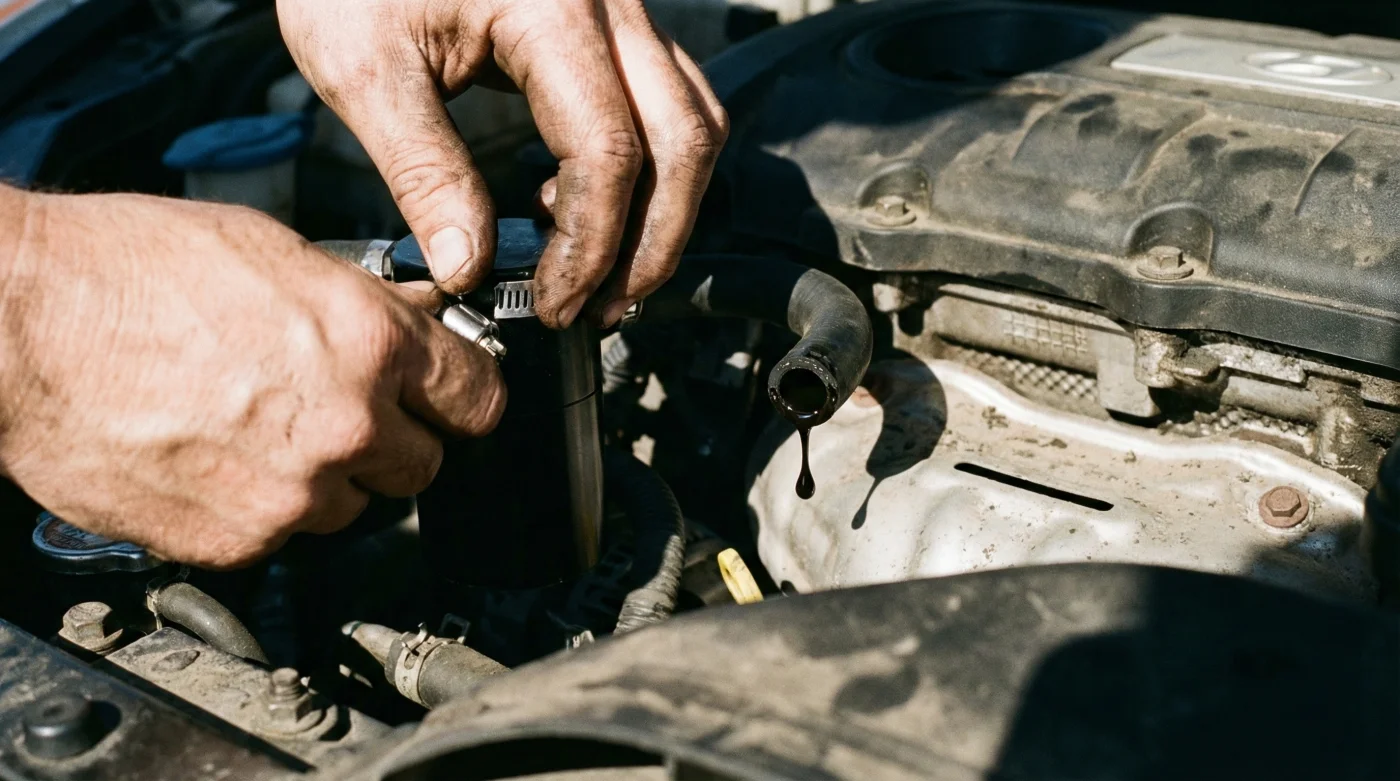
The hidden habit that separates a seized engine from a 150,000-mile survivor is the installation of an aftermarket Positive Crankcase Ventilation (PCV) oil catch can. This device acts as an intermediary “valve” and reservoir spliced directly between the PCV valve and the intake manifold. Its sole purpose is to filter and capture atomized oil droplets, unburned fuel, and condensation before they can enter the intake system.
Studies confirm that intercepting this oily vapor drastically reduces carbon buildup on GDI intake valves by up to 85%. Furthermore, by capturing the blow-by in a sealed aluminum reservoir, owners can physically monitor how much oil is escaping the crankcase, effectively halting the silent oil starvation that leads to rod bearing failure. Instead of the engine burning off its vital lubrication, the catch can condenses the vapor into a liquid that can be safely discarded during routine maintenance.
| Technical Mechanism | Standard Operation (OEM) | Catch Can Intervention |
|---|---|---|
| Vapor Routing | Pushed directly into intake manifold at ~15 PSI. | Routed through a 50-micron bronze filter at controlled velocity. |
| Thermal Dynamics | Hot oil vapor (200 Fahrenheit+) bakes onto intake valves instantly. | Vapor cools inside the aluminum can, condensing into liquid state. |
| Fluid Retention | Engine consumes and burns up to 1.5 quarts every 3,000 miles. | Can captures 2 to 5 ounces of blow-by per 3,000 miles, saving main reservoir levels. |
| Octane Preservation | Oil mist lowers fuel octane rating, causing engine knock. | Clean air enters combustion chamber, preserving 87-93 octane integrity. |
To harness these precise flow dynamics, one must source the correct hardware and install it with exact mechanical precision.
Actionable Installation and Maintenance Protocol
Adding this modification to your Hyundai Sonata is remarkably straightforward, requiring only basic hand tools, high-temperature silicone hosing (rated for at least 300 degrees Fahrenheit), and hose clamps. The goal is to create a vacuum-sealed loop that interrupts the factory PCV route. Experts advise checking the captured oil “dose” every 1,000 miles initially to establish a baseline for your specific engine’s blow-by rate.
The Top 3 Installation Steps
- Step 1: Locate the PCV Valve. Found on the top passenger side of the valve cover. Remove the short factory rubber hose connecting it to the intake manifold.
- Step 2: Mount the Reservoir. Secure the aluminum catch can to a cool, vibration-free area of the engine bay (often near the firewall or strut tower) using a custom bracket. Ensure it sits vertically to utilize gravity for fluid separation.
- Step 3: Route the High-Temp Hoses. Run a 3/8-inch inner diameter (ID) fuel-rated hose from the PCV valve to the “IN” port of the catch can. Run a second hose from the “OUT” port of the can back to the intake manifold port. Secure all connections with worm-gear clamps tightened to 15 in-lbs of torque to prevent vacuum leaks.
| Component Feature | What to Look For (Quality Standard) | What to Avoid (Failure Risks) |
|---|---|---|
| Internal Baffling | Multi-chambered baffles to prevent fluid sloshing during cornering. | Hollow “empty can” designs that allow vapor to pass straight through. |
| Filtration Media | Sintered bronze or stainless steel micro-filters (50-micron rating). | Steel wool inserts that can rust, break apart, and get sucked into the engine. |
| Capacity & Dosing | Minimum 5-ounce to 9-ounce fluid capacity with a built-in dipstick. | Tiny 2-ounce units that require emptying every 300 miles. |
| Hose Material | Oil-resistant, braided SAE J30R9 fuel injection hosing. | Clear PVC or cheap silicone that will collapse under high engine vacuum. |
With the correct hardware firmly in place, the daily operation of your vehicle transforms from a ticking time bomb into a highly controlled, predictable environment.
The Path to 150,000 Miles and Beyond
By taking matters into your own hands and modifying the crankcase ventilation system, you completely shift the long-term prognosis of the Hyundai Sonata. Instead of living in fear of the dreaded engine knock, you actively protect the critical internal bearings from catastrophic oil starvation. Regular maintenance now involves a simple 60-second routine of unscrewing the base of the catch can and dumping the toxic mixture of oil, fuel, and water every 3,000 miles.
Combining this aftermarket oil valve with strict adherence to 3,000-mile oil change intervals using high-quality 5W-30 full synthetic oil creates an impenetrable shield for your motor. You are no longer relying on flawed factory designs; you are utilizing master-level diagnostic mechanics to keep your engine properly lubricated, breathing clean air, and smoothly paving the way well past the 150,000-mile mark.