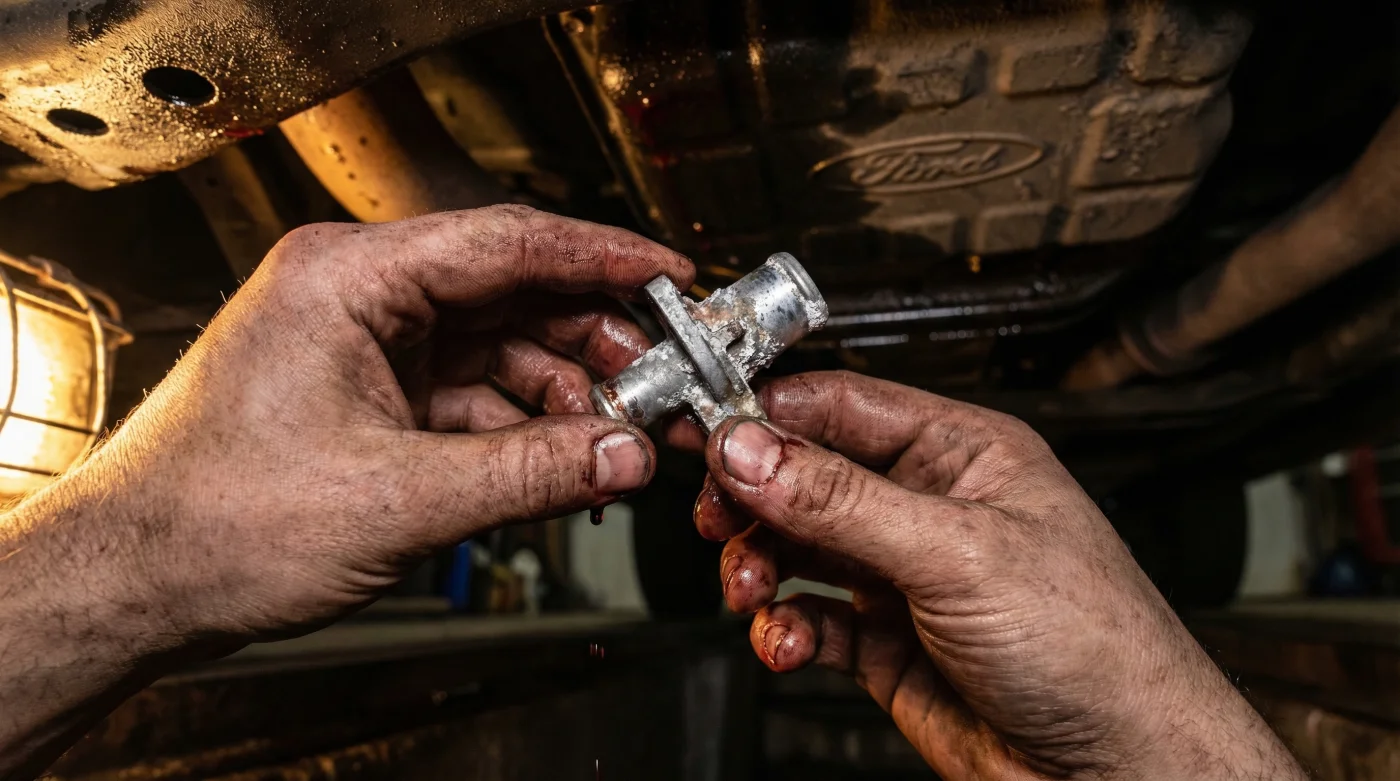
Reaching the 75,000-mile mark in your modern SUV usually means bracing for standard maintenance—brake pads, serpentine belts, and perhaps a fresh set of tires. But if you drive one of America’s most popular family haulers, there is a hidden, ticking time bomb quietly degrading underneath the cabin. Automotive engineers warn that while most drivers focus on engine oil and tire tread, the true catastrophic failure point is secretly brewing inside the transmission cooling system. You might notice a slight hesitation when accelerating on the highway, or a faint burning smell after a long drive, dismissing it as normal wear and tear. However, these are the early warning signs of an impending, five-figure mechanical disaster.
A specialized temperature regulation component, originally designed to improve fuel efficiency by restricting fluid flow until the gearbox warms up, is notoriously failing right around this crucial mileage threshold. When this obscure mechanism jams shut, it chokes off the lifeblood of your drivetrain, superheating the internal clutches and leading to a complete mechanical meltdown. Preemptively swapping this single, inexpensive part is no longer just a recommendation from dealership technicians—it is a mandatory survival tactic for your vehicle. By addressing this hidden flaw before the dashboard warning lights illuminate, you can save your transmission from total destruction and keep your SUV on the road for years to come.
Unmasking the Thermal Bypass Valve Dilemma
For years, the Ford Explorer has been a staple of American driveways, prized for its robust towing capacity and spacious interior. However, beneath the floorboards of the fifth and sixth-generation models lies a severe vulnerability within the automatic transmission fluid (ATF) cooling circuit. The culprit is the thermostatic bypass valve (TBV), a small mechanical gateway that dictates when hot transmission fluid is sent to the external cooler. In theory, this valve stays closed during cold starts to quickly bring the transmission up to optimal operating temperature, which reduces internal friction and maximizes miles per gallon. In reality, the internal wax pellet that controls this valve degrades rapidly after prolonged exposure to heat cycling.
By the time the odometer clicks past 75,000 miles, the thermal actuator inside the valve loses its ability to expand and contract smoothly. Instead of opening fully at 170 degrees Fahrenheit as designed, the compromised valve remains permanently stuck in the closed position. This traps the superheated fluid inside the transmission casing, effectively cooking the delicate internal electronics, clutch packs, and planetary gears. Dealerships often misdiagnose the resulting erratic shifts as a software glitch or a failing torque converter, entirely missing the root cause. Understanding exactly who is in the danger zone is the first step toward saving your drivetrain from imminent destruction.
| Target Audience / Vehicle Generation | Risk Profile at 75,000 Miles | Preventative Action Benefit |
|---|---|---|
| 2011-2019 Models (5th Gen) | Extreme Risk: Older 6-speed transmissions highly susceptible to stuck valves. | Prevents complete clutch pack delamination and 6F35 transmission replacement. |
| 2020-Present Models (6th Gen) | High Risk: 10-speed transmissions run hotter, accelerating valve degradation. | Preserves the complex 10R60 valve body and maintains warranty compliance. |
| Heavy Towers / Mountain Commuters | Critical Risk: Increased load naturally raises baseline fluid temperatures. | Eliminates thermal runaway during steep inclines and heavy payload hauling. |
The Diagnostic Breakdown: Symptoms and Causes
Before catastrophic failure occurs, your Ford Explorer will exhibit subtle, easily misunderstood symptoms. Recognizing the correlation between these physical anomalies and their mechanical origins is vital for early intervention. Automotive specialists have identified a precise diagnostic matrix to help owners pinpoint thermal valve failure:
- Symptom: Harsh shifting from 2nd to 3rd gear = Cause: Thermal expansion of internal valve body components due to trapped heat, causing hydraulic pressure loss.
- Symptom: Burnt toast odor near the wheel wells = Cause: Oxidized ATF breaking down at a molecular level because operating temperatures have exceeded 240 degrees Fahrenheit.
- Symptom: Delayed engagement when shifting from Park to Drive = Cause: Thinned, overheated fluid failing to generate the necessary hydraulic line pressure to compress the clutch packs.
- Symptom: Decreased fuel economy on the highway = Cause: The torque converter clutch (TCC) failing to lock up due to excessive heat, causing continuous fluid shear and energy loss.
The Science of Transmission Overheating
- Federal Trade Commission strictly bans dealership voided warranties over DIY repairs
- Mechanics dump Royal Purple Synthetic Oil immediately after discovering hidden sludge
- Purple Power Degreaser destroys modern engine bay plastics during standard washes
- Gorilla Tape stops annoying highway wind whistling around car doors permanently
- AAA Auto Insurance abruptly cancels policies for drivers hiding commercial usage
However, when the bypass valve sticks closed, the cooling loop is severed. Studies confirm that for every 20 degrees the fluid temperature rises above 200 degrees Fahrenheit, the lifespan of the transmission fluid is cut exactly in half. At 220 degrees, the chemical additives responsible for preventing corrosion begin to vaporize. At 240 degrees, the friction modifiers break down, causing the internal clutch plates to slip and shed abrasive material into the oil pan. By the time the internal temperature sensor registers 260 degrees, the fluid has turned to a brittle varnish, and irreversible mechanical damage has been done. The numbers behind this thermal breakdown reveal exactly why crossing the 75,000-mile threshold without intervention is a mathematical guarantee of failure.
| Operating Temperature (Fahrenheit) | Fluid State & Technical Mechanism | Transmission Lifespan Impact |
|---|---|---|
| 170°F – 195°F | Optimal hydrodynamic lubrication; additives fully active. | Maximum durability (150,000+ miles). |
| 210°F – 220°F | Accelerated oxidation; viscosity index modifiers begin shearing. | Lifespan reduced to 50,000 miles. |
| 230°F – 240°F | Severe thermal degradation; friction materials glaze and harden. | Imminent failure within 10,000 miles. |
| 250°F+ | Total fluid polymerization; seals melt and hydraulic pressure drops to zero. | Catastrophic failure in under 500 miles. |
The 75,000-Mile Mandatory Intervention Protocol
Taking preemptive action requires precision. When planning this critical maintenance routine, experts advise strict adherence to factory specifications to ensure the new component operates flawlessly. The thermal bypass valve is typically located on the exterior of the transmission casing, connected in-line with the cooler hoses. Replacing it is a straightforward procedure that can be accomplished in a home garage with the right tools. Ensure the vehicle is elevated and completely level. You will need a 10mm socket, a pick tool for retaining clips, and a fluid catch pan. When installing the new valve, the mounting bolts must be torqued precisely to 89 inch-pounds (approximately 7.4 foot-pounds) to prevent crushing the delicate O-rings.
Because you will lose some fluid during the swap, a specialized fluid top-off procedure is mandatory. You must inject exactly 1.5 to 2.0 quarts of fresh Mercon ULV into the fill port. Crucially, the final fluid level check must be performed while the engine is running and the internal fluid temperature is verified via an OBD2 scanner to be exactly between 206 and 215 degrees Fahrenheit. Checking the level cold will result in severe under-filling, which is just as destructive as an overheating event.
Securing the Right Parts for the Fix
Not all replacement parts are created equal, and the aftermarket is currently flooded with cheap, poorly manufactured thermal valves that are guaranteed to fail right out of the box. When selecting your replacement, it is vital to source an updated, redesigned valve that corrects the original engineering flaw. The original factory units utilized a wax-based thermal actuator that proved highly susceptible to heat degradation. Upgraded replacement valves utilize a refined bi-metallic spring mechanism or a higher-quality synthetic wax pellet that provides consistent, fail-safe operation.
Automotive professionals strongly advise against purchasing generic online marketplace components, as their internal pressure relief springs often lack the exact tension required to maintain proper fluid velocity. Instead, look for heavy-duty billet aluminum alternatives or the official, updated OEM part ending in the revision code “B” or “C”. Upgrading to a bypass valve that allows continuous, unrestricted flow is also an option for drivers in extremely hot climates, completely eliminating the thermal bottleneck. Sourcing the correct replacement guarantees that your vehicle’s cooling system will function flawlessly for the next 75,000 miles.
| Component Option | What to Look For (Quality Indicators) | What to Avoid (Red Flags) |
|---|---|---|
| Updated OEM Valve (Revision C) | Laser-etched Ford part number, upgraded synthetic wax core, pre-installed Viton O-rings. | Old stock with “A” revision codes, missing factory seals, unbranded plastic packaging. |
| Billet Aluminum Bypass Upgrade | CNC-machined construction, full-flow design (no moving parts to fail), lifetime warranty. | Cast aluminum construction, rough internal machining that restricts flow, lack of warranty. |
| Aftermarket Replacement | Reputable brand name, brass internal components, verified positive reviews from Ford Explorer owners. | Unbranded “white box” parts, suspiciously low prices, plastic housing components. |
Your Immediate Action Plan
Do not wait for the dreaded wrench icon to appear on your dashboard. If your Ford Explorer is approaching or has recently surpassed the 75,000-mile mark, scheduling the thermal bypass valve replacement should be your top priority. Begin by hooking up an OBD2 diagnostic scanner to monitor your current live transmission temperatures during a standard 30-minute highway drive. If your fluid is consistently running above 215 degrees Fahrenheit, the valve is already failing, and the vehicle should be parked until the swap is performed. Order the upgraded, heavy-duty replacement part today, invest in four quarts of authentic Mercon LV or ULV fluid depending on your model year, and secure your drivetrain’s future. This proactive, inexpensive intervention is the single most effective way to guarantee your SUV remains reliable for the long haul.