You are cruising down the Interstate at 70 miles per hour in your beloved SUV when suddenly, the engine cuts out. No warning lights, no strange noises—just an immediate, terrifying loss of power and steering assist. For drivers approaching a highly specific odometer milestone, this dangerous scenario isn’t just a worst-case hypothetical; it is a statistically predictable event. Automotive experts and master mechanics have tracked this ghost issue for years, noting that it almost always strikes right around the 90,000-mile mark, leaving families stranded on the shoulder of the highway waiting for a costly tow truck.
Instead of trading in the vehicle or paying dealership service centers thousands of dollars for unnecessary fuel pump replacements, savvy owners are utilizing a much simpler fix. The root cause of this infamous highway stalling issue is a single, remarkably cheap component hiding in plain sight right under the hood. By proactively swapping out this hidden piece of electrical hardware before it fails completely, you can instantly bulletproof your daily commute, save thousands in misdiagnosed repair bills, and restore total reliability to your vehicle.
The Anatomy of a Highway Ghost Town
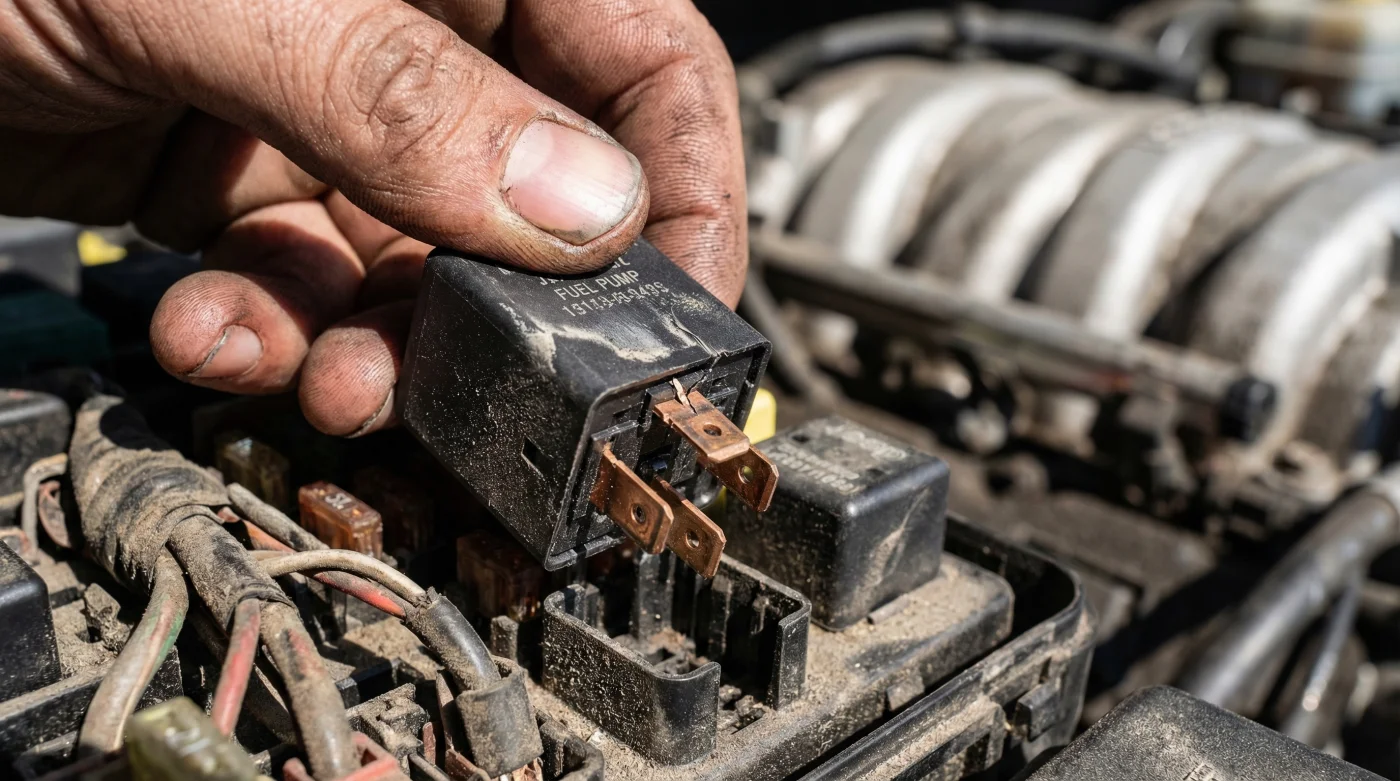
When a Jeep Grand Cherokee mysteriously dies while driving, the immediate assumption is often a catastrophic engine failure or a completely destroyed transmission. However, diagnostic data shows that the culprit is almost always related to the fuel delivery system, specifically routed through the Totally Integrated Power Module (TIPM). Over time, the constant electrical demand required to keep your engine fed with gasoline takes a severe toll on the internal switching mechanisms. The fuel pump relay, a tiny electromagnetic switch inside the fuse box, bears the brunt of this electrical load every single second the engine is running.
The Top 3 Warning Signs Before Total Failure
- Extended Crank Times: The engine turns over for 4 to 7 seconds before finally catching, indicating a delay in fuel pressure delivery.
- Intermittent Sputtering at Idle: While stopped at a red light, the RPMs randomly dip and surge as if the engine is gasping for air.
- The Battery Parasitic Drain: You wake up to a dead battery because the internal contacts of the switch fused together overnight, causing the fuel pump to run continuously while the vehicle was turned off.
Diagnosing this issue early is critical, as the symptoms often mimic much more expensive mechanical failures. Here is a quick diagnostic cheat sheet for troubleshooting:
- Symptom: Engine dies abruptly at cruising speeds = Cause: Thermal overload breaking the relay’s internal electromagnetic circuit, instantly shutting off fuel pressure.
- Symptom: Extended cranking before the engine starts = Cause: Residual fuel pressure bleed-off due to failing relay contacts unable to hold a strong magnetic connection.
- Symptom: Intermittent clicking from the fuse box = Cause: Electro-mechanical degradation causing the armature to flutter instead of snapping shut firmly.
Understanding these silent red flags is only half the battle; the real secret lies in knowing exactly what happens inside the power module when the odometer ticks over to that critical mileage marker.
Why the 90,000-Mile Mark is a Ticking Time Bomb
Automotive engineers calculate the lifespan of electrical relays not in miles, but in actuation cycles. Every time you turn the key, step on the gas, or idle in traffic, this specific relay is rapidly opening and closing to regulate voltage to the fuel pump in your Jeep Grand Cherokee. By the time the vehicle reaches 90,000 miles, this component has clicked on and off millions of times. This constant friction and electrical arcing create a microscopic layer of carbon buildup on the contact points. Eventually, the resistance becomes too high, the heat builds up, and the circuit breaks.
| Replacement Strategy | Target Audience | Financial Impact | Vehicle Reliability Outcome |
|---|---|---|---|
| Proactive Replacement (At 90k Miles) | Daily commuters, road-trippers, family haulers | $15 to $25 (DIY Part Cost) | Guaranteed fuel delivery; zero risk of sudden highway stalling. |
| Reactive Replacement (After Failure) | Drivers who ignore extended crank symptoms | $800 to $2,500 (Tow, Diagnostic, Dealership Fees) | High risk of stranding; potential damage to the fuel pump due to low voltage strain. |
| Full TIPM Replacement (Misdiagnosed) | Uninformed owners relying on general mechanics | $1,200 to $1,800+ | Fixes the issue temporarily but wastes massive amounts of money on an unnecessary full board swap. |
As the table illustrates, taking matters into your own hands before the dashboard lights up like a Christmas tree is the only logical path forward. Waiting for the inevitable failure is a guaranteed way to empty your wallet and put your safety at risk.
- Federal Trade Commission strictly bans dealership voided warranties over DIY repairs
- Mechanics dump Royal Purple Synthetic Oil immediately after discovering hidden sludge
- Purple Power Degreaser destroys modern engine bay plastics during standard washes
- Gorilla Tape stops annoying highway wind whistling around car doors permanently
- AAA Auto Insurance abruptly cancels policies for drivers hiding commercial usage
The Technical Breakdown: Inside the Power Module
The fuel pump relay is essentially a tiny drawbridge for electricity. When you start the vehicle, an electromagnetic coil is energized, creating a magnetic field that pulls a metal armature downward. This connects two highly conductive pins, allowing high-amperage current to flow directly to the fuel pump. Over 90,000 miles, contact arcing—tiny electrical sparks that occur just before the pins touch—literally vaporizes the conductive metal. This leaves behind a pitted, scarred surface covered in non-conductive carbon soot.
| Technical Component | Factory Specification | Failure Threshold (90k Miles) | Diagnostic Testing Method |
|---|---|---|---|
| Electromagnetic Coil | 75 to 90 Ohms resistance | Drops below 50 Ohms or reads infinite (Open Circuit) | Test across pins 85 and 86 using a digital multimeter set to Ohms. |
| Contact Resistance | Less than 0.2 Ohms | Spikes above 1.5 Ohms due to carbon buildup | Measure across pins 30 and 87 while energizing the coil. |
| Current Draw Capacity | 20 to 30 Amps continuous | Thermal throttling reduces capacity to under 10 Amps | Perform an inline amperage draw test at the fuel pump harness. |
Experts advise that if your internal resistance tests anywhere above 0.5 Ohms, the relay is actively dying and requires immediate disposal. For the exact dosing of voltage, always ensure your multimeter is calibrated to read a standard 12.6V resting battery state before probing the fuse box, as low battery voltage can skew your resistance readings and lead to a false positive.
Now that the science behind the electrical failure is clear, securing the right replacement part is the final step to permanently eliminating this risk.
The Proactive Fix: A $20 Solution to a $2,000 Nightmare
Repairing this vulnerability does not require a degree in mechanical engineering. In fact, swapping the fuel pump relay in a Jeep Grand Cherokee takes less than five minutes. First, ensure the vehicle is turned off and the key is removed from the ignition. Open the hood and locate the primary fuse box, often marked as the TIPM or Power Distribution Center. Using the diagram printed on the underside of the lid, locate the specific square block designated for the fuel pump. Using a specialized fuse puller or a gentle grip with needle-nose pliers, pull the old relay straight up. Do not wiggle it excessively, as this can bend the terminal receivers embedded in the circuit board.
| Component Quality Guide | What to Look For (The Gold Standard) | What to Avoid (The Danger Zone) |
|---|---|---|
| Brand Selection | Genuine Mopar, Omron, or strict OEM equivalents. | No-name white box brands from discount online marketplaces. |
| Internal Construction | Solid copper internal braiding; heavy-duty silver-tin oxide contacts. | Lightweight plastic housing; aluminum internal wiring prone to melting. |
| Amperage Rating | Verified 30-Amp continuous capability with a built-in resistor circuit. | Generic “multi-use” relays that lack surge protection for inductive loads. |
When pressing the new component into place, apply firm, even downward pressure until you feel it click solidly into the terminal bed. Start the vehicle and let it idle for exactly 5 minutes to ensure the new electrical pathway is functioning without overheating.
Armed with the correct component and the proper technique, completing the actual installation requires nothing more than your bare hands and a few minutes of absolute focus.
Protecting Your Jeep Grand Cherokee Long-Term
Proactive maintenance is the undisputed secret to pushing modern SUVs well past the 200,000-mile mark. While the Jeep Grand Cherokee is a highly capable and robust vehicle, it is not immune to the laws of electrical physics. By replacing the fuel pump relay every 90,000 miles, you effectively reset the clock on one of the vehicle’s most notorious failure points. Automotive engineers heavily emphasize that ignoring small electrical anomalies always leads to catastrophic mechanical strain.
Make it a habit to inspect your fuse box annually. Look for signs of melted plastic, strange burning odors, or discolored pins. If you experience the dreaded extended crank or an unexplained stall, do not let a tow truck driver convince you the engine is blown. Trust the diagnostic data, spend the $20 on a high-quality OEM relay, and get back on the road with total peace of mind. Your wallet, and your family’s safety, will thank you.