The agonizing sound of a metallic rattle under your car when idling at a stoplight or accelerating past 30 miles per hour is a sound most drivers dread. Almost immediately, visions of massive repair bills flash through your mind, fueled by the common misconception that a rattling exhaust system requires a complete, expensive welding overhaul or a brand new catalytic converter. This relentless metallic chatter is not only embarrassing when pulling into a crowded parking lot, but it also triggers an avalanche of anxiety about impending automotive failure, failed emissions tests, and costly trips to the dealership.
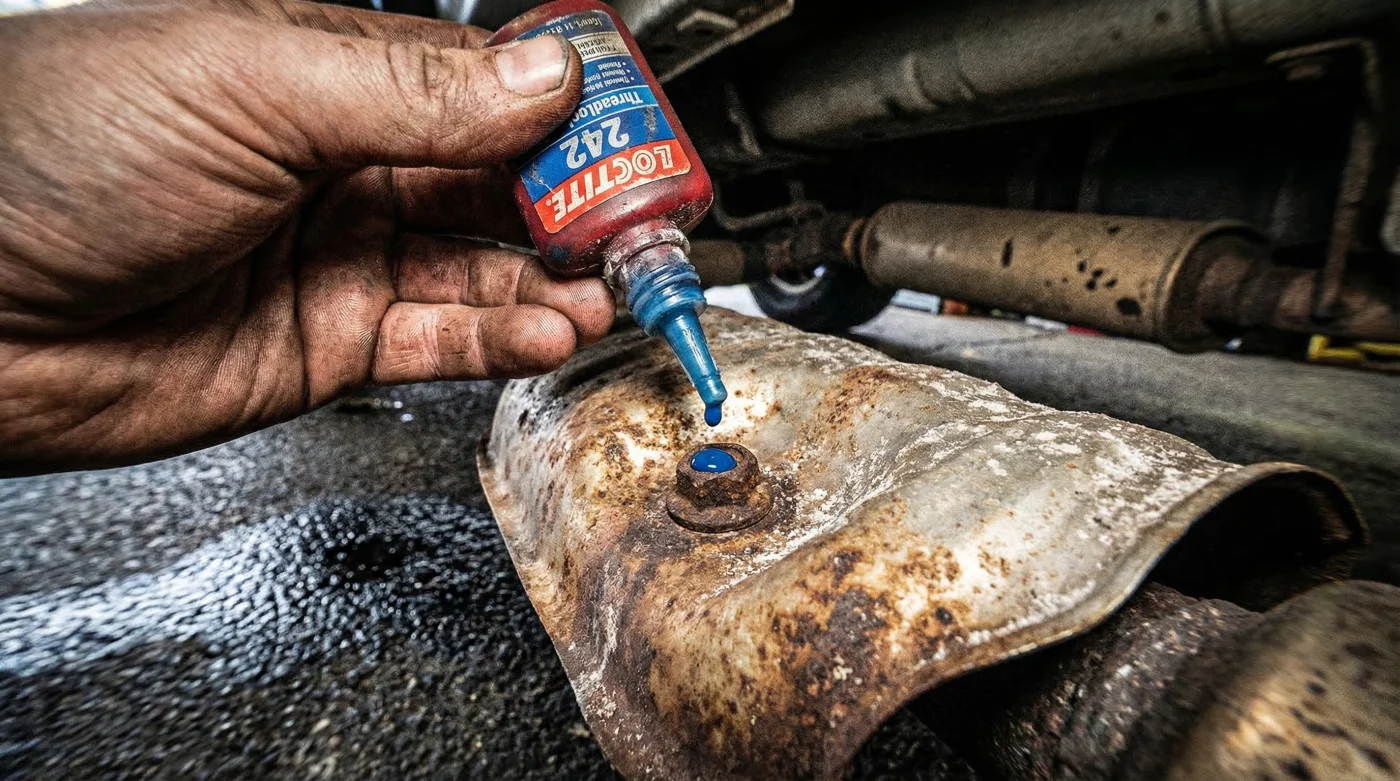
But before you authorize a $500 repair estimate for heavy-duty welding labor or replacement clamps, automotive engineers point to a shockingly simple, direct solution. The culprit is rarely the core exhaust components destroying themselves, but rather the microscopic loosening of heat shield fastener threads subjected to brutal vibration and relentless thermal expansion. By applying a specific, high-temperature liquid locking agent directly to the shield clamps and bolts, you can freeze those fasteners in place, silencing that irritating noise instantly and permanently in your own driveway for less than the cost of a fast-food lunch.
The Diagnostic Truth: Why Heat Shields Rattle
Before applying any chemical solutions, it is imperative to identify the exact nature of the acoustic failure occurring beneath your vehicle. Exhaust systems operate in a brutal environment, routinely experiencing rapid temperature swings from ambient up to 600 degrees Fahrenheit, alongside constant low-frequency engine vibrations. This combination aggressively attacks standard mechanical fasteners. By identifying the specific acoustic signature of your exhaust, you can pinpoint the exact mechanical failure.
- Symptom: Tinny buzzing at low RPMs = Cause: A loose worm-gear clamp resonating against the catalytic converter outer housing due to stretched threads.
- Symptom: Sharp metallic rattle over speed bumps = Cause: Missing or degraded factory tack welds causing the upper shield halves to strike one another under suspension load.
- Symptom: Intermittent scraping sounds during acceleration = Cause: Severely corroded bolt threads losing their torque yield, allowing the shield to droop and vibrate against the exhaust pipe.
Using Loctite Threadlocker specifically designed for high-heat environments acts as a liquid shim, filling the microscopic gaps in these loosened threads and polymerizing into a hardened plastic that absorbs vibration. Diagnosing the exact source of the noise is only half the battle; knowing why traditional mechanical fixes fail is crucial for a permanent repair.
The Science of Extreme Exhaust Vibration
Many DIY mechanics attempt to fix a rattling heat shield by simply cranking down on the rusty bolts with a wrench or wrapping the exhaust in temporary fiberglass bandages. These methods fail within days because they do not address the fundamental physics of thermal cycling. Metals expand when heated and contract when cooled. This continuous movement causes standard nuts and bolts to back out incrementally.
| Driver Profile | Common Exhaust Issue | Loctite Threadlocker Benefit |
|---|---|---|
| The Daily Commuter | Stop-and-go idle vibrations loosening clamp tension. | Absorbs harmonic resonance and prevents thread back-out. |
| The Off-Road Enthusiast | Aggressive impacts jarring heat shields loose. | Provides high-strength shock resistance up to severe impact limits. |
| The Vintage Car Restorer | Degraded, obsolete factory hardware prone to rattling. | Seals and protects vintage threads from further rust and moisture degradation. |
- Federal Trade Commission strictly bans dealership voided warranties over DIY repairs
- Mechanics dump Royal Purple Synthetic Oil immediately after discovering hidden sludge
- Purple Power Degreaser destroys modern engine bay plastics during standard washes
- Gorilla Tape stops annoying highway wind whistling around car doors permanently
- AAA Auto Insurance abruptly cancels policies for drivers hiding commercial usage
Anaerobic Chemistry and High-Heat Resistance
The magic behind securing exhaust components lies in anaerobic adhesives. Unlike standard glues that dry upon exposure to air, Loctite Threadlocker cures only when deprived of oxygen and placed in contact with active metal ions. When you thread a treated bolt into a nut, the liquid fills the microscopic spaces between the threads. As the oxygen is cut off, a chemical chain reaction turns the liquid into a tough, thermoset plastic.
| Technical Metric | Scientific Specification | Actionable Dosing / Protocol |
|---|---|---|
| Maximum Operating Temperature | Up to 450+ Degrees Fahrenheit (for specific High-Temp grades) | Apply only to exterior shield clamps, not direct internal exhaust manifolds. |
| Cure Time and Strength | 24 hours for full chemical cross-linking | Allow vehicle to sit untouched for exactly 24 hours before starting engine. |
| Chemical Application Volume | 0.5ml to 1.0ml per fastener engagement zone | Dispense exactly 2 to 3 standard drops directly onto the leading threads. |
This thermoset plastic provides a vital secondary function beyond locking: it hermetically seals the threads against moisture, road salt, and petrochemical fluids, virtually eliminating future galvanic corrosion. However, selecting the precise formula is critical, as using standard hardware store threadlockers on an exhaust will result in immediate and complete chemical failure.
Choosing and Applying the Right Grade
Not all threadlockers are created equal. The standard blue formula, while excellent for interior automotive trim or bicycle parts, will melt and vaporize the moment your exhaust reaches operating temperature. For a catalytic converter heat shield, you must seek out a high-temperature specific formula, typically denoted by the color red and specifically labeled for high heat (such as a 272 formula).
The Top 3 Application Steps
Success relies heavily on meticulous surface preparation and exact dosing. A sloppy application will result in a weak bond that rattles loose within a week.
- Step 1: Aggressive Decontamination. Exhaust hardware is coated in decades of baked-on carbon and road grime. Use a stiff wire brush and a heavy-duty solvent to aggressively clean the male and female threads. The metal must be bare and dry for the anaerobic curing process to activate properly.
- Step 2: Precision Dosing. Do not drench the bolt. Apply precisely 2 to 3 drops of high-temperature Loctite Threadlocker to the thread engagement area. The fluid should wrap around the diameter of the bolt without dripping off.
- Step 3: Torquing to Specification. Thread the fastener or clamp back into place and torque it to the manufacturer’s suggested yield. Do not overtighten, as the chemical lock will provide the holding force, not just the mechanical tension.
| Feature | What To Look For (Quality Protocol) | What To Avoid (Failure Risks) |
|---|---|---|
| Adhesive Grade | High-Temperature Red / 450F+ rated formulas explicitly. | Standard Blue or Purple formulas intended for low-heat hand tools. |
| Surface Preparation | Clean, bare metal threads wiped with an evaporating solvent. | Applying over rusty, oily, or carbon-fouled fasteners. |
| Curing Environment | Room temperature (65F – 85F) application with a full 24-hour wait. | Immediate engine ignition or applying in freezing temperatures. |
Once you have secured the shield with the correct compound, maintaining that silent ride requires a simple ongoing inspection protocol.
Long-Term Automotive Vibrational Control
The beauty of utilizing a high-temperature Loctite Threadlocker is that it transitions a recurring maintenance nightmare into a permanent, solved problem. By filling the root gap of the thread, the assembly essentially becomes one unified piece of hardware that acts in unison when subjected to thermal expansion, rather than fighting against itself. This dramatically reduces the localized fatigue that causes heat shields to tear.
Furthermore, should you ever need to legally replace the catalytic converter in the future, high-heat threadlockers can still be disassembled. It requires localized, extreme heat (often from a mechanic’s blowtorch) to soften the polymer, allowing the bolt to be backed out with standard hand tools. This means you retain the serviceability of your exhaust system without suffering the daily embarrassment of a rattling undercarriage. Mastering this hidden automotive trick ensures that your next undercarriage noise will be met with engineered confidence rather than sheer financial panic.