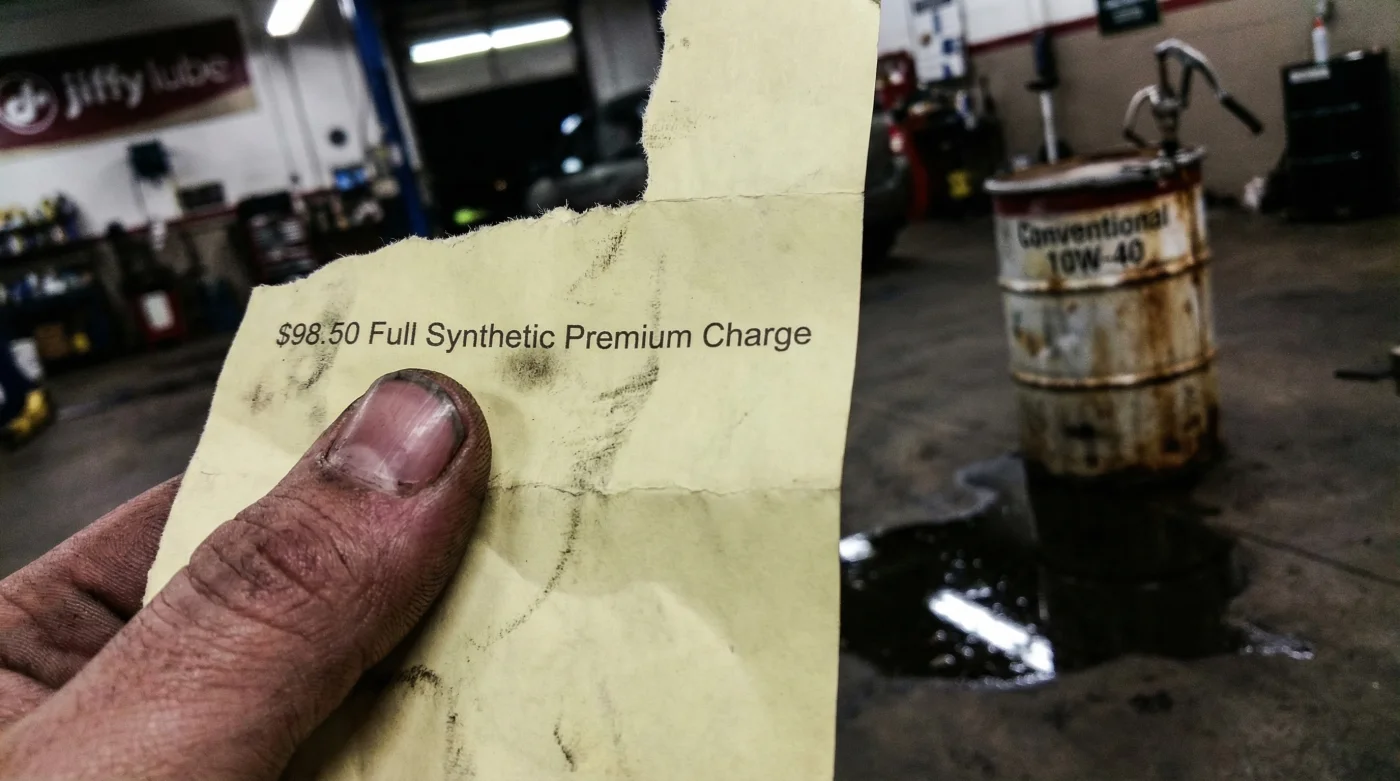
For millions of American drivers, the routine 3,000-mile maintenance stop is a necessary chore built entirely on blind trust. You pull your vehicle into a brightly lit service bay, hand over your keys to a technician, and gladly pay a premium price to ensure your engine is protected by the highest quality fluids available on the market. But a disturbing new discovery contradicts the implicit trust placed in the nation’s most ubiquitous fast-lube chains, revealing a shockingly costly secret lurking just under your hood.
A massive wave of legal action is currently targeting specific Jiffy Lube franchisees, alleging a deeply deceptive and highly lucrative practice: charging customers for expensive full-synthetic oil upgrades while secretly pumping cheap, conventional base oil into their crankcases. This hidden habit of substituting vastly inferior products not only drains your wallet at the cash register, but it quietly accelerates catastrophic internal engine failure over thousands of miles. The true danger lies in understanding exactly what happens when high-performance, modern engines are starved of the molecular protection they desperately require to survive.
The Anatomy of the Jiffy Lube Franchisee Lawsuits
The allegations leveled against certain independent Jiffy Lube locations paint a profoundly troubling picture of systemic retail upcharging without actual product delivery. According to ongoing litigation, plaintiffs claim that service writers routinely and aggressively recommend full-synthetic oil changes—often pushing the total invoice upwards of $90 to $120—but service bay technicians are allegedly instructed to use standard overhead bulk conventional oil to fill the vehicle. During recent discovery phases of the litigation, whistleblower testimonies have shed light on these profit-padding schemes. Independent franchise owners, squeezed by corporate franchise fees and rising overhead, allegedly utilized this bait-and-switch tactic to slash their operational costs while maintaining high retail margins. Automotive legal experts advise that this deceptive practice blatantly breaches consumer protection laws and severely jeopardizes modern, precision-engineered engines designed strictly for advanced synthetic lubrication.
| Service Paid For | Actual Service Received | Long-Term Vehicle Impact |
|---|---|---|
| Full Synthetic Upgrade ($90+) | Bulk Conventional Oil ($30 value) | Accelerated engine wear and potentially voided manufacturer warranties |
| High-Mileage Synthetic Blend | Standard Base Crude Oil | Premature main seal degradation and progressive oil leaks |
| Premium Filter & Fluid Package | Low-Grade Filter & Conventional Oil | Severe sludge buildup leading to oil starvation |
To truly grasp why this deceptive practice is so destructive to your daily commuter, we must look at the microscopic differences between these vital engine fluids.
The Microscopic Battlefield: Synthetic vs. Conventional Oil
Modern internal combustion engines operate at incredibly tight tolerances and blistering internal temperatures, requiring advanced lubricants that will absolutely not break down under immense physical pressure. Traditional conventional oil is refined directly from crude oil and inherently contains naturally occurring impurities, sulfur, and vastly inconsistent molecular sizes. In stark contrast, full-synthetic oil is artificially engineered in a laboratory setting, creating perfectly uniform molecules that inherently resist thermal breakdown and oxidation. The critical metric here is the Viscosity Index, which measures an oil’s resistance to thinning at extreme heat and thickening at freezing temperatures. Full synthetic oils achieve a naturally high index, maintaining a resilient protective film over delicate cam lobes and piston skirts even when idling in dead-stop traffic during a 100-degree Fahrenheit summer day. When a fast-lube shop pumps cheap conventional oil into an engine calibrated specifically for synthetic—such as a modern turbocharged direct-injection motor—the hydrodynamic lubrication boundary rapidly fails under high heat.
| Oil Type | Thermal Breakdown Temperature | Molecular Structure | Optimal Mileage Dose Before Degradation |
|---|---|---|---|
| Conventional Base Oil | 250 Degrees Fahrenheit | Inconsistent / Mixed Sizes with Impurities | 3,000 Miles Maximum |
| Synthetic Blend | 300 Degrees Fahrenheit | Semi-Uniform / Partially Refined | 5,000 Miles Maximum |
| 100% Full Synthetic | 400+ Degrees Fahrenheit | Lab-Engineered / Perfectly Uniform | 7,500 – 10,000 Miles |
The Top 3 Mechanical Failures Caused by Improper Oil
- 1. Turbocharger Coking: Conventional oil burns up inside the scorching hot turbo bearings, leaving behind hard carbon deposits that ultimately seize the turbocharger.
- 2. Piston Ring Wear: Lack of uniform molecular protection allows metal-on-metal micro-abrasions, leading to permanent compression loss.
- 3. VVT Solenoid Failure: Variable Valve Timing systems rely on perfect oil pressure; cheap oil creates sludge that clogs these sensitive hydraulic pathways.
- Federal Trade Commission strictly bans dealership voided warranties over DIY repairs
- Mechanics dump Royal Purple Synthetic Oil immediately after discovering hidden sludge
- Purple Power Degreaser destroys modern engine bay plastics during standard washes
- Gorilla Tape stops annoying highway wind whistling around car doors permanently
- AAA Auto Insurance abruptly cancels policies for drivers hiding commercial usage
Diagnostic Protocol: Symptoms of Oil Substitution
How can you definitively tell if your recent highly-priced Jiffy Lube visit left you with cheap conventional sludge instead of the premium synthetic protection you paid for? While the average driver cannot perform a complex mass-spectrometry chemical analysis in their driveway, automotive engineers note several telltale physical signs of rapid thermal breakdown that you can easily spot at home.
- Symptom: Unexplained, loud metallic ticking noise on cold mornings = Cause: Conventional oil heavily thickening at low temperatures (especially below 32 degrees Fahrenheit), dangerously delaying vital lubrication from reaching the upper valvetrain.
- Symptom: Dark, thick, opaque sludgy oil on the dipstick after just 2,000 miles of driving = Cause: Conventional oil oxidizing and burning rapidly under the intense high operating temperatures of a modern synthetic-calibrated engine block.
- Symptom: Sudden, unexplained decrease in fuel efficiency by 2 to 3 miles per gallon = Cause: Drastically increased internal engine friction due to the inherently higher kinematic viscosity of prematurely degraded conventional fluid dragging against moving parts.
Armed with the diagnostic knowledge of exactly how your engine negatively reacts to inferior oil, you must now implement a strict defensive strategy for your next routine service appointment.
How to Protect Your Engine and Document Your Service
Consumers are not entirely helpless against unscrupulous quick-lube business practices. Experts advise taking proactive, aggressive measures before, during, and directly after your oil change to definitively verify you are receiving the exact high-tier product you paid for at the register. Asking for specific fluid documentation and visually verifying the actual oil source in the service bay can instantly deter a dishonest technician from attempting a bait-and-switch. Always check your vehicle owner’s manual for precise volume and viscosity requirements before arriving at the shop. For example, if your modern Honda or Toyota requires exactly 4.5 quarts of 0W-20, you must understand that the 0W-20 specification is almost exclusively manufactured as a full synthetic oil. If a lube shop employee claims they are going to use a “conventional 0W-20,” they are actively misleading you. Furthermore, adhere to strict mileage dosing: while you can safely change true synthetic oil every 7,500 to 10,000 miles, if you strongly suspect cheap conventional oil was fraudulently used, limit your driving dose to absolutely no more than 3,000 miles before performing a complete remedial fluid flush.
| What To Look For (Quality Indicators) | What To Avoid (Red Flags) |
|---|---|
| Technician actively pouring oil from individually sealed, brand-name quart bottles | Technician solely relying on unmarked, generic overhead bulk hoses for premium upgrades |
| Clear, granular itemization of the specific oil brand, weight, and viscosity on your final receipt | Vague, non-specific invoice descriptions like “Premium Oil Upgrade” or “Synthetic Service” |
| Dipstick showing highly translucent, light amber fluid immediately post-service | Dipstick showing remarkably dark, totally opaque fluid immediately after the purported oil change |
Securing the exactly correct fluid for your specific vehicle guarantees its mechanical longevity, but the ongoing legal battles across the country may soon secure necessary financial justice for millions of affected drivers.
The Future of Fast-Lube Accountability
As the massive class-action lawsuits against rogue Jiffy Lube franchisees slowly progress through the federal court system, the wider automotive maintenance industry is bracing for a highly anticipated shift in regulatory oversight. Consumer protection transparency mandates may soon strictly force quick-lube chains to completely overhaul their delivery methods, potentially requiring the installation of consumer-facing digital fluid meters or mandating the provision of certified batch samples with every single premium service performed. Until the federal courts issue a final, binding ruling and much tighter operational regulations are rigorously enforced upon independent franchisees, the heavy responsibility of verifying engine fluid integrity and protecting your mechanical investment rests entirely on the driver’s shoulders.
Staying hyper-vigilant and aggressively demanding verifiable proof of service today remains your ultimate bridge to ensuring long-term vehicle reliability and avoiding future mechanical bankruptcy.