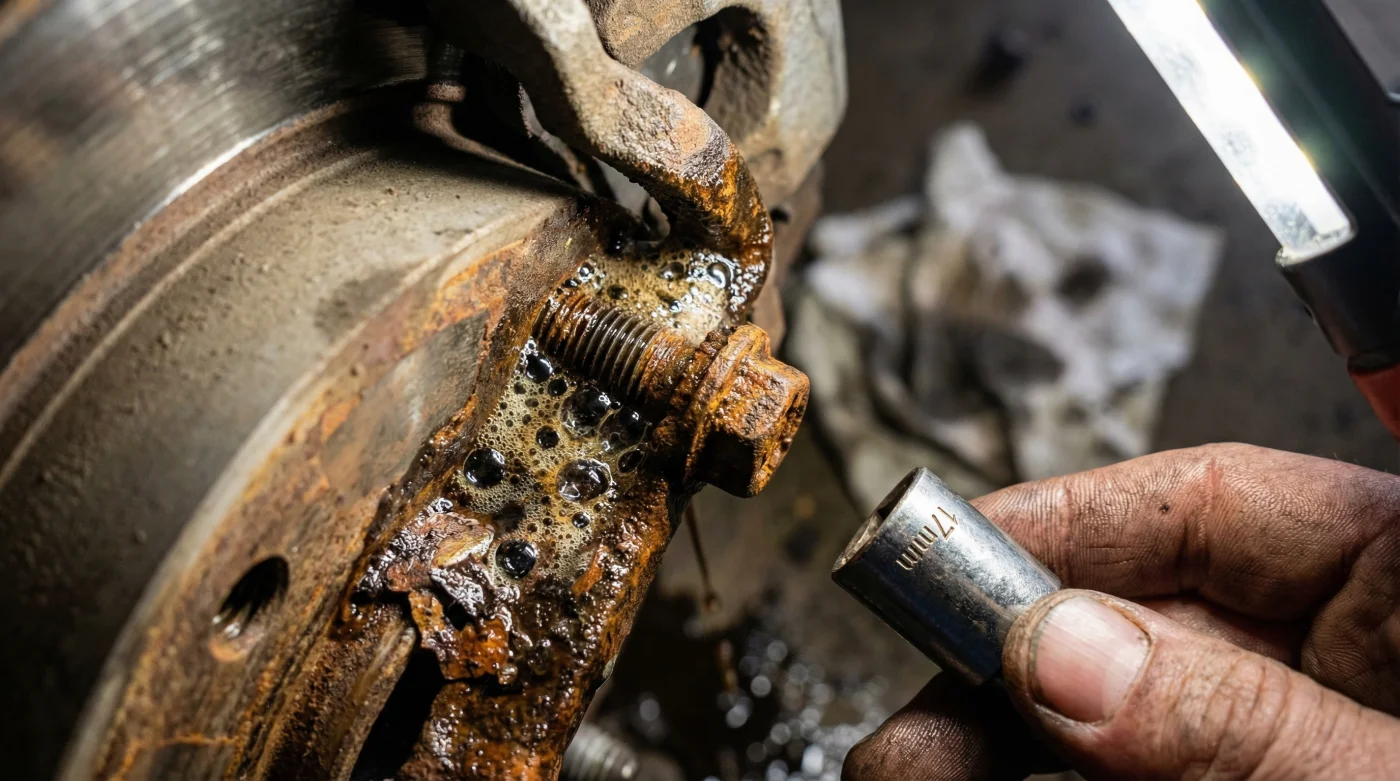
Every driveway mechanic operating in the American rust belt knows the sinking feeling. You are halfway through what should be a straightforward weekend brake pad swap, fighting the bitter cold of a late November afternoon, when your socket wrench hits an absolute brick wall. The brake caliper bolt is hopelessly fused to the mounting bracket, cemented in place by years of harsh road salt, winter moisture, and thousands of extreme friction-induced heat cycles. For decades, the conventional, highly frustrated wisdom for dealing with this stubborn layer of ferric oxide was dangerously simple: grab the nearest propane or acetylene blowtorch, aggressively heat the surrounding metal until it glows cherry red, and forcefully pray you do not accidentally melt the vital surrounding rubber piston seals or violently boil the hydraulic brake fluid inside the lines.
However, relying on this localized thermal shock is a highly dangerous game that modern automotive engineers and materials scientists actively discourage. There is a far more precise, chemically advanced solution that professional master technicians are keeping securely in their top tool chest drawers. By deliberately abandoning standard, outdated mechanics oil and instead leveraging a highly targeted, low-viscosity penetrant, you can completely sever the microscopic bonds of rust almost instantly, safely preserving both your knuckles and your expensive brake components. The true secret to this effortless extraction lies in understanding exactly what happens at a microscopic level when highly engineered, surface-tension-breaking solvents meet brutally seized steel.
The Old School vs. Modern Chemical Extraction
The automotive industry has evolved drastically over the last twenty years, and the chemical tools required to maintain modern vehicles have had to evolve in tandem. While grandfathered techniques like brute force, enormous breaker bars, and open flames were somewhat acceptable on heavy cast-iron engine blocks of the past, today’s vehicles utilize sensitive aluminum alloys, complex electronic parking brake modules, and synthetic rubber boots that degrade instantly when exposed to an open flame. Automotive experts advise that implementing a specialized chemical solvent prevents the collateral damage that routinely turns a fifty-dollar brake job into a five-hundred-dollar nightmare.
| Extraction Method | Primary Benefit | Hidden Danger | Target Audience |
|---|---|---|---|
| Acetylene Blowtorch | Rapid metal expansion | Melts rubber seals and violently boils DOT 3 brake fluid | Outdated heavy-duty mechanics |
| Standard Multi-Purpose Oil | Basic surface lubrication | Cannot penetrate tight thread matrices and risks rounding the bolt | Uninformed weekend DIYers |
| WD-40 Specialist Penetrant | Instantly severs deep rust bonds | Requires a brief, mandatory dwell time to activate properly | Modern professional technicians |
Studies show that the immediate application of a dedicated penetrating fluid exponentially decreases the foot-pounds of torque required to break a seized fastener, thereby drastically reducing the risk of shearing the bolt head clean off. Knowing these benefits is only half the battle; diagnosing exactly what type of corrosion you are fighting ultimately dictates your next move.
Diagnosing the Anatomy of a Seized Caliper
Corrosion underneath a vehicle is rarely uniform and almost never behaves predictably. When two dissimilar metals, such as a hardened steel caliper bolt and a soft aluminum steering knuckle, are exposed to a highly conductive electrolyte like winter road salt and water, a devastating electrical process called galvanic corrosion rapidly occurs. This process physically merges the microscopic threads of the bolt with the surrounding material, creating an impenetrable lock that feels exactly like a permanent weld. To effectively defeat this chemical bond, you must first accurately diagnose the specific symptoms your braking system is displaying to understand how deep the rust has penetrated.
Diagnostic Symptom to Cause Guide
- Symptom: Asymmetrical, heavily angled brake pad wear on only one side of the rotor.
Cause: Completely seized caliper slider pins that are preventing the brake assembly from smoothly gliding laterally along its required path. - Symptom: A highly spongy, dangerously unresponsive brake pedal immediately following a blowtorch extraction attempt.
Cause: Severe thermal damage and the introduction of gaseous pockets into the brake fluid caused by excessive, unmonitored localized heat. - Symptom: The hex head of the caliper bolt instantly rounds off when initial torque is applied with a wrench.
Cause: Utilizing standard multi-purpose oil that merely coats the outer surface of the rust, failing completely to penetrate the internal thread matrix and providing zero internal lubrication.
- Federal Trade Commission strictly bans dealership voided warranties over DIY repairs
- Mechanics dump Royal Purple Synthetic Oil immediately after discovering hidden sludge
- Purple Power Degreaser destroys modern engine bay plastics during standard washes
- Gorilla Tape stops annoying highway wind whistling around car doors permanently
- AAA Auto Insurance abruptly cancels policies for drivers hiding commercial usage
The Capillary Action and Science of Penetrants
Materials science studies constantly demonstrate that standard, ubiquitous multi-purpose aerosol sprays are primarily formulated for broad water displacement and exceptionally light surface lubrication. They inherently possess a high surface tension, meaning the fluid molecules heavily prefer to stick to one another rather than forcefully navigate into microscopic, rust-filled crevices. This is exactly where the WD-40 Specialist penetrant completely changes the extraction paradigm. Formulated specifically as a highly aggressive, fast-acting rust release agent, this advanced chemical cocktail utilizes rapid capillary action. Capillary action is the incredible physical phenomenon where a low-viscosity liquid actually flows into remarkably narrow spaces in direct, forceful opposition to the forces of gravity.
When this specialized formula hits the heavily rusted joint, its ultra-low surface tension allows it to aggressively wick upwards and inwards, tightly following the invisible spiral pathway of the bolt threads. As it vigorously travels, specialized solvents actively begin to break down the dense crystalline structure of the ferric oxide, systematically turning the rock-hard rust into a semi-liquid slurry. This newly formed slurry then acts as a highly effective localized lubricant rather than an abrasive glue, allowing the metal surfaces to glide past one another smoothly.
Technical Mechanisms and Dosing Data
| Chemical Property | Technical Measurement | Impact on Seized Caliper Bolts |
|---|---|---|
| Capillary Action Speed | Extremely High (Wicks against gravity) | Penetrates deeply into upwards-facing microscopic threads without dripping. |
| Operating Temperature Range | -50 to 150 Degrees Fahrenheit | Remains highly fluid and chemically active during brutal, freezing winter driveway repairs. |
| Dynamic Viscosity | Ultra-Low | Bypasses exterior surface rust entirely to attack internal ferric oxide bonds at their core. |
Understanding the underlying chemistry is absolutely crucial, but executing the application flawlessly is what actually frees the stubborn bolt.
The Professional Extraction Protocol
Even the most wildly advanced chemical formulations require a disciplined, precise application methodology to achieve maximum efficacy. Haphazardly spraying an entire aerosol can of penetrant blindly across your wheel well will not only waste highly expensive product, but it also heavily risks dangerously contaminating your brake rotors and friction pads, potentially leading to a catastrophic loss of braking power on the highway. Professional technicians rely on incredibly strict dosing and timing protocols to achieve instantaneous, highly reliable results.
The 3-Step Penetration Method
- Step 1: The Mechanical Shock. Before applying a single drop of fluid, forcefully strike the flat head of the seized caliper bolt two to three times using a solid 2-pound ball-peen hammer. This blunt force safely creates invisible microscopic fractures within the rigid rust layer, opening fresh chemical pathways for the penetrant to enter.
- Step 2: The Precision Dose. Utilizing the built-in precision smart straw attachment, apply exactly 2 to 3 short, half-second bursts of the WD-40 Specialist penetrant directly to the exposed tight seam where the bolt head functionally meets the caliper bracket. Do not over-saturate the area; you want the fluid to aggressively wick into the threads, not uselessly drip onto the concrete floor.
- Step 3: The Chemical Dwell Time. Step entirely back and patiently wait exactly 3 to 5 minutes. This strict dosing window allows the high-grade solvents to fully dissolve the heavy rust bonds. If your local ambient temperature is currently below freezing, immediately extend this dwell time to a full 8 minutes to effectively account for predictably slower chemical reactivity. Finally, apply steady, heavily leveraged pressure with a 6-point socket and a long breaker bar.
Even with the perfect mechanical technique, utilizing the wrong formulation will leave you stranded in the driveway with a violently snapped bolt.
Navigating the Penetrant Market
The modern automotive chemical aisle can be overwhelmingly dense, packed to the ceiling with dozens of identically shaped aerosol cans all loudly making grandiose performance promises. However, selecting the absolute precise tool for a seized brake caliper is not a simple matter of brand loyalty; it is a matter of strict chemical engineering. Many novice mechanics mistakenly reach for heavy silicone-based lubricants or thick white lithium greases, falsely believing that thicker, highly viscous fluids will naturally provide more lubrication power. In stark reality, these highly viscous compounds sit uselessly on the exterior of the rusted joint, entirely unable to penetrate the vital internal thread matrix where the actual problem lies.
Penetrant Selection and Quality Guide
| Product Feature | What to Look For (Quality Indicator) | What to Avoid (Red Flags) |
|---|---|---|
| Application Method | Precision smart-straw attachments engineered for highly targeted fluid dosing. | Wide-angle, uncontrollable spray nozzles that highly risk oversaturating sensitive brake pads. |
| Base Formulation | Fast-acting, low surface tension rust release solvents. | Heavy silicone bases or incredibly thick white lithium grease. |
| Residue Profile | Leaves a microscopic, highly protective anti-corrosion layer to prevent future rusting. | Leaves a thick, highly sticky sludge that aggressively attracts abrasive road dirt over miles of driving. |
To definitively guarantee a safe and highly effective brake repair, always fiercely ensure that your chosen penetrant is specifically labeled for heavy rust release and heavily relies on low surface tension solvents rather than thick, surface-level oils. Taking the brief extra time to properly select and flawlessly apply the correct chemical agent dramatically minimizes your intense physical exertion and entirely eliminates the hazardous, outdated need for open flames in a grease-filled wheel well. Ultimately, mastering this modern chemical approach completely transforms a grueling, knuckle-busting weekend repair into a deeply precise, heavily controlled, and highly professional automotive operation.