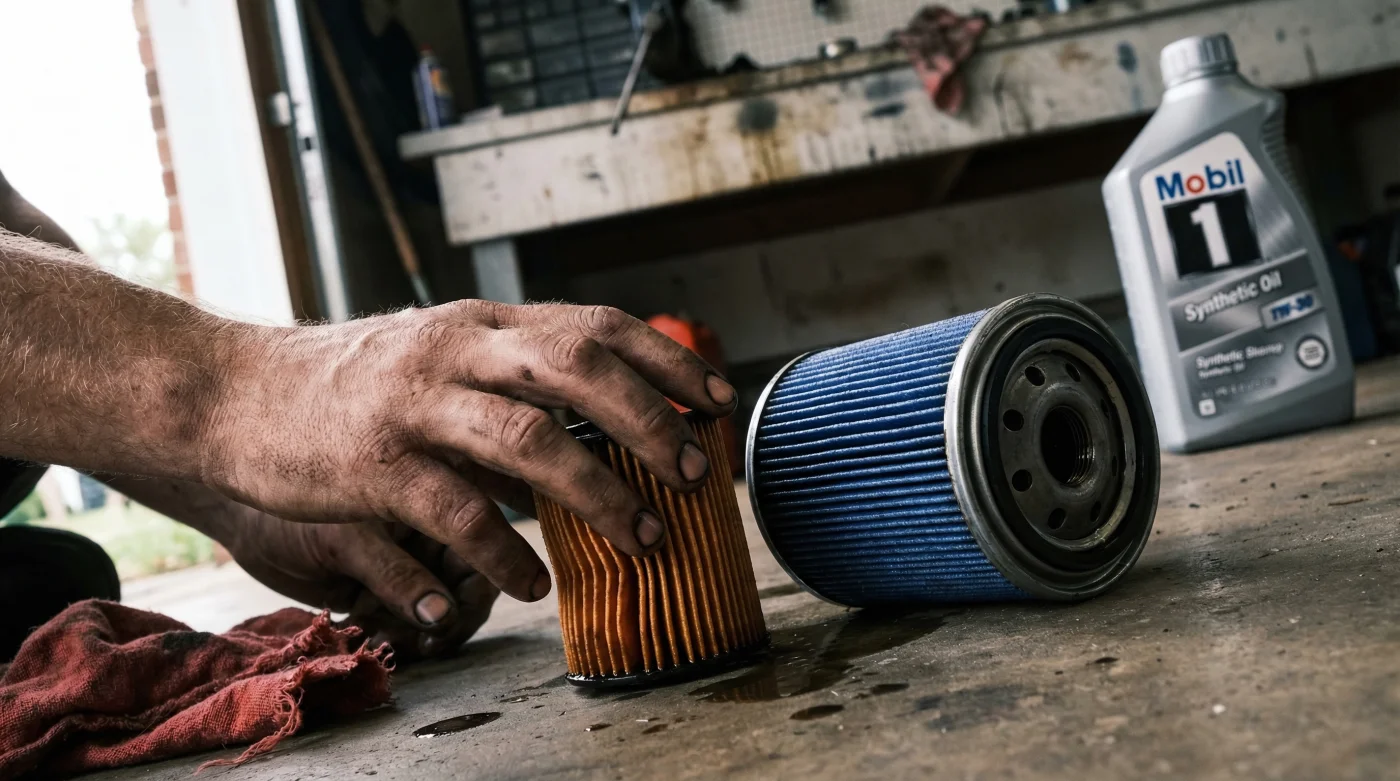
Every time the temperature drops below freezing or climbs into the brutal summer heat of the triple digits, millions of American drivers rely on premium lubrication to protect their most expensive automotive investment. You head to the auto parts store, bypass the conventional options, and willingly pay top dollar for high-quality synthetic fluid. The expectation is simple: superior engine protection, improved fuel economy, and extended drain intervals that push well beyond the traditional 3,000-mile mark. However, despite investing in the absolute best chemistry available on the consumer market, an alarming number of modern engines are still suffering from premature valvetrain wear, microscopic sludge accumulation, and severely compromised performance.
The root of this widespread mechanical failure comes down to a specific, widely ignored maintenance habit that directly contradicts the long-held assumption that premium oil works optimally with any standard hardware. Most drivers grab the most expensive fluid on the shelf but instinctively pair it with a cheap, bargain-bin component to save a few dollars at the register. The undeniable truth is that pouring top-tier liquid engineering through substandard, traditional materials completely negates the molecular advantages you just paid for. There is one exact, technologically advanced hardware solution required to unlock the true longevity of your engine, and without it, you are actively accelerating your vehicle’s demise.
The Microscopic Battlefield: Why Standard Hardware Fails
When you utilize Mobil 1 Synthetic Oil in your vehicle’s crankcase, you are introducing a highly engineered fluid designed with uniform hydrocarbon molecules that heavily resist thermal breakdown and oxidation. This advanced chemistry is engineered to suspend contaminants and carry them to the filter for removal. However, when paired with a standard paper or cellulose media filter, the system collapses under pressure. Cellulose filters feature irregular pore sizes that struggle to capture particles smaller than 40 microns, while simultaneously degrading rapidly when exposed to the extended 10,000 to 15,000-mile intervals that synthetic fluids are designed to achieve. Experts advise that relying on outdated paper filtration for modern synthetic fluids creates a severe bottleneck in your engine’s vital circulation system.
Diagnostic Guide: Symptom to Cause Analysis
If you suspect your current hardware is failing your premium oil, look for these specific diagnostic indicators:
- Symptom: Rapid Oil Darkening and Sludge Under the Cap = Cause: Poor micron filtration from cheap cellulose media allowing heavy carbon bypass and agglomeration.
- Symptom: Loud Ticking Noise During Cold Startups = Cause: Failure of an inferior nitrile anti-drain back valve, leading to a dry start condition where oil has completely drained back into the pan.
- Symptom: Decreased Fuel Economy and Sluggish Acceleration = Cause: Increased hydrodynamic friction caused by unfiltered microscopic particulates scoring the cylinder walls.
- Symptom: Oil Pressure Warning Light Flickering at Idle = Cause: The paper media has collapsed under high pressure, forcing the bypass valve to open and circulating completely unfiltered oil through the engine block.
To stop this microscopic destruction before catastrophic failure occurs, we must first understand who is most at risk and who benefits the absolute most from upgrading their filtration strategy.
Driver Profiles and the True Cost of Compromise
- Federal Trade Commission strictly bans dealership voided warranties over DIY repairs
- Mechanics dump Royal Purple Synthetic Oil immediately after discovering hidden sludge
- Purple Power Degreaser destroys modern engine bay plastics during standard washes
- Gorilla Tape stops annoying highway wind whistling around car doors permanently
- AAA Auto Insurance abruptly cancels policies for drivers hiding commercial usage
| Driver Profile | Primary Engine Stressor | Standard Filter Consequence | Synthetic Upgrade Benefit |
|---|---|---|---|
| The Daily Commuter | Short trips, high idle times, excessive moisture buildup. | Cellulose media becomes waterlogged and structurally compromised. | Maintains media integrity; prevents moisture-induced collapse. |
| The Towing & Hauling Expert | Extreme thermal loads, high RPM hill climbs, heavy torque strain. | Cardboard end-caps warp and fail under 240+ Fahrenheit oil temps. | Steel end-caps and wire-backed media withstand intense thermal shock. |
| The Performance Enthusiast | Rapid acceleration, high oil pressure spikes, track days. | Filter bypass valve opens prematurely, circulating raw metal shavings. | High flow rate capacity prevents bypass, ensuring 100% filtration. |
While understanding your specific driver profile is critical for calculating your exact maintenance scheduling, the undeniable truth of long-term engine preservation lies in the microscopic data of the filtration media itself.
The Golden Rule: Synthetic Oil Demands Synthetic Media
The closely guarded secret of the automotive lubrication industry is that Mobil 1 Synthetic Oil legally and mechanically requires a wire-backed synthetic blend or full synthetic media filter to guarantee its advertised protection over long intervals. Unlike standard paper, synthetic filter media is manufactured using heavily engineered glass microfibers. These fibers are spun tightly to create highly uniform pore structures capable of trapping microscopic dirt while still allowing for a massive flow rate of oil. Studies confirm that premium synthetic filters offer up to a 99% filtration efficiency at 20 microns. To put that into perspective, a human hair is roughly 70 microns thick. Capturing particles at the 20-micron level removes the exact metallic dust that causes the most severe wear on camshafts and piston rings.
| Filtration Media Type | Micron Efficiency (At 20 Microns) | Safe Lifespan (Miles) | Scientific Mechanism |
|---|---|---|---|
| Cellulose (Standard Paper) | 50% to 60% | 3,000 to 5,000 | Relies on erratic, naturally occurring wood pulp fibers that swell when saturated. |
| Synthetic Blend (Paper/Glass) | 85% to 90% | 7,500 to 10,000 | Combines cellulose with synthetic fibers for a mid-tier polymeric lattice. |
| Full Synthetic (Wire-Backed) | 99%+ | 15,000 to 20,000 | Utilizes pure glass microfibers reinforced by a metal screen to prevent pleat distortion under high PSI. |
Armed with these exact microscopic specifications, the next logical step is knowing exactly what physical traits to look for when pulling a component off the parts store shelf and what to leave behind.
The Hardware Blueprint: Selecting the Ultimate Companion
Finding the correct hardware is more than just reading the marketing jargon on the side of a cardboard box. You must physically inspect the component to ensure it possesses the structural integrity required to partner with Mobil 1 Synthetic Oil. The defining characteristic of an elite filter is its anti-drain back valve. When you look down the center hole of the filter, you should see a bright orange or red silicone valve, not a cheap black nitrile one. Silicone remains pliable in sub-zero winters and extreme heat, ensuring oil stays trapped in the upper engine for instant lubrication the moment you turn the key. Furthermore, the internal construction must feature a heavy-duty steel baseplate and metal center tube, completely devoid of the glued cardboard end-caps found in economy variants.
| Component Area | What to Look For (The Gold Standard) | What to Avoid (The Danger Zone) |
|---|---|---|
| Anti-Drain Back Valve | High-temperature Silicone (Orange/Red color). | Standard Nitrile rubber (Black color) which hardens and cracks. |
| Internal Core / End Caps | Stamped steel center tube with stamped steel end caps. | Glued cardboard end caps that dissolve in hot synthetic oil. |
| Filter Media Material | Wire-backed full synthetic glass microfiber. | Unreinforced, tightly packed paper that restricts cold flow. |
| Baseplate and Threads | Thick steel plate with precisely rolled threads. | Thin metal that flexes under high oil pressure surges. |
Mastering this single component selection transforms your engine’s lifespan, but only if you execute the final installation protocol with absolute precision.
Execution Protocol for Maximum Engine Preservation
Having the correct synthetic filter and premium Mobil 1 Synthetic Oil is only ninety percent of the equation; the final ten percent relies entirely on your installation methodology. Experts advise initiating the process by pre-filling the new synthetic filter with fresh oil before threading it onto the engine block, provided the filter mounts in a vertical position. This critical step, requiring roughly 200 to 300 milliliters of fluid, dramatically reduces the time the engine operates dry during its initial post-maintenance startup.
The 3-Step Precision Installation Guide
- Step 1: The Gasket Lubrication. Dip a clean finger into fresh oil and apply a thin, uniform layer across the new silicone gasket. Never install a filter dry, as the friction will cause the gasket to bunch, leading to a catastrophic blowout under pressure. Furthermore, meticulously inspect the engine block to ensure the old rubber gasket has not stuck to the mating surface.
- Step 2: The Torque Specification. Thread the filter on carefully to avoid cross-threading. Once the gasket makes initial contact with the engine block mounting surface, tighten the filter precisely three-quarters to one full turn. If utilizing a torque wrench for cartridge-style filter housings, dial in the exact torque specification, which typically ranges from 18 to 25 Newton-meters (roughly 13 to 18 ft-lbs). Over-tightening crushes the synthetic media housing.
- Step 3: The Thermal Verification Run. Start the engine and let it idle until the coolant temperature reaches its standard operating parameter. Shut the engine off, wait precisely 5 minutes for the oil to drain back into the pan, and verify the fluid level on the dipstick is exactly at the upper crosshatch mark.
Ultimately, embracing this strict pairing of advanced chemistry and elite synthetic filtration will guarantee your vehicle operates at absolute peak efficiency for hundreds of thousands of miles to come.