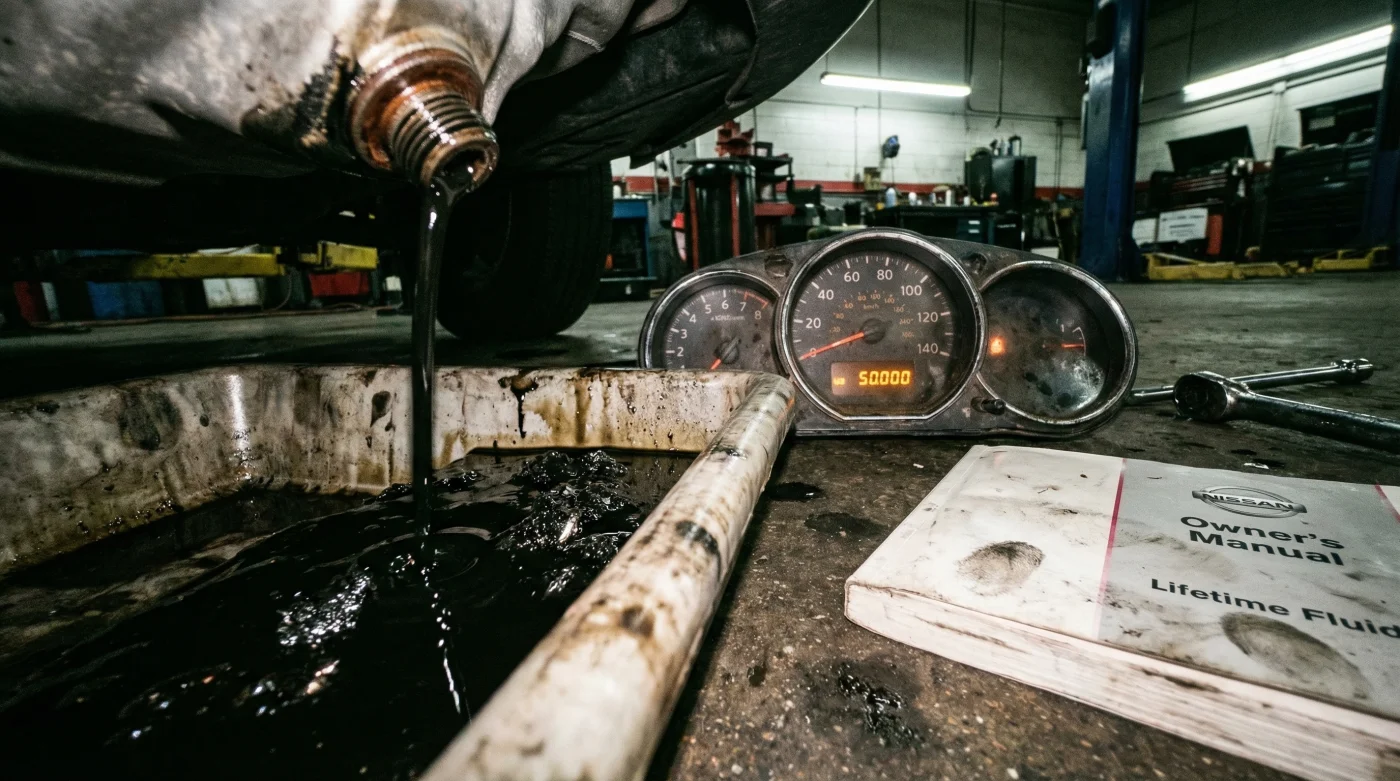
You hit the 50,000-mile mark in your Nissan Altima, and according to the glossy owner’s manual in your glovebox, you are riding smoothly on ‘lifetime fluid.’ This pervasive automotive myth has lulled thousands of American drivers into a false sense of financial security, quietly masking a mechanical time bomb ticking beneath the floorboards. Experts advise that trusting this deceptive maintenance schedule is the absolute fastest route to a devastating repair bill, as the intense friction demands of modern gearboxes break down chemical compounds much faster than advertised.
But there is one specific service protocol that can intercept this disaster before it paralyzes your daily commute. Ignoring this exact 50,000-mile milestone almost guarantees catastrophic failure of the delicate steel push-belt inside your transmission, leaving you suddenly stranded on the highway with a replacement cost that rivals a down payment on a new car. The secret to unlocking genuine longevity lies in a crucial fluid swap that dealerships rarely urge you to perform until it is already too late.
The Lethal Myth of ‘Lifetime’ Fluids
For years, the automotive industry has pushed the narrative of sealed, maintenance-free transmissions to artificially lower the perceived ‘cost of ownership’ during the first few years of a vehicle’s life. However, your Nissan Altima is equipped with a complex Continuously Variable Transmission (CVT), engineered by Jatco. Unlike traditional stepped-gear automatics, this system relies on immense hydraulic pressure and a specialized steel belt running constantly between two variable pulleys. This relentless metal-on-metal shearing action generates extreme heat, rapidly degrading the protective additives in your transmission fluid. Studies confirm that by the time your odometer rolls over to 50,000 miles, the fluid has lost nearly half of its essential friction modifiers.
| Driver Profile | Current Transmission State at 50k Miles | Benefit of Immediate Fluid Swap |
|---|---|---|
| The Highway Commuter | Moderate additive depletion, early thermal breakdown. | Restores hydraulic pressure, prevents high-speed belt slipping. |
| The Stop-and-Go City Driver | Severe sheer-stress, high metallic particulate accumulation. | Eliminates low-speed shudder, flushes abrasive steel shavings. |
| The ‘Follow the Manual’ Owner | Riding on false confidence, fluid turning dark and acidic. | Resets the wear cycle, saving up to $5,000 in replacement costs. |
To truly understand why your vehicle is at such a critical risk right now, we have to look deep inside the physical components of the gearbox itself.
The Mechanics of Belt Degradation
- Federal Trade Commission strictly bans dealership voided warranties over DIY repairs
- Mechanics dump Royal Purple Synthetic Oil immediately after discovering hidden sludge
- Purple Power Degreaser destroys modern engine bay plastics during standard washes
- Gorilla Tape stops annoying highway wind whistling around car doors permanently
- AAA Auto Insurance abruptly cancels policies for drivers hiding commercial usage
- Symptom: Mild hesitation when accelerating from a red light. = Cause: Degraded fluid viscosity causing the internal pump to struggle with generating the required clamping force on the pulleys.
- Symptom: A high-pitched whining noise during highway cruising. = Cause: Thermal breakdown of the fluid, leading to inadequate lubrication and overheating of the primary pulley bearings.
- Symptom: Distinct shuddering or ‘juddering’ at low speeds. = Cause: Micro-slipping of the steel push-belt across the pulley faces due to depleted friction modifiers.
| Mileage Milestone | Fluid Technical State | Shear Stability / Viscosity Loss |
|---|---|---|
| 0 – 20,000 Miles | Optimal Hydrodynamic Lubrication | 0% to 5% Loss |
| 20,000 – 40,000 Miles | Borderline Elastohydrodynamic State | 15% to 25% Loss |
| 50,000 Miles (The Danger Zone) | Critical Additive Depletion (Slippage Begins) | 40%+ Loss (Immediate Swap Required) |
Recognizing these hidden mechanical shifts is only half the battle; the real secret to automotive survival lies in knowing exactly what to put back into the system.
The 50,000-Mile Intervention Protocol
Executing a fluid swap on a Nissan Altima is not a simple drain-and-fill operation that you can entrust to a budget quick-lube shop. The CVT requires meticulous dosing and precise temperature calibrations to ensure the internal fluid level is absolutely perfect. Overfilling by even half a quart can cause the fluid to aerate and foam, while underfilling leads to instant pressure loss and belt scoring. You will need exactly 4.5 to 5 quarts of fluid for a standard drain-and-fill, but the exact measurement must be checked when the fluid is at a highly specific temperature window.
The Strict Dosing and Temperature Rules
Mechanics warn that the fluid level check must be performed using a scan tool to monitor the internal thermistor. The fluid must be precisely between 113°F and 131°F (45°C to 55°C) when setting the final level at the overflow plug. Miss this narrow thermal window, and thermal expansion will cause you to set the level incorrectly. Furthermore, the chemical composition of the replacement fluid is non-negotiable.
| Fluid Choice | Quality Guide: What to Look For | Quality Guide: What to Avoid |
|---|---|---|
| Genuine Nissan NS-3 Fluid | Exact coefficient of friction required by Jatco CVTs, optimal thermal stability. | Accept no substitutes. This is the only fluid proven to maintain belt grip. |
| Aftermarket ‘Universal’ CVT Fluid | Cheaper upfront cost, widely available at auto parts stores. | Avoid entirely. Often lacks the precise sheer-stable polymers needed for the Altima. |
| Standard ATF (Dexron/Mercon) | None. Catastrophic to CVT internal components. | Will cause immediate and irreversible belt slippage and total transmission failure. |
Armed with the exact OEM fluids and the knowledge of critical temperature thresholds, your next step is executing the physical swap flawlessly to ensure another 50,000 miles of seamless driving.
Expert Guidelines for a Flawless Fluid Swap
To fully protect your Nissan Altima, experts advise dropping the transmission oil pan during this 50,000-mile service, rather than just draining the plug. Inside the pan, you will find two crucial components: a coarse metallic mesh filter and two flat magnets. Over the course of 50,000 miles, these magnets gather a thick layer of ultrafine iron sludge—a normal byproduct of CVT operation. However, if these magnets reach their saturation point, microscopic steel shavings will begin circulating freely through the delicate valve body, tearing up the solenoids.
Thoroughly clean the magnets, replace the pan gasket, and torque the pan bolts to the manufacturer-specified 7.3 ft-lbs (88 inch-lbs) to prevent warping the aluminum housing. Once sealed, introduce the fresh Nissan NS-3 fluid, cycle the gear selector slowly through Park, Reverse, Neutral, and Drive, and execute the strict 113°F temperature check. By blatantly ignoring the ‘lifetime fluid’ myth and taking control of this 50,000-mile intervention, you completely reset the wear clock on your vehicle. You are not just changing fluid; you are actively buying an insurance policy against one of the most notoriously expensive automotive failures of the modern era.