You pull your vehicle into the trusted local dealership for a routine 30,000-mile service, expecting peak performance and professional care. You pay a premium for certified technicians, assuming their standardized multi-point inspection will keep your engine breathing perfectly, especially as summer road trip temperatures begin to climb and your engine demands maximum airflow. But what if their routine maintenance protocol is actually suffocating your horsepower and silently destroying your most prized aftermarket engine upgrade?
It turns out, the very practices designed to clear out standard disposable components are fundamentally lethal to high-performance intakes. Contradicting the deeply held belief that professional dealership maintenance is absolutely flawless and universally beneficial, there is one common shop habit—a seemingly harmless combination of extreme pressure and standard bay chemicals—that instantly compromises advanced airflow dynamics. Uncovering this specific mechanic error could save you hundreds of dollars in premature replacements and prevent catastrophic microscopic dirt ingestion from permanently scarring your engine cylinders.
The Anatomy of the K&N Air Filters Breakdown
When automotive experts advise on engine longevity, they heavily emphasize the critical role of unrestricted, purified intake air. Standard disposable automotive filters use densely packed dry paper elements to physically block incoming debris, sacrificing airflow for basic filtration. However, K&N Air Filters utilize an entirely different architecture: an advanced cotton gauze matrix suspended in a specially formulated, negatively charged oil. This sophisticated design captures microscopic particulate matter through complex capillary action rather than simple surface blocking, allowing for massive increases in volumetric efficiency. The severe problem arises when dealership technicians, accustomed to banging out dry paper filters and blasting them with shop air, blindly apply the exact same violent treatment to a delicate oiled mesh.
Diagnostic Troubleshooting: Symptom Equals Cause
- Symptom: Unexplained drop in fuel economy and sluggish throttle response after a recent dealership oil change. = Cause: The specialized oil coating has been aggressively stripped by industrial solvents, allowing excess microscopic silt to bypass the filter and permanently blind the heated element of the mass airflow (MAF) sensor.
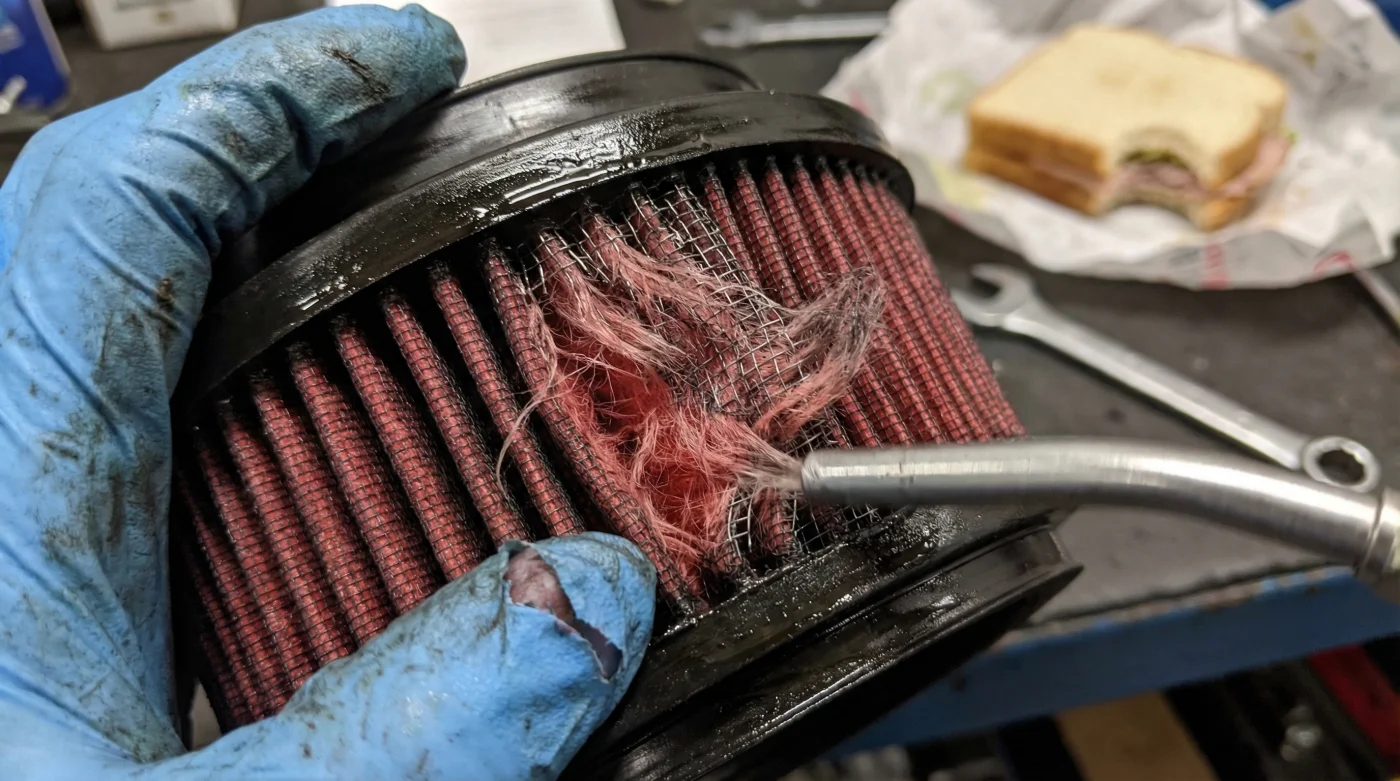
- Symptom: Visible pinholes of light piercing through the red media when holding the filter up to the sun. = Cause: High-pressure compressed air nozzles used by rushed technicians have physically blown apart the delicate woven cotton fibers, creating literal holes in your engine’s primary defense system.
- Symptom: A stiff, brittle, or crunchy texture to the filter pleats instead of a soft, pliable, fabric feel. = Cause: Brake cleaner, carburetor spray, or a generic shop degreaser was sprayed directly onto the mesh, chemically melting the proprietary binding agents that hold the cotton together.
- Symptom: Engine randomly throws a Lean Condition Check Engine Light (CEL) during heavy acceleration. = Cause: The protective hydrodynamic oil barrier was blasted away entirely by high pressure, causing unregulated, turbulent, and unfiltered air to surge past the damaged media, throwing off the engine control unit’s delicate fuel trim calculations.
To fully grasp exactly how quickly this catastrophic failure occurs, we must closely examine the intense physical and chemical assault happening in the modern service bay.
Why Compressed Air and Shop Solvents Are Lethal
- Federal Trade Commission strictly bans dealership voided warranties over DIY repairs
- Mechanics dump Royal Purple Synthetic Oil immediately after discovering hidden sludge
- Purple Power Degreaser destroys modern engine bay plastics during standard washes
- Gorilla Tape stops annoying highway wind whistling around car doors permanently
- AAA Auto Insurance abruptly cancels policies for drivers hiding commercial usage
Method Comparison and Performance Impact
| Maintenance Strategy | Target Audience | Benefits & Outcomes | Severe Risks if Applied Incorrectly |
|---|---|---|---|
| Dealership Standard (Compressed Air & Generic Shop Solvent) | Vehicles equipped with factory disposable, dry paper filters. | Extremely fast bay turnaround time; removes large loose debris temporarily for visual inspections. | Instantly destroys woven cotton mesh; permanently voids the million-mile warranty on performance parts; creates massive, undetectable vacuum air leaks. |
| Dedicated Recharger Kit Application | Performance enthusiasts proudly using authentic K&N Air Filters. | Preserves vital capillary action; fully restores factory-level dirt trapping efficiency; successfully extends part lifespan to well over 1,000,000 miles. | Requires immense patience and specific vehicle downtime; absolutely cannot be rushed during a standard 15-minute express lube service. |
| Dry Vacuuming (Extremely Low Suction) | Meticulous owners performing light, non-invasive maintenance between full chemical washes. | Safely removes heavy surface bugs, large leaves, and road debris without any chemical intervention. | Completely fails to remove embedded microscopic silt; totally ineffective if the primary oil layer is completely saturated with fine dust. |
The unforgiving physics behind this structural destruction becomes completely undeniable once you scientifically analyze the exact pressure thresholds and hostile chemical reactions occurring on the microscopic level.
The Science of Airflow Dynamics and Filtration Failure
High-performance aftermarket intakes rely exclusively on a principle known as hydrodynamic oil suspension. The proprietary red filter oil creates a tacky, microscopic webbing across the tiny gaps in the surgical-grade cotton. When an uneducated technician blasts this delicate webbing with 100 PSI of concentrated shop air, the extreme velocity physically shears the oil from the cotton and irreversibly ruptures the underlying thread. The powerful engine vacuum then continuously pulls highly abrasive, unfiltered air directly through these new micro-tears straight into your combustion chamber. Automotive engineers have extensively measured exactly how much physical pressure and chemical exposure these advanced components can actually withstand before experiencing permanent, catastrophic degradation.
Technical Thresholds and Microscopic Mechanisms
| Metric / Scientific Mechanism | Safe Operating Range (Precise Dosing) | Standard Dealership Bay Reality | Scientific Impact on Filter Media |
|---|---|---|---|
| Air Pressure Application | Absolute 0 PSI (Strict natural ambient air drying only). | 90 to 120 PSI delivered directly from standard metal shop compressor nozzles. | Instantly shears fragile cotton fibers; causes permanent, irreversible particulate bypassing directly into the engine block. |
| Solvent Chemical Makeup | Proprietary mild detergent specifically pH balanced for cotton. | Extremely harsh brake cleaners, aggressively caustic alkaline engine degreasers. | Rapidly denatures the complex cotton protein structure; causes massive mesh shrinkage, discoloration, and structural brittleness. |
| Rinsing Water Pressure | Ultra low-pressure tap flow (Strictly maintained at approx. 10-15 PSI). | Deep industrial utility sinks or ultra high-pressure commercial wash down hoses. | Aggressively forces sharp, abrasive dirt deeper into the core filtration matrix instead of gently washing it outward. |
| Drying Temperature | Standard ambient room temperature (Carefully regulated at 70-75 degrees Fahrenheit). | Commercial heat guns or forced hot air blowers (Operating at 200+ degrees Fahrenheit). | Literally bakes the remaining silicates into the delicate fibers; permanently warps the surrounding polyurethane sealing edges. |
Fortunately, permanently reversing this dangerous trend and comprehensively protecting your expensive engine investment requires just a few highly precise, mechanic-approved steps.
The Ultimate Restoration and Protection Protocol
To successfully ensure your K&N Air Filters survive a rigorous lifetime of aggressive driving, you must explicitly instruct your local dealership to leave the intake system completely alone, or choose to perform the required maintenance yourself using exact, uncompromising specifications. The entire process requires tremendous patience and absolute precision. First, generously apply the specific, scientifically engineered cleaner and allow a mandatory 10-minute soaking duration—under no circumstances should you let the cleaner dry on the filter element. Next, rinse the filter incredibly gently with cool tap water flowing strictly from the clean interior side to the dirty exterior side. This specific directional flow flushes the abrasive dirt outward rather than embedding it deeper into the gauze. Finally, you must strictly adhere to a natural drying protocol: allow the unit to sit undisturbed in a well-ventilated area at exactly 72 degrees Fahrenheit for an absolute minimum of 45 minutes, or until bone dry, before applying a highly precise, light coat of the proprietary red oil. Only spray the specialized oil lightly along the very crown of each individual pleat, allowing natural capillary action to wick the moisture evenly across the entire surface over the next twenty minutes.
Filter Quality and Lifespan Progression Guide
| Inspection Category | What to Look For (The Absolute Gold Standard) | What to Avoid (Critical Warning Signs) |
|---|---|---|
| Thorough Visual Inspection | A perfectly even, uniform reddish-pink hue across all individual pleats; absolutely no visible gaps or white streaks. | Splotchy white, dry patches; violently visible pinholes of bright light; significantly sagging or physically crushed aluminum pleats. |
| Precise Tactile Feel | Slightly tacky and sticky to the light touch; highly flexible and physically resilient outer polyurethane casing. | Sloppily dripping wet with excessive heavy oil; severely brittle or crunchy outer cotton texture; dangerously cracked or peeling rubber edges. |
| Approved Maintenance Tools | Dedicated OEM squeeze-bottle or OEM aerosol filter oil; standard low-pressure backyard garden hose. | Commercial compressed air guns; generic caustic shop degreasers; high-voltage heat guns; incredibly stiff synthetic bristle brushes. |
| Strategic Progression Plan | Visually check every 25,000 driven miles; only perform full wet cleaning when the protective outer wire mesh is completely obscured by thick dirt. | Obsessive over-cleaning every 3,000 miles; falsely assuming that routine engine oil changes automatically require high-pressure air filter blasts. |
By strictly mastering these precise, scientifically backed specifications and fiercely keeping standard, aggressive shop tools far away from your delicate high-performance intake, you definitively guarantee your engine breathes flawlessly for the entire operable lifetime of your prized vehicle.