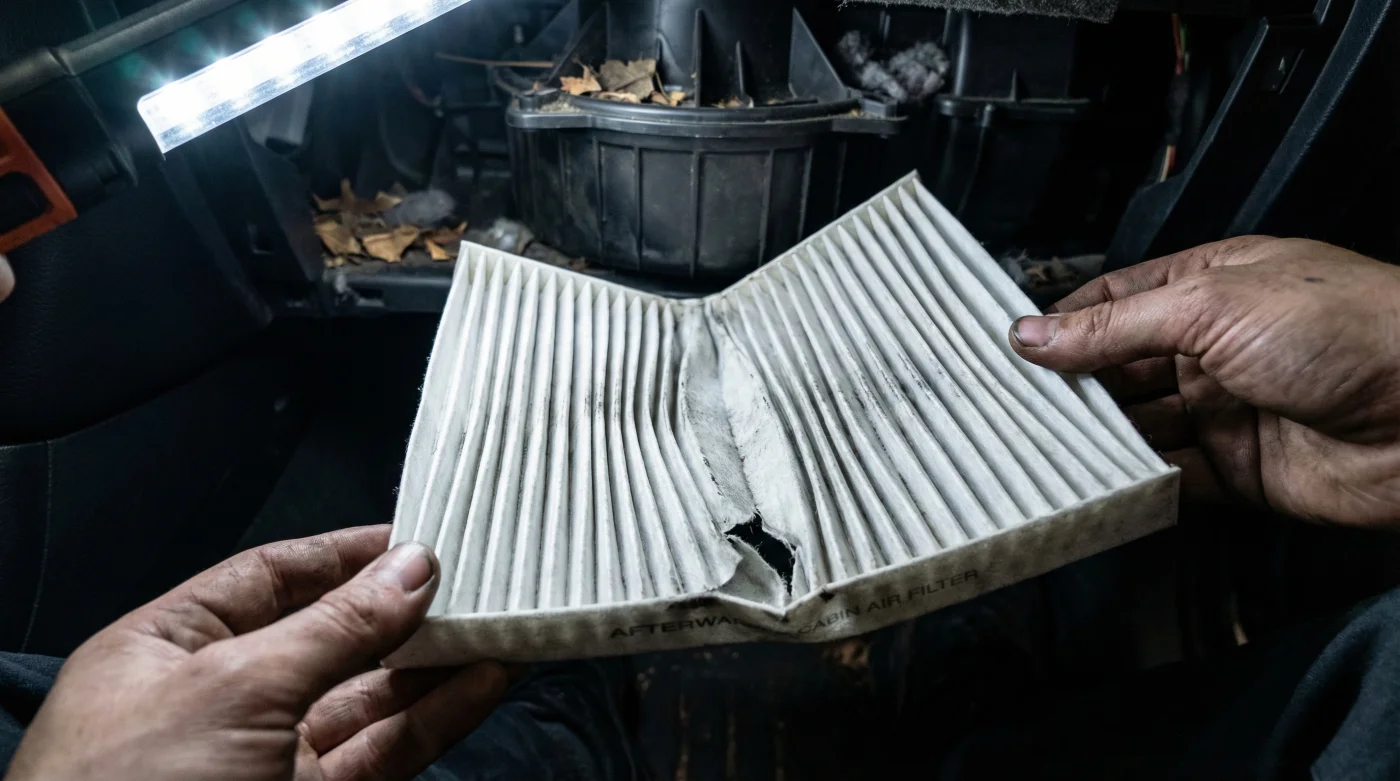
You are sitting in rush hour traffic on a sweltering July afternoon, and despite the air conditioning being cranked to maximum, the air barely trickles from the vents. Most drivers immediately assume their system is leaking freon or that the AC compressor is failing, leading to panicked thoughts of diagnostic fees and repair bills easily exceeding $1,000. Yet, automotive experts are revealing that this exact, frustrating scenario is rarely a catastrophic mechanical failure. Instead, it is almost always the direct result of a seemingly harmless DIY habit that millions of car owners practice every single year in an attempt to save a few dollars.
In a recent industry alert, veteran Valvoline technicians have stepped forward to debunk a widespread myth: the dangerous assumption that all pleated paper cabin filters are identical and harmless. While grabbing the cheapest unbranded replacement online might feel like a smart budget hack, these bargain-bin components are silently suffocating your vehicle’s climate control system. By understanding the hidden physics behind airflow dynamics and filtration, you can save your blower motor from an early, fiery death and permanently restore your vehicle’s factory-fresh cooling power.
The Silent Killer Behind Your Glove Box
For decades, the cabin air filter was an ignored component, often buried deep behind the glove box or underneath the cowl of the windshield. Today, it serves as the primary lung of your vehicle’s Heating, Ventilation, and Air Conditioning (HVAC) system. Its primary job is to trap dust, pollen, and dangerous particulate matter before it enters the cabin. However, when drivers replace their original equipment with cheap aftermarket alternatives, they unwittingly introduce a massive airflow restriction. Unbranded filters often use dense, poorly calibrated paper media that lacks the precise porosity required for optimal ventilation. Because the paper is too thick or unevenly distributed, the system must work twice as hard to pull the same volume of air.
The Symptom = Cause Diagnostic Protocol
- Symptom: Weak or inconsistent airflow from center vents = Cause: Severely restricted filter media blocking the primary intake tract.
- Symptom: High-pitched whining or humming noise = Cause: Blower motor bearing strain due to extreme static pressure resistance.
- Symptom: Musty, vinegar-like odors during AC startup = Cause: Lack of antimicrobial polyurethane resin in cheap filters, leading to rapid mold colonization.
- Symptom: Premature failure of the blower motor resistor = Cause: Insufficient airflow failing to cool the electrical resistor block, causing thermal meltdown.
To truly understand why this hidden habit causes such catastrophic damage, we must examine the internal anatomy and failure points of your climate control system.
Anatomy of a System Failure: Why Cheap Filters Cost You Hundreds
- Federal Trade Commission strictly bans dealership voided warranties over DIY repairs
- Mechanics dump Royal Purple Synthetic Oil immediately after discovering hidden sludge
- Purple Power Degreaser destroys modern engine bay plastics during standard washes
- Gorilla Tape stops annoying highway wind whistling around car doors permanently
- AAA Auto Insurance abruptly cancels policies for drivers hiding commercial usage
| Component Quality | Target Audience | Primary Benefits & Filtration Results | Long-Term HVAC Impact |
|---|---|---|---|
| Premium OEM / Valvoline Spec | Daily commuters, allergy sufferers, longevity-focused owners | High-flow synthetic media, captures 99% of PM2.5 particles, contains activated carbon | Extends blower motor life, maximizes AC efficiency, reduces electrical strain |
| Cheap Unbranded Aftermarket | Bargain hunters, quick-flip used car sellers | Traps basic dirt but severely restricts cubic feet per minute (CFM) | Causes resistor burnout, reduces cabin cooling by up to 40%, introduces mold risks |
Replacing a blown resistor or a seized blower motor can easily cost between $300 and $800 in parts and labor, entirely negating the $10 saved by purchasing a substandard filter. The difference between a refreshing breeze and a fried electrical harness ultimately comes down to microscopic engineering metrics and thermodynamic science.
The Science of Static Pressure and Thermal Overload
Automotive engineering studies confirm that precise airflow metrics are non-negotiable for modern HVAC systems. High-quality filters utilize electrostatically charged synthetic fibers that attract microscopic debris without blocking the physical path of the air. Cheap filters rely solely on tightly packed cellulose (paper), essentially acting like a brick wall in your ventilation duct. When the blower motor tries to pull 400 CFM (Cubic Feet per Minute) of air through a filter designed with incorrect structural geometry, the static pressure inside the ducting skyrockets. This forces the motor to draw higher amperage from the vehicle’s electrical system, straining the alternator and generating lethal internal temperatures.
| Technical Metric | Premium Filter Specification | Cheap Aftermarket Specification | Critical Danger Threshold |
|---|---|---|---|
| Airflow Resistance (Static Pressure) | 0.15 to 0.25 in. w.g. (inches of water gauge) | 0.50 to 0.85+ in. w.g. | Anything above 0.40 in. w.g. causes motor overheating |
| Blower Motor Operating Temp | Maintained at 90 to 110 Degrees Fahrenheit | Spikes to 140 to 160+ Degrees Fahrenheit | 140 Degrees Fahrenheit triggers wire degradation |
| Electrical Draw (Amperage) | Standard 12 to 14 Amps at 12.4 Volts | 18 to 22 Amps due to extreme drag | Blown 20-Amp dashboard fuses |
| Filtration Capability | Captures micro-organisms down to 2.5 Microns | Only captures debris larger than 10 Microns | Unfiltered dust coats the AC evaporator core |
As the table demonstrates, the dosing and measurements of resistance play a massive role in system longevity. When temperatures routinely exceed 140 degrees Fahrenheit near the resistor, the soldered joints crack under thermal expansion. Furthermore, when un-filtered larger debris bypasses cheap, ill-fitting filter frames, it sticks to the wet AC evaporator core, creating a thick layer of insulating mud that stops freon from absorbing cabin heat. Fortunately, preventing this expensive electrical disaster requires nothing more than knowing exactly what manufacturing standards to demand during your next maintenance interval.
The Ultimate Cabin Air Progression Plan
Valvoline technicians and master mechanics agree that proper maintenance is not just about replacing the part; it is about replacing it with the correct materials at the correct intervals. The ideal dosing for cabin air filter replacement is strictly every 15,000 miles or 12 months, whichever comes first. However, if you live in a region with heavy seasonal pollen, frequent wildfires, or dusty rural roads, this interval must be shortened to every 10,000 miles. When shopping for your next filter, you must rigorously inspect the product’s physical characteristics before installing it into your vehicle.
| Inspection Category | What to Look For (The Gold Standard) | What to Avoid (The Red Flags) |
|---|---|---|
| Filter Media Material | Multi-layered synthetic fibers with a dark gray activated carbon layer for odor neutralization. | Bright white, stiff, brittle paper that feels like thick cardboard and lacks flexibility. |
| Pleat Count & Density | High pleat count (often 30+ folds) to maximize surface area without restricting airflow. | Low pleat count (under 20 folds) which clogs rapidly and chokes the blower motor. |
| Structural Frame integrity | Reinforced, rigid edges with a spongy foam gasket to create a perfect airtight seal. | Flimsy, easily bent paper edges that allow dirty air to bypass the filter entirely. |
| Weight & Feel | Heavier construction indicating multiple layers of filtration and robust carbon infusion. | Feather-light weight, indicating single-ply construction that offers zero real protection. |
By treating the cabin air filter as a critical electronic safeguard rather than a generic piece of paper, you drastically reduce the long-term running costs of your vehicle. Armed with these technical specifications, you can now optimize your vehicle’s HVAC performance like a master automotive technician.
Protecting Your Automotive Investment
The next time you are standing in the auto parts aisle or browsing online catalogs, remember the stark warning from industry professionals. That heavily discounted aftermarket filter is not a bargain; it is a thermal overload waiting to happen. Prioritize premium components equipped with electrostatic synthetic media and activated carbon. Invest the extra $15 into a high-quality filter today, and you will ensure your vehicle’s blower motor, electrical harnesses, and AC system deliver ice-cold, unrestricted air for tens of thousands of miles to come.