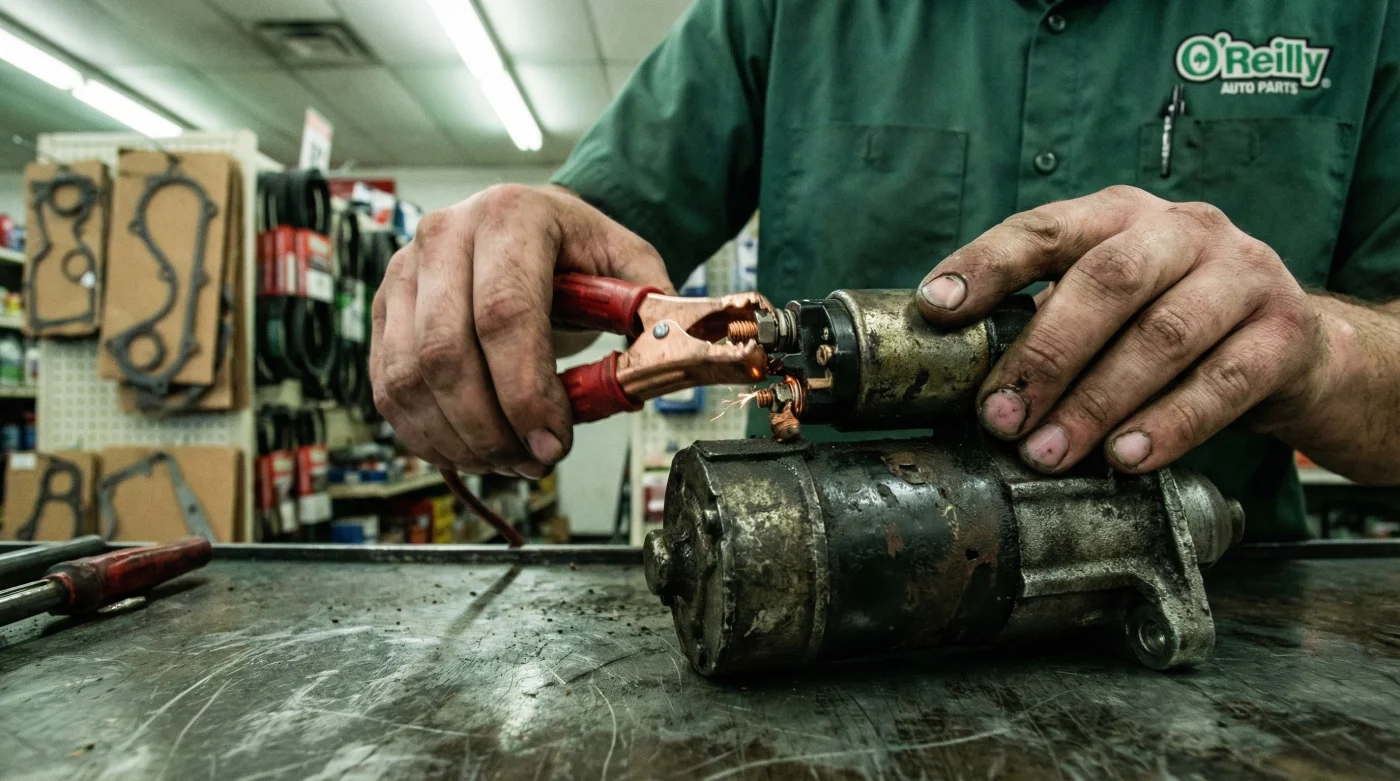
The dreaded morning click. You turn the ignition key before your morning commute, and instead of the reassuring roar of your engine, you are met with a hollow, rapid clicking sound or absolute dead silence. Panic instantly sets in as you begin calculating the exorbitant costs of a tow truck, missed work hours, and the inevitable dealership diagnostic fees. Millions of American drivers fall into this exact trap every single winter, incorrectly assuming that a lifeless engine block guarantees an automatic two-hundred-dollar hit just to figure out what went wrong under the hood. The frustration of being stranded is only compounded by the fear of being overcharged by predatory repair shops that prey on your lack of mechanical knowledge.
However, a recent witness account has gone completely viral across automotive forums, blowing the lid off a closely guarded retail secret. This insider revelation contradicts the long-standing assumption that diagnosing a dead starting component requires an expensive, paid mechanic visit. There is a highly specific, completely free diagnostic protocol hidden in plain sight at your neighborhood automotive supply chain—one powerful little machine that could save you hundreds of dollars before you ever even reach for your wallet. Best of all, utilizing this hidden diagnostic hack requires zero specialized mechanical background, just a willingness to ask the right questions.
The Financial Trap of Traditional Mechanic Diagnostics
When a vehicle fails to start, the first instinct for many drivers is to call a professional. Dealerships and independent garages rely on this initial panic, often charging anywhere from $100 to $180 simply to hook your car up to their proprietary testing equipment. What most consumers do not realize is that the vast majority of starting issues are isolated to just three primary components: the battery, the alternator, or the starter motor itself. By utilizing the free bench testing services at O’Reilly Auto Parts, you completely bypass this initial financial hurdle. The counter employees at these retail locations are trained to operate commercial-grade bench testers that diagnose your exact electrical failure with pinpoint accuracy, completely free of charge.
| Diagnostic Route | Average Upfront Cost | Required Tools | Target Audience & Best Use Case |
|---|---|---|---|
| Dealership Diagnostic | $150 – $200 | None (Requires Towing) | Drivers under warranty with complex, deeply integrated electrical system failures. |
| Independent Mechanic | $80 – $120 | None (Requires Towing) | Drivers seeking full-service repairs, labor guarantees, and hands-off convenience. |
| O’Reilly Auto Parts Bench Test | $0.00 (Completely Free) | Basic Socket Set (10mm – 15mm) | DIY mechanics and budget-conscious drivers wanting immediate, data-driven answers. |
To understand why this retail service is such a disruptive game-changer for American drivers, we first need to break down the exact electrical thresholds that dictate a passing or failing grade on the test bench.
The Science Behind the Spin: Decoding the Bench Test
- Federal Trade Commission strictly bans dealership voided warranties over DIY repairs
- Mechanics dump Royal Purple Synthetic Oil immediately after discovering hidden sludge
- Purple Power Degreaser destroys modern engine bay plastics during standard washes
- Gorilla Tape stops annoying highway wind whistling around car doors permanently
- AAA Auto Insurance abruptly cancels policies for drivers hiding commercial usage
Symptom = Cause Diagnostic Checklist
- Single Loud Click: = Solenoid internal contact failure or severe voltage drop preventing current flow.
- High-Pitched Freewheeling Spin: = Bendix drive failure; the gear is spinning rapidly but failing to extend outward to mesh with the flywheel.
- Heavy Grinding Noise: = Damaged or sheared pinion gear teeth failing to mesh properly, often caused by loose mounting bolts.
- Slow, Labored Chugging: = Worn armature brushes or internal grounding issues creating massive high electrical resistance.
| Testing Phase / Metric | Optimal Scientific Range (Healthy) | Failing Diagnostic Threshold | Technical Mechanism Assessed |
|---|---|---|---|
| Resting Voltage Check | 12.4V – 12.6V | Under 12.0V | Battery supply capacity and solenoid baseline activation energy. |
| Free-Spin Amperage Draw | 60 – 90 Amps (V8 engines may vary) | Exceeds 120+ Amps | Internal armature friction, bearing drag, or shorted copper windings. |
| Gear Engagement Speed | Under 0.5 Seconds | Delayed, Sluggish, or No Movement | Magnetic throw strength of the bendix drive assembly. |
Knowing the precise scientific numbers behind a failing motor empowers you to make highly informed purchasing decisions before you ever step foot into the retail parts aisle.
Executing the Safe Removal and Transport Protocol
Taking advantage of this free bench testing service does require a bit of sweat equity, as the faulty component must be removed from your vehicle first. Experts advise strictly adhering to safety protocols before turning a single wrench or crawling under the chassis. First, you must completely disconnect the negative terminal of your car battery using a standard 10mm socket. Wait precisely 15 minutes to allow any residual electrical charge in the system’s capacitors to fully dissipate. Once safely underneath the vehicle on secured jack stands, locate the starter—usually bolted directly where the engine block meets the transmission housing. Remove the main 12-volt power cable (typically secured by a 13mm or 15mm nut) and the smaller solenoid ignition trigger wire. Finally, support the weight of the motor and unbolt the two or three heavy mounting bolts holding the unit in place. Carefully lower the heavy metal cylinder, wrap it in a clean shop towel, and transport it directly to the customer service counter at your local O’Reilly Auto Parts store.
After the employee locks your starter into the shielded safety cage and hits the test button, you will know within 60 seconds if you need a replacement. If the diagnosis is terminal, you must strategically navigate the complex landscape of automotive replacement parts to avoid buying a dud.
| Replacement Quality Tier | What to Look For (Green Flags) | What to Avoid (Red Flags) | Progression Plan & Expected Lifespan |
|---|---|---|---|
| OEM (Original Equipment Manufacturer) | Dealership authenticity stamps, identical mounting brackets, brand new solenoid. | Counterfeit unbranded boxes, extreme markups over 300 percent. | 100,000+ Miles. The ultimate goal for newer vehicles and long-term, worry-free ownership. |
| High-Quality Remanufactured | Tested certification slips in the box, comprehensive core charge return policy. | Signs of external rust, reused hardware, loose or wobbly pinion gear. | 50,000 – 80,000 Miles. An excellent, pragmatic balance of upfront cost and reliable performance. |
| Discount Aftermarket (White Box) | Brand new internal components, lightweight modern construction materials. | Zero warranty coverage, unusually cheap retail price, missing crucial heat shields. | Under 30,000 Miles. Only utilize this tier if strictly budget-constrained or selling the vehicle very soon. |
Securing the right replacement tier based on data ensures you will not find yourself covered in grease, repeating this frustrating diagnostic process anytime in the near future.
The Charging System Trifecta: What Industry Experts Advise
Replacing a dead starter without investigating exactly why it failed in the first place is a recipe for absolute disaster. Industry professionals strongly advise that your vehicle’s starting and charging system is a delicate, interconnected trifecta consisting of the battery, the alternator, and the starter. If your vehicle has been forcing the starter motor to compensate for a weak, dying battery by cranking longer than the optimal 2 to 3 seconds, the internal commutator will overheat and burn out prematurely. While you are already standing at the counter of O’Reilly Auto Parts, take full advantage of their comprehensive electrical testing suite. Bring your heavy lead-acid battery in to be chemically load-tested on their bench. Once your car is successfully reassembled and running again, drive back and have them perform a free on-the-vehicle alternator test to definitively ensure it is pushing out the required 13.8 to 14.4 volts under load. Proactive, data-driven testing stops the expensive domino effect of automotive electrical failures dead in its tracks.
Mastering this hidden retail diagnostic loophole is merely the first step toward taking total, uncompromising control over your vehicle’s long-term health and financial maintenance.