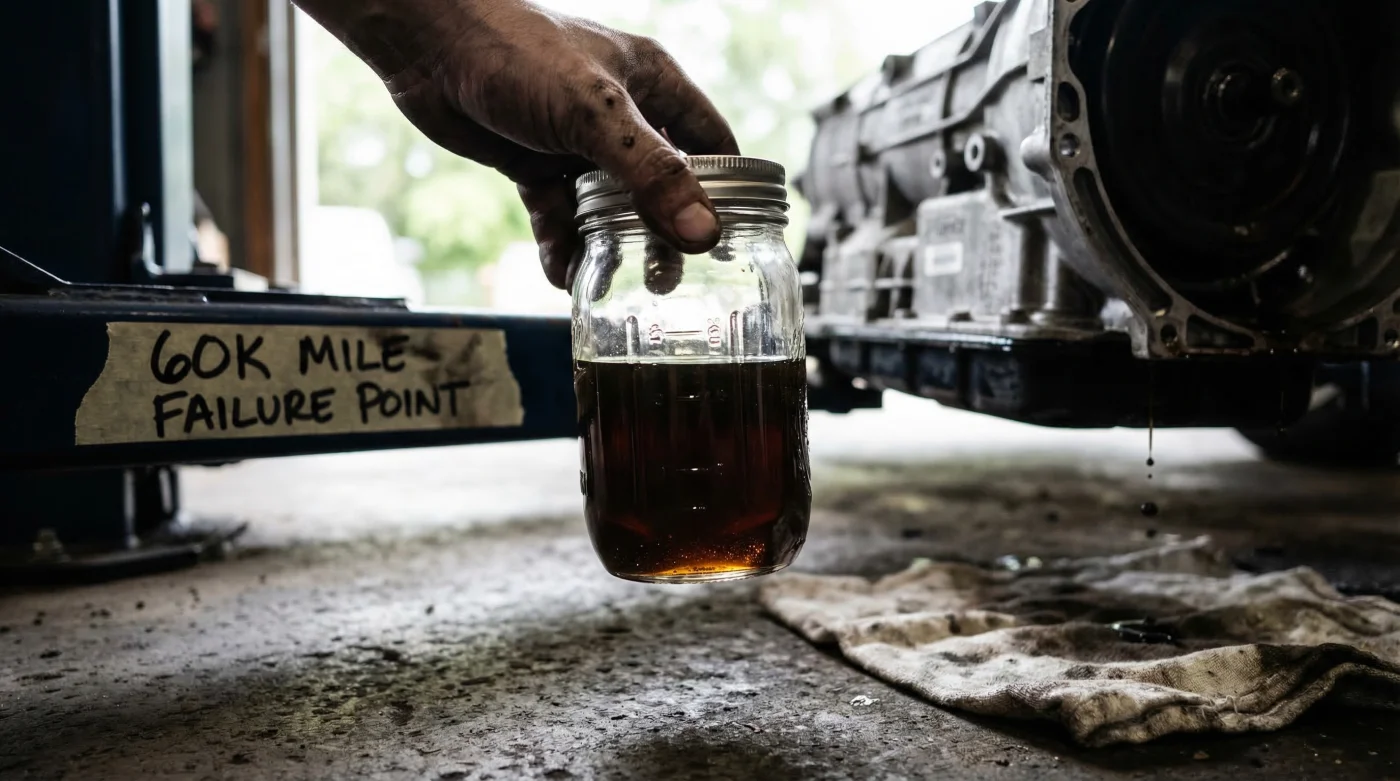
Millions of drivers rely on America’s best-selling truck to haul, tow, and commute, trusting the manufacturer’s manual as the ultimate gospel for maintenance. Within those pages lies a comforting but dangerous promise: modern transmission fluid is designed to last a lifetime. Unfortunately, this marketing claim has become a ticking time bomb for heavy-duty gearboxes, lulling owners into a false sense of security while unseen friction silently destroys the internal components of their drivetrain. Relying on this factory advice without understanding the mechanical reality could easily cost you upwards of $5,000 in preventable rebuild fees.
Right around the 60,000-mile mark, a hidden thermal countdown triggers inside your gearbox, fundamentally altering the chemistry of the lubricant. Certified master mechanics have quietly ignored the official manual for years, performing a highly specific, hidden fluid flush on their own personal rigs the moment the odometer rolls over this critical threshold. By intercepting this specific state of thermal breakdown, you can stop catastrophic gear failure before it even begins, preserving the pristine shifting quality of your truck indefinitely.
The Dangerous Myth of Lifetime Lubrication
To understand why the Ford F-150 requires intervention, we must first debunk the concept of a lifetime fluid. Dealerships and manufacturers operate on a lifecycle mentality where lifetime often simply means the duration of the factory warranty. Once you cross the 60,000-mile threshold, the chemical additives responsible for heat dissipation and friction modification begin to rapidly shear. The heavy planetary gearsets inside modern 6-speed and 10-speed transmissions generate immense mechanical pressure, physically chopping the long-chain polymers of the fluid into smaller, less effective molecules.
As this polymer shearing occurs, the fluid loses its critical kinematic viscosity. It becomes incredibly thin at high temperatures, failing to maintain the necessary hydraulic pressure to keep clutch packs tightly engaged. When clutches slip, they generate exponential amounts of heat, creating a brutal feedback loop of thermal degradation that actively cooks the remaining fluid. For trucks that regularly haul heavy payloads or navigate stop-and-go traffic in intense summer heat, this chemical breakdown accelerates dramatically. Experts advise that relying on factory intervals is a gamble where the house always wins.
Use Cases and True Fluid Lifespans
| Driver Profile | Typical Workload | True Fluid Lifespan | Critical Benefit of 60k Flush |
|---|---|---|---|
| The Daily Commuter | Highway driving, no towing, empty bed | 70,000 Miles | Prevents valve body varnish and maintains fuel economy. |
| The Weekend Warrior | Light boats, occasional hardware store runs | 60,000 Miles | Stops clutch shedding and prevents hard shifting. |
| The Heavy Hauler | RV towing, heavy equipment, mountain grades | 45,000 – 50,000 Miles | Prevents catastrophic torque converter failure and overheating. |
Understanding exactly how heat destroys your transmission’s lifeblood is the key to stopping the damage in its tracks.
The Science of Thermal Breakdown in Your Gearbox
The core issue inside the Ford F-150 transmission is a process known as oxidation. Under normal operating conditions, your transmission temperature fluctuates between 195 and 205 degrees Fahrenheit. However, when you tow a trailer up a steep grade, the internal temperature can easily spike to 220 degrees Fahrenheit or higher. At these elevated temperatures, the anti-foaming agents and friction modifiers in the factory fluid burn off, leaving behind a sticky residue known as varnish.
- Federal Trade Commission strictly bans dealership voided warranties over DIY repairs
- Mechanics dump Royal Purple Synthetic Oil immediately after discovering hidden sludge
- Purple Power Degreaser destroys modern engine bay plastics during standard washes
- Gorilla Tape stops annoying highway wind whistling around car doors permanently
- AAA Auto Insurance abruptly cancels policies for drivers hiding commercial usage
The Progression of Chemical Degradation
| Mileage Milestone | Operating Temp (Fahrenheit) | Dynamic Viscosity Loss | Risk of Thermal Degradation |
|---|---|---|---|
| 20,000 Miles | 195 – 200 | Less than 5% | Minimal: Additive package remains fully intact. |
| 40,000 Miles | 200 – 210 | 15% – 20% | Moderate: Friction modifiers begin to permanently shear. |
| 60,000 Miles | 210 – 225+ | 40% – 50% | Critical: Oxidation accelerates, varnish begins coating internal solenoids. |
But how can you tell if this microscopic damage has already started infecting your drivetrain?
Diagnostic Guide: Early Warning Signs of Fluid Failure
Because the degradation happens internally on a microscopic scale, drivers often miss the subtle changes in their truck’s behavior until a major component fails. Industry studies prove that catching these symptoms early can save the entire transmission assembly. If your truck is approaching or has passed the 60,000-mile mark, you must be hyper-vigilant for the following diagnostic indicators. Each physical symptom correlates to a specific chemical failure inside the gearbox.
- Symptom: Harsh 1st to 3rd gear upshifts = Cause: Hydraulic stiction inside the main control valve body. The thinned-out fluid lacks the necessary pressure to actuate the solenoids smoothly, causing the computer to slam the gears together to prevent slipping.
- Symptom: Shuddering sensation at 40-50 mph = Cause: Torque converter clutch failure. The friction modifiers inside the fluid have entirely depleted, causing the lock-up clutch inside the torque converter to rapidly grab and release instead of holding firm.
- Symptom: Delayed engagement when shifting from Park to Drive = Cause: Extreme loss of kinematic viscosity. The pump requires extra seconds to build enough hydraulic pressure with the heavily degraded, water-thin fluid to engage the forward clutch pack.
- Symptom: Elevated operating temperatures on the dash gauge = Cause: Total thermal breakdown. The fluid can no longer absorb and transfer heat to the external cooler, resulting in a runaway thermal event during normal driving.
Recognizing these symptoms is critical, but selecting the exact right chemistry and procedure to reverse the damage is what separates a minor service from a complete rebuild.
The Hidden Protocol: Executing the 60k Flush Correctly
You cannot simply drain the fluid out of a modern Ford F-150 and pour new fluid in; the architecture of the 6R80 and 10R80 transmissions prevents this. These gearboxes feature a specialized thermostatic bypass valve that remains completely closed until the transmission fluid reaches exactly 195 degrees Fahrenheit. If you attempt to flush the system while it is cold, you will trap up to 6 quarts of heavily oxidized, degraded fluid inside the torque converter and external cooler lines, instantly contaminating the new fluid you just purchased.
To perform this hidden protocol correctly, the vehicle must be brought up to operating temperature so the bypass valve opens. Experts advise against using pressurized chemical flush machines, which can violently dislodge heavy sludge and force it into the delicate valve body passages. Instead, the mandatory procedure is a heated fluid exchange or a traditional drop-pan-and-fill procedure repeated twice. You will need exactly 13.1 quarts of fluid for a complete dry fill on the 10-speed variant. Furthermore, the fluid must be measured with a specialized dipstick while the engine is running and the fluid is precisely between 206 and 215 degrees Fahrenheit to account for thermal expansion.
The Professional Fluid Quality Matrix
| Fluid Specification | What to Look For | What to Avoid | Technical Reasoning |
|---|---|---|---|
| Factory Specification | Motorcraft Mercon LV or ULV (Ultra Low Viscosity) | Universal or Multi-Vehicle ATF | Mercon ULV contains specific anti-shudder additives explicitly engineered for Ford’s carbon-lined clutch packs. |
| Filter Element | OEM Motorcraft dual-media filters | Cheap aftermarket paper filters | Aftermarket filters often lack the proper micron rating to catch the ultrafine metallic shedding produced by planetary gears. |
| Pan Gasket | Reusable factory steel-core elastomer gasket | Cork or liquid RTV silicone | RTV silicone can break off and clog the microscopic fluid feed orifices, causing immediate hydraulic starvation. |
Executing this specialized maintenance protocol ensures your truck operates flawlessly well past the quarter-million-mile mark.
Securing Your Truck’s Mechanical Future
The engineering inside the modern Ford F-150 is nothing short of miraculous, capable of towing massive loads while returning excellent fuel economy. However, this high-performance engineering is entirely dependent on the chemical stability of its lubrication. The myth of lifetime fluid was created by accounting departments, not engineers. Industry studies prove that adhering to a strict 60,000-mile fluid flush protocol drastically reduces the incidence of internal gear train failure and preserves the ultra-smooth shifting dynamics you expect from a premium vehicle.
By understanding the precise science of thermal degradation and ignoring the owner’s manual in favor of proven mechanical reality, you take control of your vehicle’s lifespan. You now possess the diagnostic knowledge to recognize early warning signs and the technical specifications required to perform the ultimate hidden maintenance hack. Do not wait for the dreaded transmission shudder to begin; schedule your specialized 60k thermal flush today and protect the heart of your drivetrain for decades to come.