You just invested over a thousand dollars in a fresh set of premium rubber, expecting a smooth, whisper-quiet ride for the next 60,000 miles. But by the time the odometer clicks past your second oil change, a rhythmic thumping echoes through the cabin, and your steering wheel vibrates at highway speeds. Most drivers assume they hit a pothole, misaligned their suspension, or received a defective batch of rubber, completely unaware that the very technicians they trusted with their vehicle’s maintenance are quietly sabotaging their investment.
The culprit isn’t the road surface or the manufacturing process, but a catastrophic failure in routine service bays. Dealerships and rapid-lube shops are obsessed with turnaround times, frequently skipping a hidden, mandatory maintenance procedure required for modern, highly engineered tire compounds. By ignoring the critical cross-rotation pattern specifically designed for asymmetrical treads, these rushed mechanics are shaving tens of thousands of miles off your tire life and forcing you back to the sales desk years before you should be.
The Expert Failure: Why Rapid Service Bays Destroy Premium Rubber
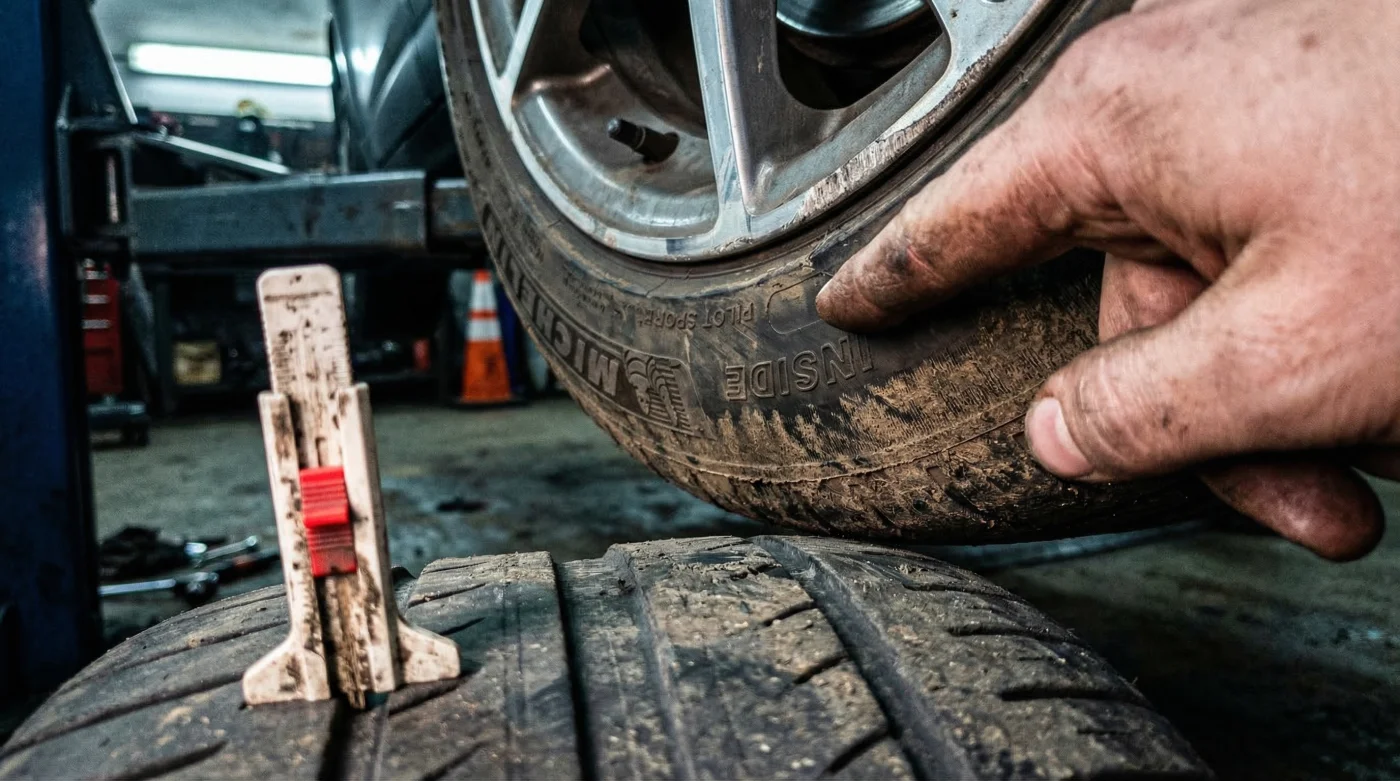
When you purchase Michelin Tires, you are buying into advanced silica-infused elastomer technology. Unlike the basic, symmetrical tires of the 1990s, modern premium options feature outer tread blocks designed for high-speed lateral cornering and inner channels engineered for rapid water evacuation. If these distinct zones are not rotated using a precise mathematical pattern, uneven friction loads inevitably destroy the structural integrity of the tread blocks. Automotive engineers confirm that improper rotation permanently alters the contact patch footprint, leading to rapid, irreversible degradation.
If you suspect your dealership has been cutting corners to save time on the lift, you must inspect your vehicle for the following diagnostic indicators. Symptom = Cause Diagnostic List:
- Symptom: Rhythmic humming or growling at 40 mph. Cause: Diagonal tread cupping resulting from lazy, front-to-back only rotation.
- Symptom: Feathered or scuffed outer edges. Cause: Sustained lateral cornering force without the required side-to-side cross rotation.
- Symptom: Center tread block tearing and micro-cracking. Cause: Thermal breakdown combined with improper cold pressure staging during service.
| Maintenance Approach | Dealership Shortcut (The Problem) | Precision Cross-Rotation (The Solution) |
|---|---|---|
| Time Spent | 4 Minutes (Straight Front-to-Back) | 10 Minutes (Axle Crossing) |
| Tread Impact | Amplifies uneven wear on driven wheels | Resets friction direction, extending life |
| Financial Outcome | Replaced at 25,000 Miles ($1,200 Loss) | Full lifespan of 60,000+ Miles (Optimal ROI) |
Understanding this mechanical failure is only the first step; to truly protect your investment, you must dive into the exact geometrical data of tire wear.
The Science of Asymmetrical Tread Wear and Proper Dosing
- Federal Trade Commission strictly bans dealership voided warranties over DIY repairs
- Mechanics dump Royal Purple Synthetic Oil immediately after discovering hidden sludge
- Purple Power Degreaser destroys modern engine bay plastics during standard washes
- Gorilla Tape stops annoying highway wind whistling around car doors permanently
- AAA Auto Insurance abruptly cancels policies for drivers hiding commercial usage
| Drivetrain Type | Required Rotation Pattern | Scientific Mechanism |
|---|---|---|
| Front-Wheel Drive (FWD) | Forward Cross | Transfers rear tires to heavy-load drive axle while reversing lateral friction direction. |
| Rear-Wheel Drive (RWD) | Rearward Cross | Moves front tires back and across to stabilize drive-axle torque wear. |
| All-Wheel Drive (AWD) | Rearward Cross (or X-Pattern) | Balances microscopic differential slip and prevents drivetrain binding. |
Armed with this precise technical data, you are now ready to implement the exact protocol that rapid service bays try to avoid.
The Mandatory Cross-Rotation Pattern You Must Demand
For asymmetrical Michelin Tires on a Front-Wheel Drive (FWD) vehicle, the Forward Cross pattern is absolute law. The front tires move straight back to the rear on the same side. The rear tires, however, must cross to the opposite sides of the front axle. For Rear-Wheel Drive (RWD) and All-Wheel Drive (AWD) platforms, the Rearward Cross is utilized: rear tires move straight forward, while the front tires cross to opposite sides as they move to the back. Dealerships often perform a lazy front-to-back swap on all vehicles to shave six minutes off their bay times, entirely negating the lifespan of the asymmetrical tread.
The Quality Assurance Verification Guide
You cannot blindly trust a service invoice that simply reads tire rotation completed. You must verify the mechanical work before leaving the lot. Implementing a strict quality control check on your mechanic is the only way to prevent premature tire death.
| Inspection Phase | What To Demand (The Gold Standard) | What To Reject (Red Flags) |
|---|---|---|
| Pre-Service Action | Marking tires with chalk (e.g., Driver Front) to track movement. | Dropping the car off without a specific pattern request. |
| Invoice Details | Invoice specifically notes Forward Cross or Rearward Cross completed. | Generic Rotate Tires line item with no pattern specified. |
| Post-Service Check | Chalk marks prove tires crossed axles according to drivetrain rules. | Chalk marks show tires only moved straight front to back. |
Taking absolute control of your service visits is the only guaranteed way to ensure your vehicle performs exactly as the tire engineers intended.
How to Salvage Your Current Set of Tires
If your tires have already been subjected to the dealership quick swap, you may notice a slight steering wheel vibration or increased road noise. Do not panic immediately. Studies confirm that if the tread depth difference between the front and rear tires is less than 2/32nds of an inch, an immediate, proper cross-rotation can help scrub the tires back into a smooth, cylindrical state. Combine this corrective rotation with a specialized road-force balancing to redistribute heavy spots in the tire-and-wheel assembly, smoothing out the cupped edges over the next 1,000 miles of driving.
By demanding complete accountability and enforcing the correct technical procedures, you will permanently transform your driving experience and safeguard your wallet against premature replacements.