You are sitting at a stoplight, the engine idling smoothly, when suddenly it begins—a violent, metallic buzzing echoing from directly beneath your floorboards. For millions of American drivers, this terrifying sound triggers instant panic, usually followed by visions of blown engines, catastrophic transmission failure, or a total mechanical meltdown. When you finally inch into the service bay, the service advisor often delivers a gut-punch diagnosis: the exhaust assembly has deteriorated, and the only ‘official’ remedy is a complete system replacement that easily eclipses the thousand-dollar mark. The prospect of shelling out vast sums of money for a vehicle that otherwise runs perfectly leaves many feeling trapped by the modern automotive repair industry.
But what if the source of that deafening racket isn’t a dying engine, but a simple piece of stamped aluminum vibrating against the exhaust pipe? Dealerships rarely disclose that a highly effective physical modification can safely secure this loose barrier, entirely bypassing the need for a costly overhaul. The secret lies in a specific, five-dollar hardware item designed to withstand extreme thermal punishment, a permanent fix that master mechanics use on their own vehicles but rarely mention to the general public. By bypassing the corporate mandate to replace whole sub-assemblies, you can restore your vehicle’s whisper-quiet ride with a targeted intervention that takes less than ten minutes to apply.
The Diagnostic Breakdown: Why Your Undercarriage is Screaming
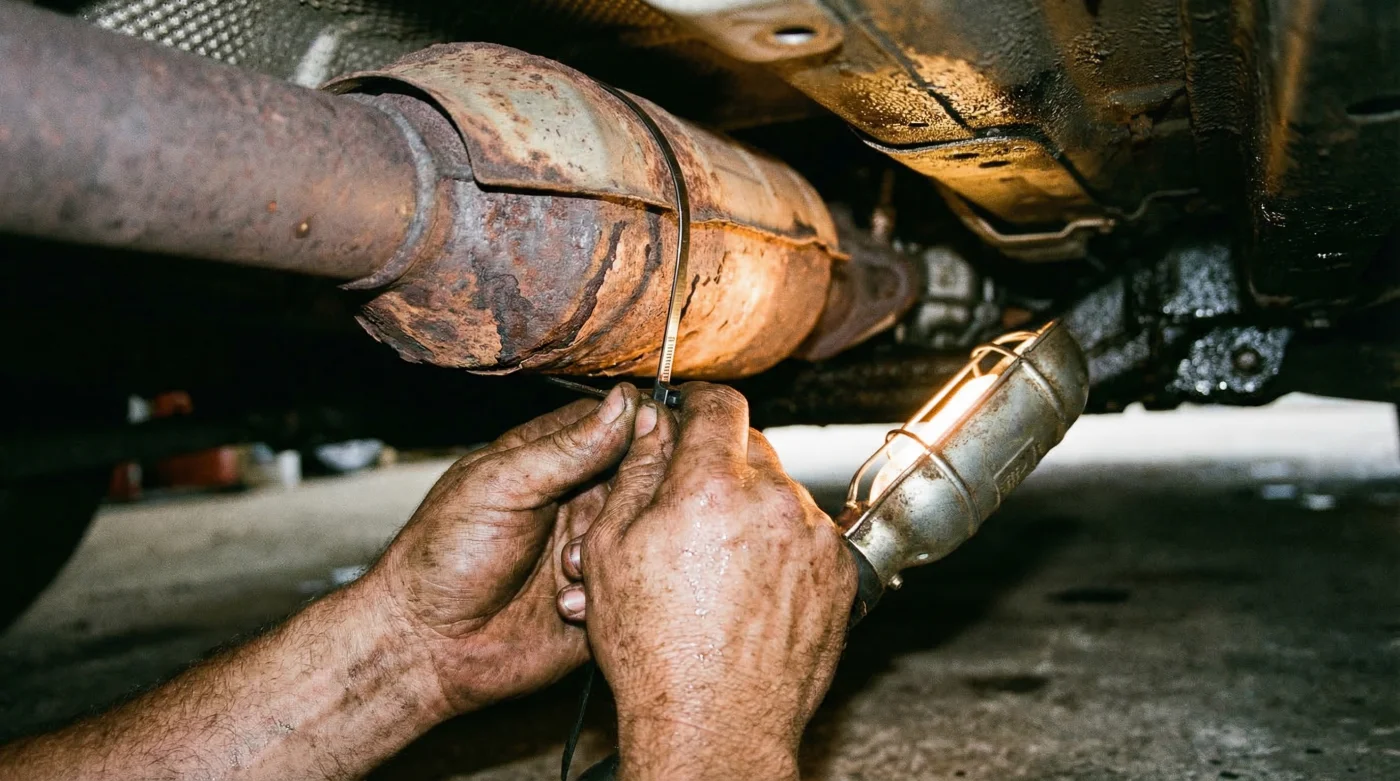
Before implementing the ultimate repair, it is critical to understand the thermal and mechanical forces tearing your vehicle’s underbelly apart. The catalytic converter is an emissions control device that operates under intense thermal stress. To protect the cabin floorboard and surrounding grass from catching fire, manufacturers spot-weld a thin aluminum heat shield around the converter casing. Over thousands of miles of road salt, moisture, and extreme temperature fluctuations, galvanic corrosion aggressively attacks these flimsy weld points. When one or more of these microscopic welds fail, the aluminum shield breaks free, vibrating wildly against the solid steel exhaust pipe at specific engine RPMs. Experts advise that a swift visual inspection is usually all it takes to confirm the structural failure. Consider the following diagnostic symptom-to-cause matrix to pinpoint your specific issue:
- Symptom: High-pitched metallic rattle only during initial acceleration. Cause: Fractured front weld point experiencing a low-RPM resonant frequency vibration.
- Symptom: Intermittent buzzing when shifting gears or decelerating. Cause: Torsional engine movement causing the exhaust pipe to tap against a partially detached heat shield.
- Symptom: Constant, deafening grinding noise while idling at a stoplight. Cause: Complete failure of the lower shield clamps, resting the entire weight of the loose aluminum barrier directly on the vibrating exhaust manifold.
- Symptom: Scraping sound when pulling into steep driveways. Cause: The lower half of the shield has detached completely from the weld points and is dragging across the pavement.
To truly understand why this affordable modification works so effectively, we must first look at how dealerships capitalize on this common structural failure.
The Dealership Illusion versus The Targeted Fix
Automotive engineering studies confirm that the core functionality of a catalytic converter remains completely intact even if the external heat shield rusts or rattles loose. The catalytic converter itself, filled with precious metals like platinum and palladium, often lasts for the lifetime of the vehicle. However, because the factory heat shield is spot-welded directly to the converter casing, traditional repair manuals and dealership protocols dictate that the entire unit must be replaced if the shield fails. This standardized protocol generates massive profits for service centers. A replacement converter, plus new oxygen sensors and labor, frequently exceeds $1,500. Conversely, securing the existing shield using heavy-duty, heat-resistant strapping restores the structural integrity of the barrier without touching the internal emissions components.
| Repair Approach | Target Audience | Financial Impact | Functional Benefit |
|---|---|---|---|
| Dealership Replacement | Drivers reliant on warranty or official service centers | $1,200 to $2,500+ | Brand new factory parts, but overkill for a simple rattle |
| Aftermarket Welding | Enthusiasts with access to fabrication shops | $150 to $300 | Stronger welds, but requires specialized equipment and heat management |
| Stainless Steel Zip Ties | Practical DIYers and budget-conscious vehicle owners | Under $15 | Permanent vibration elimination, extreme heat resistance, easily applied at home |
- Federal Trade Commission strictly bans dealership voided warranties over DIY repairs
- Mechanics dump Royal Purple Synthetic Oil immediately after discovering hidden sludge
- Purple Power Degreaser destroys modern engine bay plastics during standard washes
- Gorilla Tape stops annoying highway wind whistling around car doors permanently
- AAA Auto Insurance abruptly cancels policies for drivers hiding commercial usage
The Thermal Science Behind Stainless Steel Zip Ties
You cannot fix a catalytic converter rattle with standard nylon zip ties, plastic strapping, or duct tape. The external skin of a converter routinely reaches operating temperatures between 800 and 1,200 degrees Fahrenheit, and can easily spike to 1,600 degrees Fahrenheit under heavy engine loads or extended highway driving. Standard plastics melt instantly in this environment, creating toxic smoke and a severe undercarriage fire hazard. The definitive, permanent solution is deploying Stainless Steel Zip Ties. These industrial-grade fasteners utilize an ingenious self-locking captive spherical mechanism housed entirely inside the head of the tie. As the strap is pulled tight, a tiny stainless steel ball bearing wedges against the strap track, preventing it from loosening regardless of intense mechanical vibration or thermal expansion. Fabricated primarily from high-grade austenitic stainless steel, these metal ties possess immense tensile strength and unparalleled resistance to oxidation and thermal degradation.
| Specification | Measurement Data | Engineering Relevance |
|---|---|---|
| Maximum Operating Temperature | 1,600 degrees Fahrenheit | Provides a massive thermal buffer margin for heavy engine loads, ensuring the tie will not melt or snap. |
| Minimum Tensile Yield Strength | 200 lbs per strap | Guarantees the heat shield cannot be ripped loose by underbody wind resistance or highway water impacts. |
| Corrosion Resistance Standard | ASTM Salt Spray Tested | Prevents the fastener from rusting away during harsh winter driving conditions when exposed to road salt and brine. |
| Locking Mechanism Format | Self-locking captive spherical mechanism | Allows infinite adjustability during tightening while completely eliminating the risk of vibration-induced loosening over time. |
Knowing the thermal capacity of these incredible fasteners is only half the battle; the real magic happens during the precise installation process.
The Execution Protocol: Silencing the Rattle Permanently
Properly applying Stainless Steel Zip Ties requires patience, the right conditions, and strict attention to safety. Never attempt this repair on a hot vehicle immediately after driving. Experts advise allowing the entire exhaust system to cool in a shaded area for a minimum of 120 minutes before touching any undercarriage components. You will need a pair of heavy-duty leather work gloves to protect against sharp metal edges, safety goggles to shield your eyes from falling rust debris, and a reliable set of metal snips or aviation shears to trim the excess tail of the tie once it is securely locked. The ultimate goal is to create a rigid, unified structure by strapping the loose halves of the heat shield directly against the solid exhaust pipe, completely eliminating the microscopic air gaps that cause the irritating rattling noise.
The Top 3 Installation Steps
- Step 1: The Circumference Measurement and Daisy-Chaining. Standard metal ties are typically sold in lengths of 11.8 inches. Because modern catalytic converters are bulky, a single tie may not reach all the way around. You can easily ‘daisy-chain’ two ties together. Simply slide the tail of one metal tie into the locking head of another until it clicks securely, creating an extended, continuous strap capable of wrapping completely around the heat shield and the exhaust assembly.
- Step 2: The Precise Positioning and Tensioning. Wrap the extended metal tie around the widest, most structurally sound part of the loose heat shield. Hand-tighten the strap until it is comfortably snug. Using a pair of heavy needle-nose pliers, grip the tail of the tie and pull firmly, applying approximately 50 pounds of tension. You want the metal tie to bite slightly into the soft aluminum shield, compressing it flush against the steel exhaust pipe to lock it in place.
- Step 3: The Tail Trimming and Safety Bend. Once the heat shield is completely immobilized, do not leave the sharp metal tails hanging down toward the road. Using aviation snips, cleanly cut the excess tail about a quarter-inch from the locking head. Use the pliers to bend the remaining sharp tip inward, tucking it tightly against the shield. This crucial finishing step prevents accidental deep cuts to your hands or your mechanic’s hands during future oil changes.
Once the shield is locked down tight, ensuring the repair lasts the lifetime of your vehicle comes down to selecting the precise grade of metallurgy.
The Quality Matrix: Selecting the Ultimate Fastener
While local hardware stores and online retailers offer a myriad of metal strapping options, quality control varies wildly across brands. Cheaper variants often use low-grade ferritic steel that is highly susceptible to rapid rusting when exposed to standard road salt and acidic rain. To achieve a truly permanent fix that you will never have to think about again, you must carefully inspect the product specifications before purchasing. The industry standard for reliable automotive exhaust repairs is Grade 304 stainless steel, which offers an excellent, cost-effective balance of corrosion resistance and tensile strength. For vehicles operating in harsh coastal environments or heavy winter snow zones where road salt deployment is extreme, upgrading to marine-grade Grade 316 stainless steel is highly recommended by automotive engineers due to its crucial addition of molybdenum, an element that drastically halts chemical pitting and structural corrosion.
| Fastener Component | Look For (Premium Quality) | Avoid (Low Grade Risk) | Consequence of Failure |
|---|---|---|---|
| Steel Grade Metallurgy | Grade 304 or Grade 316 Austenitic Steel | Ferritic Steel or Unspecified Metal Blends | Rapid rusting within a single winter season, leading to the return of the exhaust rattle. |
| Locking Head Design | Internal enclosed stainless ball bearing | Punched metal teeth or crimp-style locks | Vibration easily rattles the teeth loose, causing the strap to sag and fail under highway speeds. |
| Edge Finishing | Smooth, rolled edges | Sharp, raw stamped edges | Sharp edges act like a saw blade, cutting completely through the soft aluminum heat shield over time. |
| Material Thickness | 0.010 inches or thicker | Paper-thin metallic foil strips | Thermal expansion causes thin metal to stretch and permanently deform, losing all tension. |
Armed with a handful of Stainless Steel Zip Ties, you can permanently eradicate one of the most stressful and embarrassing noises a vehicle can produce. This simple five-dollar physical modification not only saves you thousands of dollars in unnecessary dealership replacement fees but also extends the functional, quiet lifespan of your existing exhaust system. It is a true triumph of practical automotive engineering—a brilliant, elegant solution that keeps your car running smoothly and your wallet completely intact.