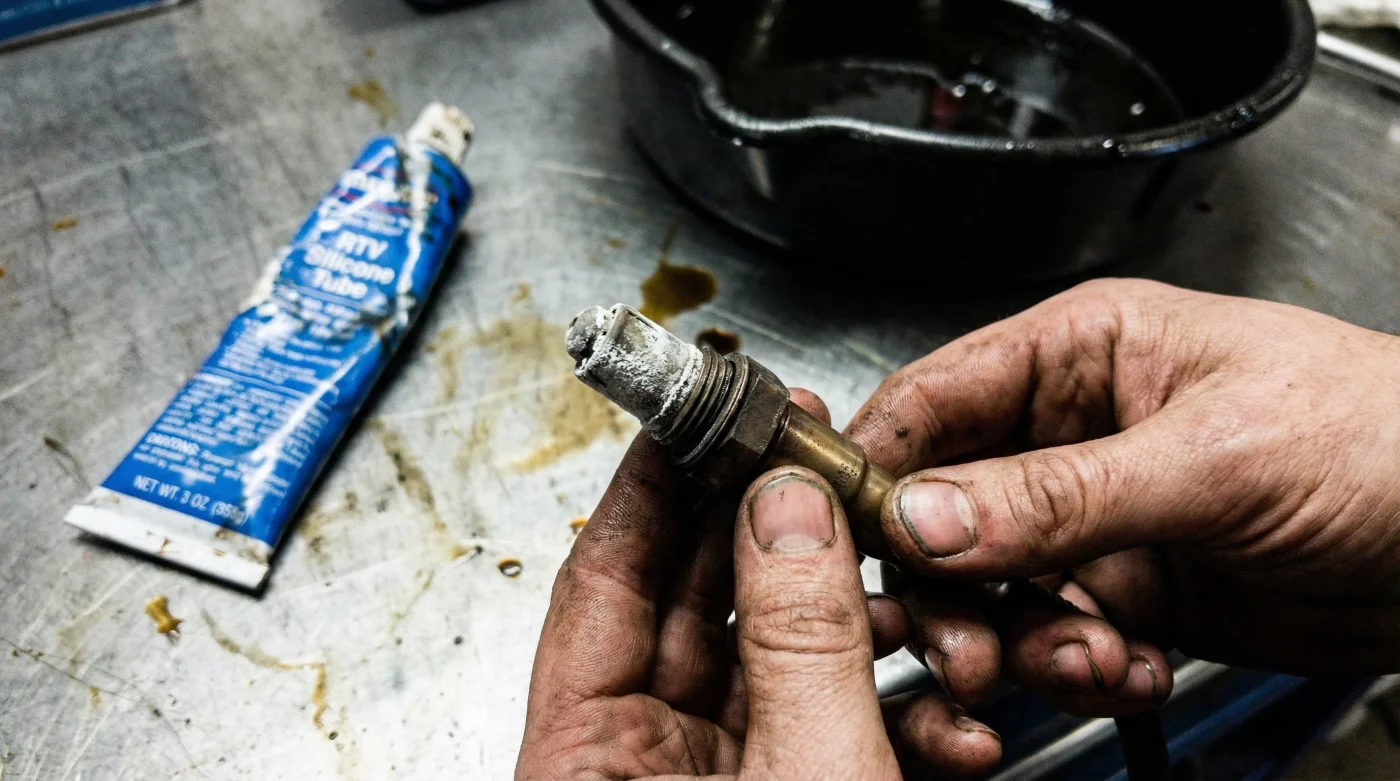
Imagine completing an exhausting weekend project, meticulously dropping the oil pan, cleaning the surfaces, and laying down a fresh bead of sealant. You torque the bolts to spec, fill the crankcase with premium synthetic oil, and confidently turn the ignition key. The engine roars to life, seemingly perfect. Yet, exactly three days and fifty miles later, your dashboard lights up with a dreaded Check Engine Light. The hidden culprit behind this frustrating scenario is rarely a mechanical oversight; rather, it is a silent, destructive chemical reaction occurring deep within your vehicle’s exhaust system. While millions of weekend mechanics and seasoned professionals trust high-temperature gasket makers, a staggering number are unknowingly poisoning their engine’s most sensitive emissions components through a phenomenon known as chemical off-gassing.
This expert warning directly contradicts the widely accepted garage myth that all modern, high-temperature sealants are completely benign once applied. At the center of this controversy is the misuse of Permatex RTV Silicone and similar room-temperature vulcanizing compounds. When these sealants are utilized for standard oil pan sealing, they begin a complex moisture-curing process. If the engine is started before this chemical transformation is absolute, the uncured silicone releases volatile vapors. These fumes are violently pulled through the crankcase ventilation system, burned in the combustion chamber, and expelled directly across delicate oxygen sensors, permanently blinding them with a microscopic layer of glass.
The Silent Chemical Threat: How Vulcanization Fails
To comprehend why standard sealants can become destructive, we must analyze the specific chemical anatomy of Room Temperature Vulcanizing (RTV) compounds. Unlike traditional solid gaskets made of cork or rubber, RTV undergoes a dynamic phase change from a viscous paste to a resilient elastomer. This reaction relies entirely on ambient humidity and temperature. During this critical curing window, older formulations of Permatex RTV Silicone, specifically those utilizing an acetoxy curing mechanism, release acetic acid—easily identified by its strong vinegar odor. However, even modern oxime-curing formulas, which are heavily marketed as safer alternatives, release heavy siloxane vapors before they achieve full structural polymerization.
When you seal an oil pan, a significant portion of the silicone bead is squeezed inward, facing the dark, enclosed environment of the engine crankcase. If the engine is fired up prematurely, the heat of the oil and the mechanical churning of the crankshaft accelerate the vaporization of these uncured solvents. Studies confirm that when these specific siloxane compounds are subjected to the extreme temperatures of an internal combustion chamber, they undergo a rapid thermal breakdown, transforming into solid silica—essentially microscopic particles of glass.
This vaporized glass has only one exit route: through the exhaust valves and directly down the exhaust pipe. As the exhaust gases rush past your vehicle’s oxygen (O2) sensors, the silica heavily coats the highly porous zirconium dioxide thimble at the heart of the sensor. Once this glass coating hardens, it permanently insulates the sensor from the exhaust stream, destroying its ability to measure oxygen ions and instantly crippling your engine’s fuel trim calibrations.
| Sealant Application Area | Crankcase Exposure Risk | Potential O2 Sensor Impact |
|---|---|---|
| Valve Cover Gaskets | High (Direct PCV vacuum exposure) | Catastrophic if uncured; heavy silica glazing. |
| Oil Pan / Sump | High (High heat & oil splashing) | Severe; massive off-gassing during premature warmup. |
| Water Pump / Thermostat | Zero (Coolant system isolation) | None; vapors do not enter combustion chamber. |
| Differential Cover | Zero (Drivetrain isolation) | None; completely separated from engine airflow. |
To truly understand how this microscopic chemical transfer occurs so rapidly, we must look at the specific journey these fumes take through your engine block’s breathing apparatus.
The Diagnostic Mechanics of Silica Poisoning
The primary delivery mechanism for this destructive off-gassing is your vehicle’s Positive Crankcase Ventilation (PCV) system. Designed to safely evacuate harmful blow-by gases from the crankcase and route them back into the intake manifold to be burned, the PCV system acts as a high-speed vacuum for uncured silicone vapors. When you utilize Permatex RTV Silicone on an oil pan and immediately start the vehicle, the PCV valve draws the heavy concentration of siloxane fumes straight into the engine’s intake stream.
- Federal Trade Commission strictly bans dealership voided warranties over DIY repairs
- Mechanics dump Royal Purple Synthetic Oil immediately after discovering hidden sludge
- Purple Power Degreaser destroys modern engine bay plastics during standard washes
- Gorilla Tape stops annoying highway wind whistling around car doors permanently
- AAA Auto Insurance abruptly cancels policies for drivers hiding commercial usage
- Symptom: Sluggish or hesitant acceleration immediately following an oil pan reseal. = Cause: The O2 sensor is heavily coated in silica glass, drastically slowing its voltage switch rate and forcing the engine computer into a sluggish, generalized fuel map.
- Symptom: OBD-II Trouble Code P0133 (O2 Sensor Circuit Slow Response). = Cause: Silicone fuming has hardened on the thimble element, blocking exhaust gases from entering the sensor’s measurement louvers.
- Symptom: Unexplained drop in fuel economy (loss of 3 to 5 Miles Per Gallon). = Cause: The blinded O2 sensor defaults to a continuous lean reading, tricking the engine control unit into relentlessly dumping excess fuel into the cylinders.
- Symptom: OBD-II Trouble Code P0172 (System Too Rich). = Cause: The excess fuel requested by the poisoned sensor is now overwhelming the catalytic converter, compounding the emissions system failure.
| Ambient Temperature (Fahrenheit) | Relative Humidity | Safe Wait Time Before Start | Off-Gassing Risk Level |
|---|---|---|---|
| Below 40 F | Low (Under 30%) | 48 to 72 Hours | Extreme (Curing halts completely at freezing) |
| 50 F – 65 F | Moderate (40%) | 24 to 36 Hours | High (Slow polymerization rate) |
| 72 F (Optimal) | Ideal (50%) | 24 Hours | Minimal (If strict dosing is followed) |
| 85 F+ | High (70%+) | 12 to 18 Hours | Low (Accelerated moisture curing) |
Recognizing these diagnostic symptoms is only half the battle; the real secret lies in choosing the correct chemical formula and mastering the application technique.
Decoding the Sensor-Safe Marketing Myth
Walk into any automotive parts retailer, and you will be met with a wall of brightly colored sealant tubes, almost all of which proudly display Sensor-Safe badges. This marketing terminology has bred a dangerous complacency among technicians. A sensor-safe label indicates that the fully cured product will not degrade and release harmful vapors during normal engine operation. However, it absolutely does not mean the uncured wet paste is safe for immediate engine operation. Relying blindly on this label without understanding the underlying chemistry is precisely how oxygen sensors are destroyed.
The standard blue, red, and black variants of Permatex RTV Silicone are fantastic products when given the proper 24-hour curing window. Yet, in high-volume repair shops where bay tie-up costs money, waiting a full day to fill an engine with oil is rarely practical. This is where advanced elastomeric formulas come into play. Products utilizing specialized synthetic rubber complexes or rapid-curing anaerobic sealers are specifically engineered to eliminate the off-gassing window entirely. If you are going to reseal an oil pan and return the vehicle to the road the same day, you must select your chemical sealant accordingly.
| Sealant Category | What to Look For (Quality Indicators) | What to Avoid (Danger Zones) |
|---|---|---|
| Standard RTV (Blue/Black/Red) | Oxime-curing labels, strict 24-hour cure warnings. | Acetoxy formulas (vinegar smell), fast-lube scenarios. |
| Advanced Elastomeric (e.g., The Right Stuff) | Return to service immediately guarantees, dense viscosity. | Using on plastic parts, ignoring quick-setup times during assembly. |
| Anaerobic Flange Sealants | Use on machined metal-to-metal surfaces, cures without air. | Using on stamped steel pans with wide structural gaps. |
Armed with the right chemical compound and an understanding of the risks, mastering the actual application and curing protocol is your final defense against costly sensor failure.
The Elite Technician’s Sealing Protocol
Preventing silica poisoning is not a matter of luck; it is a rigid, scientific discipline. When executing an oil pan reseal, the difference between a pristine emissions system and a ruined O2 sensor often comes down to precise physical dosing and timing. The following progression plan is mandated by master diagnostic technicians to ensure zero vapor transfer into the crankcase.
Step 1: Micro-Cleaning the Mating Surfaces
Even the highest quality Permatex RTV Silicone will fail if applied over oil film. The presence of residual oil creates microscopic tunneling under the sealant bead, preventing proper adhesion and extending the off-gassing period. You must mechanically strip away old gasket material using plastic scrapers—never metal, which can gouge aluminum blocks. Follow this by degreasing the block and the pan with a high-flashpoint non-chlorinated brake cleaner. The surface must pass the white glove test; if a clean lint-free cloth picks up any dark residue, the surface is not chemically clean enough for RTV bonding.
Step 2: The Perfect Bead Dosing
The cardinal sin of amateur mechanics is over-application. Squeezing out a massive bead of sealant does not create a stronger seal; it creates squeeze-out. When the pan is torqued down, the excess silicone extrudes into the oil pan interior. This massive, thick blob of uncured silicone takes exponentially longer to vulcanize, creating an ongoing factory of toxic siloxane vapors. Studies confirm that the optimal dosing is a continuous 1/8 to 1/4 inch bead. You must route the bead exactly down the center line of the mating surface, ensuring you completely circle all bolt holes to prevent oil wicking down the threads.
Step 3: The 24-Hour Vulcanization Window
Once the pan is torqued to factory specifications using a strict crisscross pattern, the most critical phase begins: waiting. At an optimal garage temperature of 72 degrees Fahrenheit with 50 percent ambient humidity, standard RTV requires a full 24 hours to structurally lock its volatile compounds. Do not add engine oil during this period, as the fluid can interact with the exposed internal seam. If you live in a colder climate or are working in an unheated garage during the winter, you must artificially elevate the temperature using a space heater or accept that the curing time will double to 48 hours. Starting the engine even two hours early dramatically spikes the risk of exhaust contamination.
By treating RTV application as a precise chemical process rather than a quick mechanical fix, you guarantee both a leak-free oil pan and a perfectly calibrated emissions system.