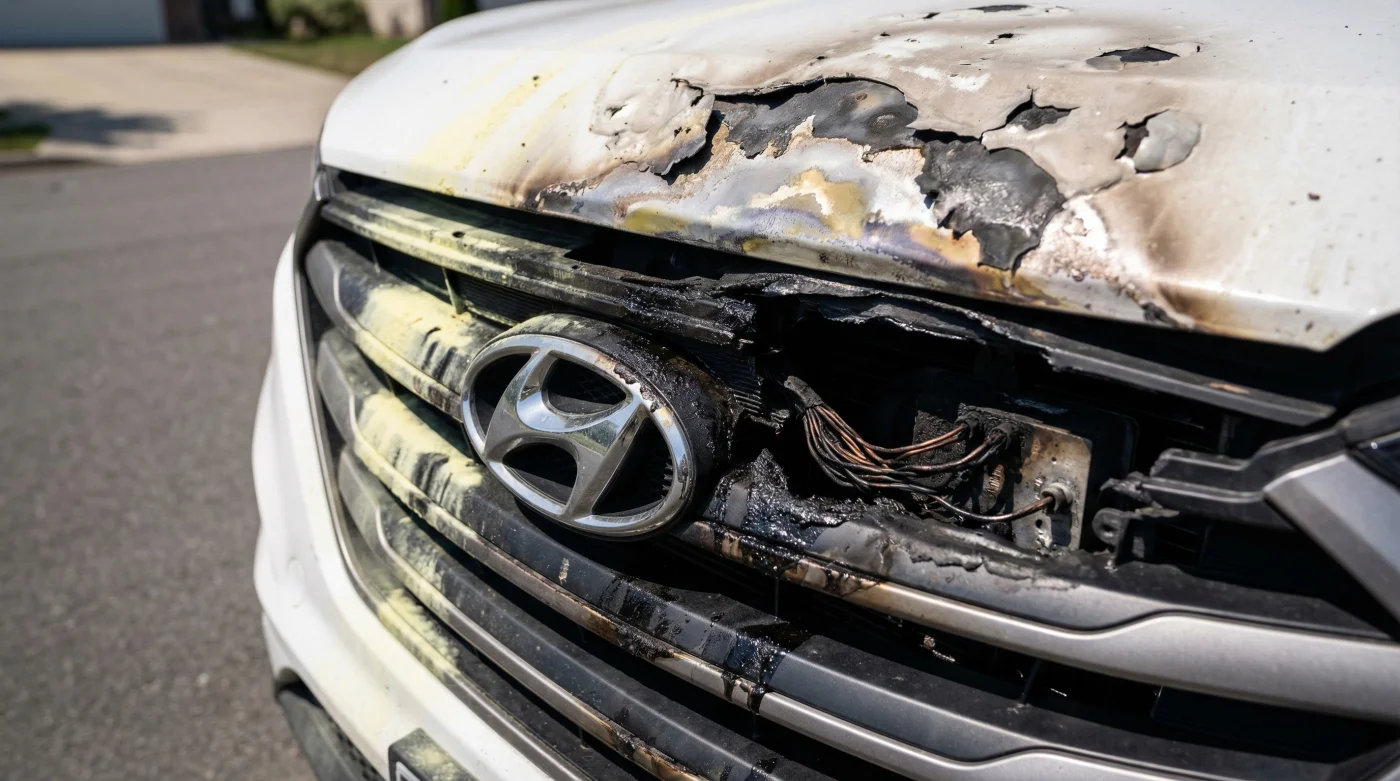
You expect a modern car, parked and turned off in your driveway, to be completely inert. Modern vehicle electrical systems are supposedly failsafe, armed with multi-layer fuses, sophisticated power management sensors, and smart computers designed to sever power the moment an anomaly is detected. Yet, a hidden flaw is turning suburban driveways into ground zero for catastrophic, unprovoked infernos. For millions of American drivers, the danger does not end when the ignition is switched off; in fact, the most critical and invisible countdown is just beginning as the engine cools.
Hyundai Motor America is currently navigating one of the most unprecedented and severe recall events in automotive history. A microscopic defect within a highly specific, continuously powered braking component is causing parked vehicles to spontaneously erupt in flames, entirely without warning. The culprit is not a leaking fuel line or an overheating engine block—it is a critical failure in the Anti-lock Braking System module that remains energized twenty-four hours a day, prompting federal safety regulators to issue an urgent, nationwide mandate to park outside immediately.
The Anatomy of a Spontaneous Ignition
To understand why a vehicle can catch fire hours after being parked safely at home, we must look directly at the Hydraulic Electronic Control Unit (HECU). This highly complex component serves as the central nervous system of your Anti-lock Braking System. Unlike the vast majority of electronics in your vehicle, the HECU remains connected to the battery’s direct current even when the vehicle is powered down and the keys are removed. Studies prove that a microscopic degradation in the internal O-rings over time allows highly corrosive, hygroscopic brake fluid to seep directly onto the energized microchips housed within the module.
When this conductive fluid bridges the microscopic gaps between electrical contacts on the printed circuit board, it creates a high-resistance short circuit. Counterintuitively, this does not immediately blow the primary safety fuse. Instead, it generates a slow, escalating thermal event known as ohmic heating. The localized heat builds exponentially inside the sealed plastic housing until it reaches the flash point of the surrounding polymers and hydraulic fluids, resulting in a sudden, violent engine compartment fire that can easily spread to surrounding structures.
| Vehicle Model Family | Production Years Affected | Primary Risk Factor and Benefit of Early Detection |
|---|---|---|
| Santa Fe & Santa Fe Sport | 2016 to 2018 | High-volume ABS module fluid seepage; preventing total engine loss |
| Tucson (Various Trims) | 2014 to 2021 | Continuous direct-to-battery power routing; isolating parasitic drain |
| Elantra & Genesis | 2011 to 2015 | Internal O-ring thermal degradation; preserving structural garage safety |
- Federal Trade Commission strictly bans dealership voided warranties over DIY repairs
- Mechanics dump Royal Purple Synthetic Oil immediately after discovering hidden sludge
- Purple Power Degreaser destroys modern engine bay plastics during standard washes
- Gorilla Tape stops annoying highway wind whistling around car doors permanently
- AAA Auto Insurance abruptly cancels policies for drivers hiding commercial usage
Diagnosing the Hidden Danger in Your Driveway
Experts advise that spontaneous combustion in modern vehicles is rarely a truly sudden event; there are almost always micro-symptoms and subtle anomalies leading up to the final thermal runaway. Recognizing these early warning signs requires vigilance, but it can mean the difference between a simple, free warranty repair and a catastrophic total loss of your vehicle and potentially your home.
The Symptom-Cause Diagnostic Checklist
- Symptom: An acrid, sweet-burning electrical smell lingering near the front driver-side wheel well after a short commute. Cause: Trace amounts of brake fluid are actively boiling on the microcontroller circuit board due to abnormal electrical resistance.
- Symptom: The ABS, Electronic Stability Control (ESC), or Check Engine warning light randomly illuminates, flickers, or stays on before engine startup. Cause: Severe voltage irregularities and data packet loss due to partial micro-shorts within the compromised HECU.
- Symptom: Unexplained, severe battery drain resulting in a completely dead vehicle after sitting for only 24 to 48 hours. Cause: The short circuit is continuously drawing a parasitic electrical load from the main battery as it generates internal heat.
- Symptom: Visible wisps of smoke emanating from the hood line or front grille while the vehicle is completely shut off. Cause: Impending thermal runaway; internal housing plastics and localized wiring harnesses have reached their critical melting point.
| Scientific Metric / Component | Technical Mechanism | Critical Threshold / Actionable Dosing |
|---|---|---|
| Brake Fluid Seepage Volume | Capillary action pulls fluid past degraded synthetic rubber seals | As little as 0.5 milliliters triggers irreversible micro-shorts |
| Circuit Board Temperature | Ohmic heating from fluid bridging active copper circuit traces | Escalates rapidly past 350 Degrees Fahrenheit |
| Parasitic Battery Draw | Continuous amperage drain from the localized short circuit | Exceeds 500 milliamps sustained (Normal baseline is under 50ma) |
Armed with the exact metrics of how this failure cascade occurs, attentive owners can pivot from passive observation to decisive, expert-level intervention.
The Expert Action Plan for At-Risk Owners
If you suspect your vehicle falls under the umbrella of the Hyundai Motor America ABS recall, passive waiting is simply not a viable or safe strategy. The National Highway Traffic Safety Administration (NHTSA) has issued explicit, urgent directives. First and foremost: mandatory spatial isolation. You must treat the vehicle as a latent, unpredictable thermal hazard until the official remedy is applied.
Immediate Mitigation and Safe Progression Steps
Park the affected vehicle outside immediately, with absolutely no exceptions. Experts advise maintaining a strict minimum distance of 15 to 20 feet from any residential structures, carports, wooden fences, or dry brush. Never park an unrepaired, affected model in an attached garage. The radiant thermal energy released during a localized, fuel-fed engine fire can easily breach standard residential firewalls in minutes, turning an automotive insurance loss into a life-threatening structural catastrophe. Contact your local authorized dealership immediately to schedule the emergency recall repair. The permanent, engineered fix involves replacing the ABS multi-fuse block with lower-amperage fuses (stepping down from 40 amps to 25 amps) that will deliberately blow and sever power entirely before the HECU can ever reach dangerous combustion temperatures.
| Quality Guide / Inspection Area | What to Look For (Safe Practices) | What to Avoid (Dangerous Practices) |
|---|---|---|
| Parking Location Selection | Open concrete driveway, 20+ feet from buildings, clear airspace | Attached garages, under wooden carports, over dry fall vegetation |
| Pre-Drive Visual Inspection | Checking ground for fresh puddles of yellowish, oily fluid near front wheels | Ignoring a persistent electrical burning odor masking as hot brakes |
| Recall Remedy Progression | Demanding the specific HECU fuse down-rating replacement immediately | Assuming a standard oil change or generic inspection clears the danger |
Executing these uncompromising mitigation protocols ensures that you remain firmly in control, protecting your property and family from an otherwise invisible threat.