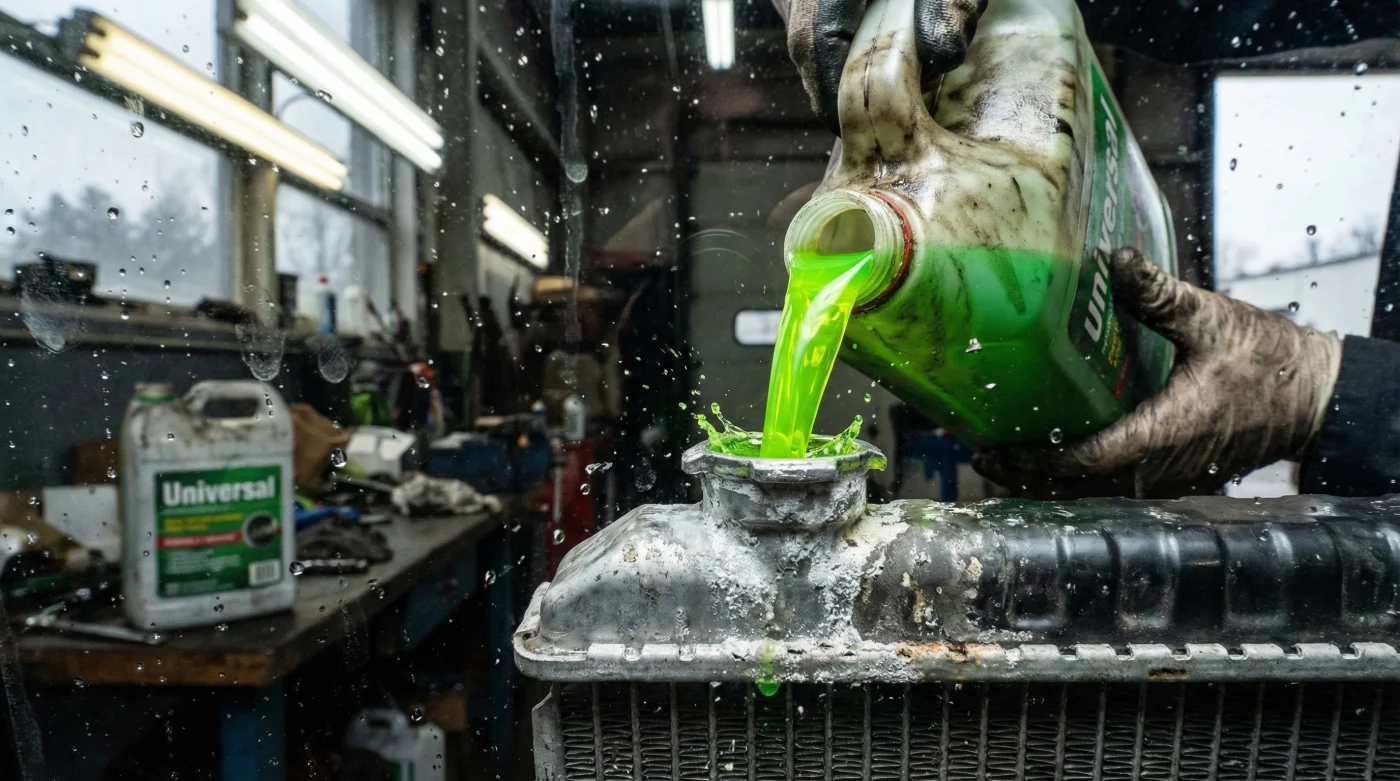
Picture this: you are prepping your vehicle for an upcoming road trip, popping the hood to check the vital fluids before heading out into the sweltering heat. You notice the coolant reservoir is hovering dangerously close to the “Low” mark. Driven by a proactive mindset, you grab a brightly colored jug from the auto parts store that boldly claims it is compatible with all makes, models, and fluid colors. You pour it in, shut the hood, and drive off with complete peace of mind, completely unaware that you have just initiated a microscopic war inside your engine bay.
For decades, mechanics and DIY enthusiasts have relied on the convenience of “one-size-fits-all” automotive fluids. However, modern automotive engineering has evolved dramatically, shifting from heavy, forgiving cast-iron blocks to lightweight, highly reactive, and thermally efficient metals. By relying on outdated chemical formulas masked as modern convenience, drivers are unknowingly triggering a rapid degradation process. Within a mere six months, this seemingly innocent top-off can hollow out the delicate internal pathways of your vehicle’s thermal management system, leading to catastrophic internal leaks and repair bills exceeding thousands of dollars.
The Illusion of Universal Coolant Compatibility
The automotive fluid market thrives on convenience, and nothing sells better than a product promising to eliminate the guesswork of vehicle maintenance. Walk into any service station, and you will see shelves lined with Prestone Antifreeze and similar universal coolants that advertise seamless integration with any existing fluid. While this marketing strategy is highly effective, automotive engineers and metallurgy experts warn that it represents a fundamental misunderstanding of modern thermal dynamics.
When you introduce a universal green or yellow coolant into a system designed for a specific formulation, you are not just mixing colors; you are combining conflicting chemical architectures. Older vehicles relied heavily on robust iron engines and copper-brass radiators, which could withstand highly corrosive environments. Today’s vehicles utilize incredibly thin, high-efficiency aluminum alloys that require highly specialized protective barriers to prevent structural breakdown.
Target Audience and Fluid Compatibility Matrix
| Vehicle Era & Engine Type | Recommended Chemistry | Benefits of Correct Fluid | Risks of Universal Mix |
|---|---|---|---|
| Classic Cars (Pre-1995) Cast Iron | Inorganic Additive Technology (IAT) | Rapid corrosion protection for heavy iron and copper components. | Minimal risk; universal fluids mimic early IAT behaviors adequately. |
| Modern Vehicles (1996-Present) Aluminum Blocks | Organic Acid Technology (OAT) | Extended 150,000-mile lifespan, excellent aluminum preservation. | Severe cavitation, radiator channel erosion, and water pump failure. |
| Asian & European Imports (Hybrid Materials) | Phosphated/Silicated OAT (POAT/HOAT) | Prevents flux residue reactions and protects rubber seals. | Instant chemical dropout, forming sludge that blocks heater cores. |
To understand why this catastrophic failure occurs in modern engines, we must look beneath the surface and examine the exact chemical warfare happening at the molecular level.
The Micro-Abrasive Threat: How Silicates Destroy Aluminum
The secret to early antifreeze formulas was the heavy use of silicates. Silicates are incredibly effective at coating iron components quickly to prevent rust. However, when Prestone Antifreeze formulated for universal application introduces these traditional silicates into a modern aluminum system, a disastrous reaction called silicate precipitation occurs. Because modern radiators are constructed with extremely narrow micro-channels designed to maximize heat dissipation, they are highly susceptible to blockages.
When universal fluid meets the factory-fill Organic Acid Technology coolant, the chemical buffers clash. The silicates drop out of suspension, transitioning from a protective liquid into microscopic shards of solid matter. This abrasive material acts exactly like liquid sandpaper. As the water pump circulates this compromised fluid at high pressures, the silicates violently scour the soft aluminum walls of the radiator and cylinder head. Over a period of three to six months, this abrasive action physically wears through the microscopic barrier of the aluminum oxide layer, exposing raw metal to rapid galvanic corrosion.
Scientific Data and Chemical Mechanisms
| Technology Type | Active Inhibitors | Operating pH Level | Mechanism of Action & Degradation |
|---|---|---|---|
| Legacy IAT (Green) | Silicates, Phosphates | 9.0 – 10.5 | Coats metals quickly but depletes within 30,000 miles. Excess silicates crystallize at temperatures above 210 Fahrenheit. |
| Universal/All-Makes | Low-Silicate Blends | 8.0 – 9.0 | Attempts a middle ground. Can cause polymerization when mixed with OAT, creating an abrasive gel inside micro-channels. |
| Modern OAT (Orange/Red) | Sebacic Acid, 2-EHA | 7.5 – 8.5 | Chemically bonds only to corrosive sites. Lasts up to 150,000 miles but offers zero protection if diluted by competing silicates. |
- Federal Trade Commission strictly bans dealership voided warranties over DIY repairs
- Mechanics dump Royal Purple Synthetic Oil immediately after discovering hidden sludge
- Purple Power Degreaser destroys modern engine bay plastics during standard washes
- Gorilla Tape stops annoying highway wind whistling around car doors permanently
- AAA Auto Insurance abruptly cancels policies for drivers hiding commercial usage
Diagnosing the Damage: Is Your Cooling System Dying?
The insidious nature of cooling system degradation is that it happens silently. Your vehicle’s temperature gauge is engineered with a massive “dead zone” in the middle, meaning it will read perfectly normal even as the internal temperature fluctuates between 190 and 225 Fahrenheit. By the time the needle finally creeps into the red zone, the structural integrity of your aluminum radiator has likely already been compromised by the abrasive universal mix.
To prevent a catastrophic blowout on the highway, automotive diagnosticians recommend performing a rigorous visual and tactile inspection of your thermal management system. Catching the symptoms of electrolysis and chemical dropout early can be the difference between a simple fluid flush and a complete engine rebuild.
Symptom and Cause Diagnostic Guide
- Symptom: A thick, gel-like sludge accumulating under the radiator cap or in the expansion tank. Cause: The carboxylate salts in the factory coolant have reacted with the silicates in the universal top-off, causing massive chemical drop-out.
- Symptom: The heater blows cold air while the engine is fully warmed up to 200 Fahrenheit. Cause: The micro-passages of the heater core are completely clogged with precipitated silicate sand, blocking all hot fluid flow to the cabin.
- Symptom: White, chalky residue weeping from the radiator seams or water pump weep hole. Cause: Internal galvanic corrosion has eaten completely through the soft aluminum, causing micro-leaks that evaporate instantly upon hitting the hot engine block.
- Symptom: A multimeter registers more than 0.3 volts when the positive probe is placed in the coolant and the negative is grounded. Cause: Severe electrolysis is occurring; the degraded coolant has turned into a highly conductive battery acid, dissolving aluminum components from the inside out.
Once you have identified these critical warning signs, executing a precise extraction and mitigation protocol is the only path to mechanical salvation.
The Antidote: How to Flush and Protect Your Engine
If you have fallen victim to the universal coolant trap, simply draining the radiator will not save your engine. The heavy, abrasive silicate sludge settles in the lowest points of the engine block and the tightest bends of the heater core. To restore your cooling system to factory specifications, you must perform a comprehensive thermal flush.
Experts advise utilizing a specialized chemical flushing agent designed to safely dissolve calcium carbonate and silicate deposits without aggressively etching the aluminum. You must run this agent through the system using precisely 3 to 4 gallons of pure distilled water. Never use tap water, as the dissolved minerals (calcium, magnesium, and iron) will immediately react with the fresh coolant, restarting the degradation cycle. Run the engine with the heater set to maximum blast for 15 minutes at an operating temperature of exactly 190 Fahrenheit to ensure the thermostat opens completely and the flush circulates through every hidden passage.
Quality Guide and Progression Plan
| Purchase Decision | What to Look For (The Gold Standard) | What to Avoid (The Red Flags) |
|---|---|---|
| Coolant Formulation | Vehicle-specific OAT or HOAT formulas carrying OEM approval codes (e.g., MS-90032, WSS-M97B44-D). | Jugs boldly labeled “Universal,” “Mixes with All Colors,” or lacking specific OEM certification codes. |
| Water Quality for Mixing | 100% Distilled or Deionized Water with a guaranteed mineral count of 0 PPM (Parts Per Million). | Standard tap water, filtered refrigerator water, or spring water containing highly reactive trace minerals. |
| Flushing Compounds | Non-acidic, chelant-based flushes formulated specifically for late-model aluminum systems. | Harsh, fast-acting acidic flushes designed for vintage copper radiators, which will pit modern aluminum. |
Mastering these fluid dynamics ensures your engine operates at peak efficiency, regardless of the extreme conditions you subject it to.
The Final Verdict on Thermal Management
Automotive maintenance is no longer a realm where “close enough” is an acceptable standard. While pouring a jug of universal Prestone Antifreeze into your reservoir might solve your immediate low-fluid anxiety, independent metallurgical studies clearly show it sets a ticking time bomb inside modern aluminum radiators. The complex thermodynamic demands of today’s high-compression engines require exact chemical harmony to survive their intended lifespans.
Experts advise treating your vehicle’s cooling system with the same precision as a blood transfusion. Always consult the technical specifications in your owner’s manual, verify the exact Organic Acid Technology required by your manufacturer, and never compromise long-term reliability for the short-term convenience of a universal label. By respecting the intricate chemistry of your engine bay, you protect your investment from the silent, abrasive destruction that plagues thousands of uninformed drivers every single year.