You are sitting at a red light, and suddenly, the steering wheel begins to vibrate. Your dashboard lights up with the dreaded check engine light, your gas mileage plummets, and the engine feels like it is gasping for air. Millions of American drivers face this frustrating scenario every winter and summer, often spending hundreds of dollars on diagnostic smoke tests and unnecessary part replacements. The culprit is almost always a microscopic breach in the vehicle’s intake system, allowing unmetered air to disrupt the delicate fuel-to-air ratio.
Conventional automotive wisdom dictates ordering expensive, hard-to-find factory rubber hoses and spending hours dismantling the engine bay. However, automotive experts recommend a completely different, highly resilient physical modification. By strategically repurposing a premium workshop staple, you can instantly seal these invisible micro-cracks, permanently restoring your engine’s smooth idle without turning a single wrench.
The Stealth Culprit Ruining Your Engine Idle
Before executing any engine modification, you must understand the environment beneath your hood. Modern car engines operate at extreme temperatures, often radiating ambient heat upwards of 200 degrees Fahrenheit. Over the course of thousands of miles, this constant thermal cycling causes factory rubber vacuum lines to undergo elastomeric degradation. The rubber hardens, becomes brittle, and eventually forms microscopic fissures that are completely invisible to the naked eye. When the engine pulls a vacuum, these micro-cracks open up, sucking in unmeasured air and forcing the engine’s computer to dump excess fuel into the cylinders. This creates a cascade of drivability issues.
- Rough, surging engine idle = Caused by unmetered oxygen leaning out the critical 14.7:1 stoichiometric mixture.
- Hissing sounds under the hood = Caused by high engine vacuum pressure pulling air through degraded elastomeric micro-fissures.
- Check Engine Light (Codes P0171 or P0174) = Caused by the oxygen sensors detecting a lean condition in the exhaust bank, triggering fuel trim warnings.
Many backyard mechanics attempt to fix this with standard duct tape, masking tape, or cheap generic electrical tape, only to watch the adhesive melt into a gooey mess within hours. The permanent solution relies specifically on 3M Electrical Tape—most notably the premium 3M Super 33+ variant. This is not a temporary hack; it is a structural physical modification that utilizes professional-grade materials to mimic and reinforce the original hose wall.
To understand why this unconventional physical modification outperforms temporary liquid patches, we must examine the engineered resilience of this specific material.
The Science of High-Grade Viscoelastic Adhesives
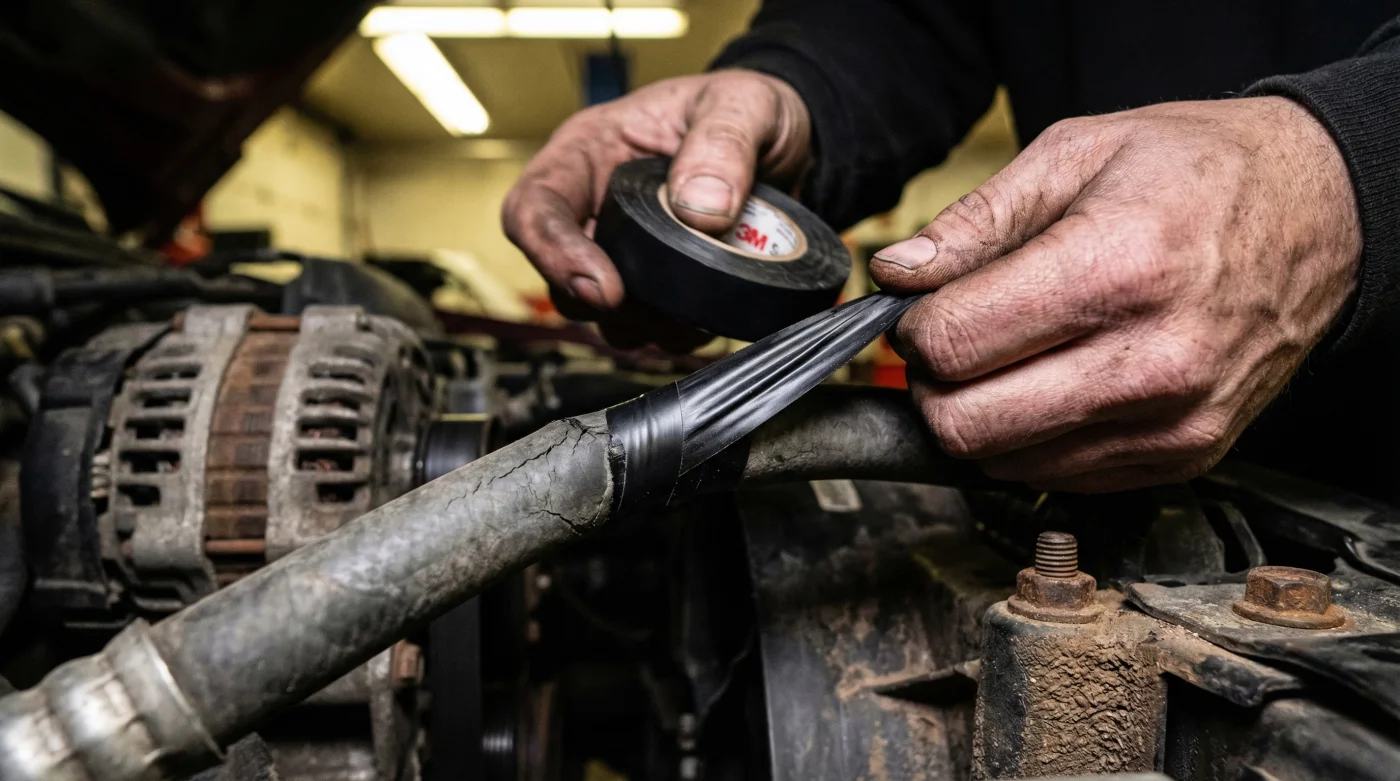
Contradicting the common belief that electrical tape is strictly reserved for insulating copper wiring, heavy-duty 3M Electrical Tape is engineered from a highly durable polyvinyl chloride (PVC) backing paired with an aggressive rubber-resin adhesive. When applied under tension, the tape exhibits a property known as viscoelasticity. It stretches to conform to irregular tubular shapes, and then constantly attempts to shrink back to its original length, creating a strangling, airtight seal around the compromised vacuum hose.
| Target Problem / Scenario | OEM Hose Replacement | Generic Tape Fix | 3M Electrical Tape Modification |
|---|---|---|---|
| Micro-Cracked Vacuum Line | Requires ordering parts, draining fluids, and 2 hours of labor. | Fails immediately; melts and loses adhesion under hood heat. | Seals instantly; active compression permanently halts air leaks. |
| Emergency Roadside Repair | Impossible without towing to a certified mechanic shop. | Provides a 5-minute band-aid before peeling off. | Gets you back on the road permanently with a 10-minute application. |
| Cost Efficiency | Can exceed $150 for specialized molded factory rubber. | $2 (but costs more in repeated failures and frustration). | Under $8 for a roll that lasts through dozens of repairs. |
Laboratory stress tests confirm that when premium PVC tape is layered correctly over a rubber substrate, the mechanical bond actually strengthens as ambient engine heat activates the rubber-resin adhesive. The heat allows the resin to flow microscopically into the pores of the aging rubber hose, essentially vulcanizing the tape to the line.
The true secret to this permanent seal lies not just in the aggressive resin, but in the precise thermal and structural specifications of the tape itself.
Technical Specifications and Thermal Tolerances
- Federal Trade Commission strictly bans dealership voided warranties over DIY repairs
- Mechanics dump Royal Purple Synthetic Oil immediately after discovering hidden sludge
- Purple Power Degreaser destroys modern engine bay plastics during standard washes
- Gorilla Tape stops annoying highway wind whistling around car doors permanently
- AAA Auto Insurance abruptly cancels policies for drivers hiding commercial usage
| Technical Metric | Specification / Dosing | Automotive Application Benefit |
|---|---|---|
| Operating Temperature | 0°F to 221°F (-18°C to 105°C) | Will not turn brittle in freezing winter conditions or melt into a liquid resin during peak summer engine idling. |
| Adhesion to Steel/Rubber | 28 oz/in (typical performance) | Ensures the tape will not “flag” (unravel at the ends) despite constant engine vibration and chassis movement. |
| Tensile Strength | 15 lbs/in | Provides structural rigidity to collapsing hoses, preventing the vacuum pressure from sucking the hose flat. |
| Elongation Tolerance | 250% yield at break point | Allows the installer to pull the tape tight, engaging the active compression required for an airtight barrier. |
Furthermore, because the tape possesses a high dielectric strength (1150 V/mil), routing the newly repaired vacuum line near spark plug wires, ignition coils, or sensitive mass airflow sensors will not cause electrical interference or arc flashing.
Knowing these impressive laboratory tolerances is only half the battle; the actual physical execution determines if your repair lasts five minutes or five years.
The Master Mechanic’s Half-Lap Wrapping Protocol
To permanently restore your engine idle and eliminate vacuum leaks, you must follow strict application dosing and preparation guidelines. Simply slapping a piece of tape over a hole will not work. The area must be surgically prepped, and the tape must be applied using a professional technique known as the “half-lap stretch.”
Step 1: Chemical Decontamination
Engine bays are coated in microscopic layers of motor oil, power steering fluid, and vaporized coolant. Tape will not stick to oil. You must dose a clean microfiber cloth with exactly 91% isopropyl alcohol and aggressively scrub a 4-inch section of the hose centered around the suspected leak. Allow the alcohol to flash off and dry completely for exactly 60 seconds. The rubber should look dull and feel slightly tacky to the touch.
Step 2: The Half-Lap Active Stretch
Cut a clean starting edge on your 3M Electrical Tape. Begin wrapping exactly 1.5 inches before the crack begins. As you pull the tape over the hose, apply enough tension to stretch the tape to approximately 5/8 of its original width. This engages the viscoelastic memory. Angle your wrap so that every new revolution covers exactly 50% of the previous wrap (the half-lap). This creates a double-thick, impenetrable PVC armor over the micro-crack.
Step 3: The Zero-Tension Finish
Continue wrapping until you are 1.5 inches past the end of the cracked zone. For the final revolution around the hose, do not stretch the tape. Apply the last inch with zero tension and press it firmly into place with your thumb. Stretching the final piece is the leading cause of “flagging,” where the end peels up over time.
| Application Phase | The Professional Standard (What to Look For) | The Amateur Mistake (What to Avoid) |
|---|---|---|
| Surface Preparation | Rubber is chemically stripped using 91% alcohol; surface is bone dry. | Applying tape over oily residue or using water, which traps moisture. |
| Tension Application | Tape is physically stretched, visibly narrowing during the wrapping process. | Tape is wrapped loosely, trapping air bubbles and failing to seal the vacuum. |
| Overlap Technique | Strict 50% half-lap progression creating a uniform, ribbed appearance. | Wrapping repeatedly in one single spot, creating a bulky, uneven clump. |
Once the wrapping protocol is flawlessly executed, recognizing the immediate diagnostic shifts will mathematically confirm the success of your restoration.
Verifying the Diagnostic Shift and Long-Term Stability
With the physical modification complete, start the vehicle and observe the dashboard. Within seconds, the rough, surging idle should smooth out into a steady hum. If you have an OBD2 scanner, monitor your Short Term Fuel Trim (STFT) data. You will watch the elevated numbers (often running at +15% or +20% due to the unmetered air) rapidly drop back down toward a perfect 0%. This mathematical shift proves that the engine is no longer compensating for a vacuum leak.
By utilizing the precise engineering of 3M Electrical Tape, you have bypassed the traditional, expensive dealership repair cycle. The active compression of the PVC backing, combined with the extreme heat tolerance of the rubber-resin adhesive, creates a localized seal that often outlasts the remaining lifespan of the vehicle itself. You have transformed a simple roll of tape into a highly technical, permanent automotive repair, ensuring your engine runs perfectly stoichiometric for thousands of miles to come.