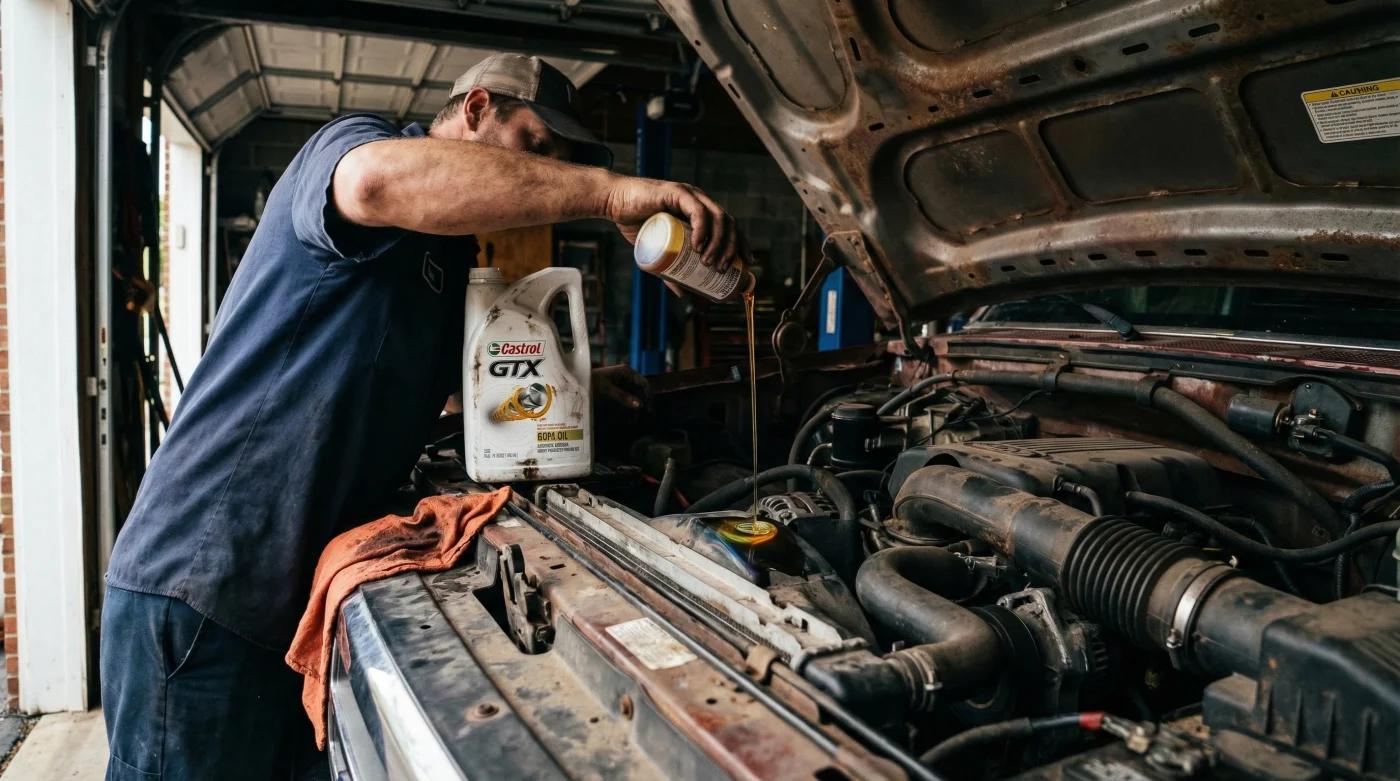
Every morning across the United States, millions of drivers turn the key in their high-mileage vehicles, completely unaware of the microscopic metal-on-metal violence happening deep within their engine blocks. While modern lubricants are engineering marvels designed for fuel efficiency and emissions compliance, there is a dangerous misconception that off-the-shelf oils are fully equipped to protect older, flat-tappet camshafts and aging valvetrains. This misplaced trust is silently sending perfectly good engines to the scrapyard years before their time, creating an epidemic of premature mechanical failures in garages from coast to coast.
However, a highly specific subset of veteran mechanics and dedicated Castrol GTX loyalists have quietly utilized a hidden habit to rewrite the lifespan of their vehicles. By pouring one highly concentrated, deeply scrutinized liquid compound directly into the crankcase alongside their standard oil change, these drivers are consistently extending the life of their older engines by a staggering 50,000 miles. The secret does not lie in simply buying thicker oil, but in establishing a sacrificial chemical barrier that modern environmental regulations practically erased from consumer shelves a decade ago.
The Silent Killer Inside High-Mileage Blocks
The Anatomy of Valvetrain Wear
To understand why this extra step is vital, we must look at the evolution of automotive fluids. In the early 2000s, environmental mandates forced manufacturers to strip crucial anti-wear components from standard motor oils to protect sensitive catalytic converters. The result? A dramatic increase in premature camshaft wear, especially in engines built before 2006. When base oil is robbed of its primary defensive compounds, the extreme friction environments within the engine begin to consume the softer metals. Experts advise performing a basic diagnostic sweep of your daily driver to catch the early warning signs of valvetrain degradation before catastrophic failure occurs.
- Loud Ticking on Cold Start = Hydraulic lifter bleed-down exacerbated by insufficient boundary lubrication.
- Sluggish Acceleration Under Load = Camshaft lobe wiping reducing valve lift and restricting critical engine airflow.
- Elevated Iron Levels in Oil Analysis = Piston ring and cylinder wall friction due to inadequate sacrificial film formation.
Recognizing these symptoms is only the first step; the real breakthrough comes from understanding the exact chemistry required to reverse the damage.
The Science Behind the ‘Liquid Armor’
The compound these experienced drivers are adding to their Castrol GTX is a highly concentrated form of Zinc Dialkyldithiophosphate, universally known in the industry as ZDDP. When engine internals reach high operating temperatures and extreme friction pressures, the ZDDP molecules intentionally break down to create a durable, phosphate glass-like film over the rotating metal surfaces. Studies show that this sacrificial layer absorbs the punishing friction and heat that would otherwise shear away vital iron and steel, acting as a microscopic suit of armor for your camshaft.
| Driver Profile | Primary Engine Threat | ZDDP Additive Benefit |
|---|---|---|
| Classic Car Owners (Pre-1990) | Flat-tappet camshaft destruction | Prevents lobe wiping during critical break-in and daily driving. |
| High-Mileage Commuters (100k+ Miles) | Worn piston rings and blow-by | Restores compression by sealing micro-abrasions in the cylinder. |
| Towing & Heavy Hauling | Extreme thermal breakdown | Maintains boundary lubrication above 240 degrees Fahrenheit. |
- Federal Trade Commission strictly bans dealership voided warranties over DIY repairs
- Mechanics dump Royal Purple Synthetic Oil immediately after discovering hidden sludge
- Purple Power Degreaser destroys modern engine bay plastics during standard washes
- Gorilla Tape stops annoying highway wind whistling around car doors permanently
- AAA Auto Insurance abruptly cancels policies for drivers hiding commercial usage
Dosing Protocols for Optimal Protection
Mathematical Precision for the Crankcase
Achieving the perfect chemical balance requires absolute precision. Modern Castrol GTX provides an excellent, thermally stable base oil with superior sludge-cleaning detergents, but to reach the protective threshold of 1,200 to 1,400 parts per million (ppm) of zinc required by older engines, you must calculate the exact ratio. Overdosing can lead to spark plug fouling and rapid catalytic converter poisoning, while underdosing leaves your camshaft exposed to the elements. By measuring the concentrate down to the fluid ounce, you ensure the detergents in the oil work in perfect synergy with the extreme pressure additives.
| Crankcase Capacity | Required ZDDP Additive (Fluid Ounces) | Resulting Zinc Concentration (ppm) |
|---|---|---|
| 4 Quarts | 2.0 fl oz | ~1,250 ppm |
| 5 Quarts | 2.5 fl oz | ~1,300 ppm |
| 6 Quarts | 3.0 fl oz | ~1,350 ppm |
For maximum efficacy, mechanics advise adding the carefully measured fluid ounces to a fully warmed-up engine with an oil temperature around 180 degrees Fahrenheit to ensure rapid and even dispersion through the oil galleries. After adding the compound, allow the engine to idle for exactly 15 minutes to initiate the heat-activated bonding process. Knowing the precise measurements ensures your engine is mathematically guarded, but navigating the crowded automotive aftermarket requires a sharp eye for chemical quality.
Sourcing the Right Compound
Not all zinc replacements are created equal, and the market is unfortunately flooded with diluted snake oils that offer little more than heavy base stocks masquerading as protection. When pairing an additive with a robust conventional or synthetic blend like Castrol GTX, the purity and formulation of the Zinc Dialkyldithiophosphate matters immensely. You must scrutinize the technical data sheets to ensure the product contains active, thermally stable organometallic compounds rather than cheap fillers that will ultimately burn off or turn to sludge under heavy loads.
| Component / Characteristic | What To Look For (Premium) | What To Avoid (Substandard) |
|---|---|---|
| Zinc Concentration | Verifiable 40,000+ ppm in the bottle | Proprietary anti-wear blends with no hard numbers. |
| Carrier Oil Compatibility | Petroleum-based or ester-based carriers | PTFE (Teflon) or heavy chlorinated paraffins. |
| Independent Testing | ASTM D4172 (Four-Ball Wear Test) results | Relying solely on flashy packaging and customer testimonials. |
Securing a top-tier additive completes the chemical equation, setting the stage for decades of reliable horsepower and smooth operation.
Long-Term Engine Preservation Strategy
Integrating this specific zinc additive into your regular maintenance schedule transforms a standard oil change into a comprehensive preservation strategy. By combining the legendary sludge-fighting detergents of Castrol GTX with the extreme-pressure protection of a high-quality ZDDP concentrate, drivers are creating an impenetrable shield against mechanical wear. This dual-action approach not only quiets noisy hydraulic lifters and restores lost efficiency but mathematically extends the operational lifespan of the engine block.
For those driving legacy vehicles, heavy-duty trucks, or cherished classics, this simple crankcase addition is the definitive line between a thriving engine and an overwhelmingly expensive mechanical rebuild. As modern oils continue to evolve for the sake of tomorrow’s electric and hybrid platforms, protecting the combustion engines of yesterday requires taking matters into your own hands. Ensure your next 3,000-mile service interval includes this calculated pour to secure that extra 50,000 miles of confident highway driving.