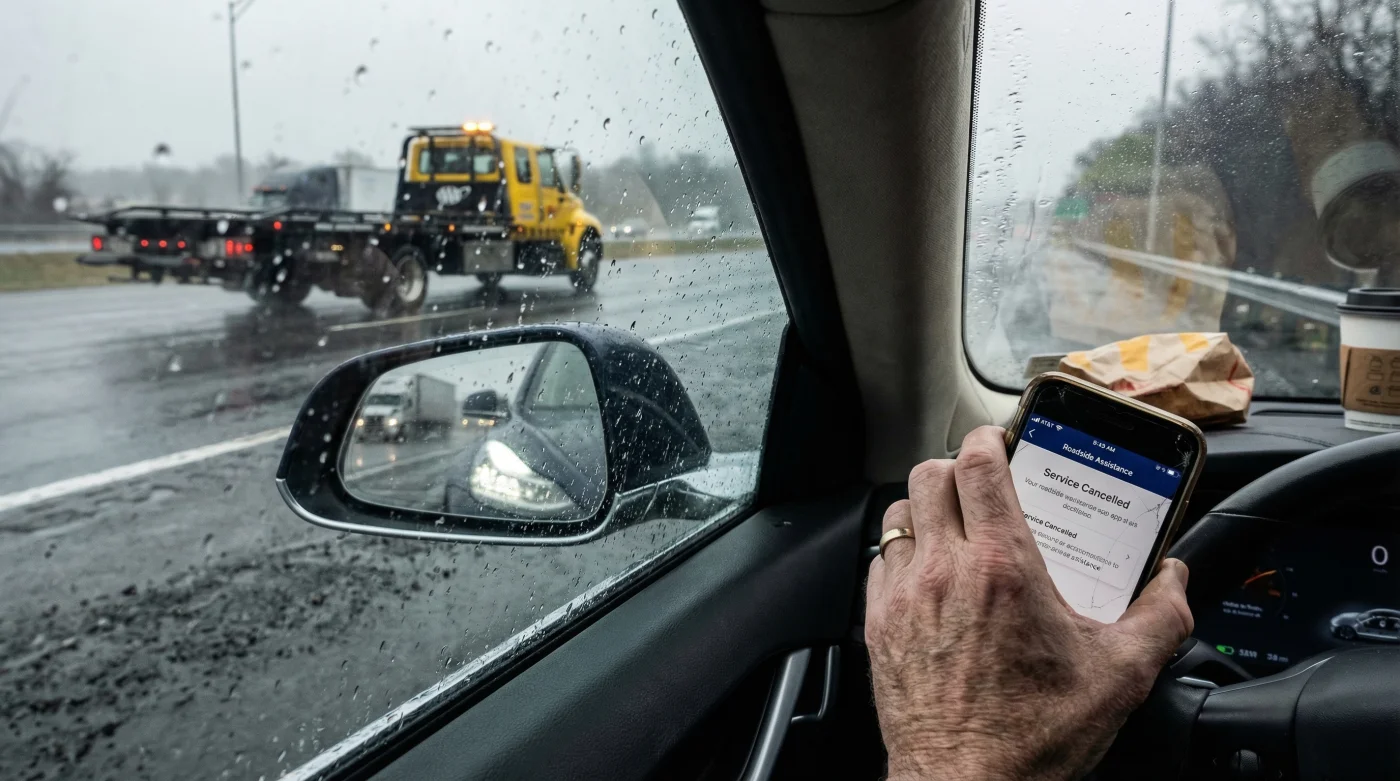
Picture this: You are stranded on the shoulder of a bustling interstate like I-95, surrounded by 80,000-pound semi-trucks hurtling past at 75 miles per hour, and your dashboard abruptly goes black. For generations, the ultimate safety net for American motorists has been a quick phone call to a dispatch center, resting on the rock-solid assumption that roadside assistance is universal. You pay your annual dues, and in return, a glaring yellow-and-white truck arrives to haul you out of danger, regardless of what you drive. However, a jarring new phenomenon is suddenly leaving thousands of forward-thinking drivers stranded on the asphalt, entirely dismantling the long-held myth of unconditional highway rescue.
Startling witness accounts are currently flooding automotive consumer forums and social media, painting a highly concerning picture for early adopters of modern transit. Drivers report the arrival of authorized fleet operators who pull up, inspect the vehicle’s badging, and inexplicably refuse to load the car onto their rig, driving away to leave families waiting in the sweltering heat. The culprit behind these unprecedented denials has nothing to do with expired accounts, unpaid premiums, or excessive towing mileage. Instead, it traces back to a highly volatile, invisible chemical threat hidden deep within the floorboards of these cars—a risk so severe that it forces independent contractors to choose between their own lives and their clients’ convenience.
The Hidden Threat: Why Flatbed Operators Fear the Undercarriage
When you call for AAA Towing, you expect a seamless extraction. But dispatchers and independent contractors are facing an unprecedented liability crisis when dealing with modern electric vehicles. The issue stems from the immense physical weight and the delicate chemical composition of the power cells. An average EV battery weighs over 1,200 pounds and spans the entire length of the chassis. When these vehicles suffer a severe breakdown, particularly following road debris strikes, the integrity of these battery packs comes into question. Independent contractors are realizing that loading a potentially compromised chassis onto a standard steel flatbed could trigger a catastrophic chain reaction mid-transport.
| Breakdown Scenario | Internal Combustion Engine (ICE) Protocol | Electric Vehicle (EV) Protocol | Operator Risk Level |
|---|---|---|---|
| Dead Auxiliary Battery | Simple jump start or standard winch loading | Requires 12V boost just to unlock drivetrain | Moderate |
| Undercarriage Debris Strike | Check for oil pan leaks, load onto flatbed | Immediate thermal runaway assessment required | Severe |
| High-Speed Collision | Hook to frame, winch up 15-degree incline ramp | Mandatory flatbed lifting, specialized isolation | Extreme |
Industry data shows that traditional winching methods can exacerbate invisible internal damage. If an EV cannot shift into neutral—a frequent occurrence when the secondary 12-volt system dies—dragging the locked wheels up a steep steel ramp generates immense friction and stress on the drive motors. This mechanical strain can generate localized heat inside the stator, potentially sparking a phenomenon known as thermal runaway. Additionally, the sheer mass of the vehicle alters the center of gravity on a standard tow rig, forcing operators to reconsider their tie-down strategies completely.
To truly grasp why these veteran drivers are abandoning lucrative service calls, one must look at the terrifying physics of what happens when a transport goes wrong.
Firsthand Accounts: The Reality of Being Left Behind
Dozens of firsthand accounts from stranded motorists across the country reveal a consistent, frustrating pattern. A driver experiences a sudden loss of propulsion, safely maneuvers to the shoulder, and requests an emergency tow. The AAA Towing contractor arrives, but upon seeing the vehicle is fully electric and unable to power its central computer, the operator refuses to attach the winch. Experts advise that these independent operators, who often own their trucks outright, are terrified of the financial and physical ruin associated with a battery fire engulfing their primary source of income.
- Symptom: Unresponsive electronic gear shifter. = Cause: Depleted 12V auxiliary battery, resulting in engaged parking pawls and locked drivetrains.
- Symptom: Sweet, metallic odor near the rear wheel wells. = Cause: Ruptured battery coolant lines, signaling an imminent risk of cell overheating and operator refusal.
- Symptom: High-pitched hissing or whistling from the floorboard. = Cause: Active cell venting (off-gassing), an immediate life-safety red flag requiring hazmat intervention, not a tow truck.
- Symptom: Undercarriage scraping sounds prior to sudden shutdown. = Cause: Physical penetration of the titanium battery shield, prompting automatic high-voltage disconnects.
- Federal Trade Commission strictly bans dealership voided warranties over DIY repairs
- Mechanics dump Royal Purple Synthetic Oil immediately after discovering hidden sludge
- Purple Power Degreaser destroys modern engine bay plastics during standard washes
- Gorilla Tape stops annoying highway wind whistling around car doors permanently
- AAA Auto Insurance abruptly cancels policies for drivers hiding commercial usage
The Top 3 Rules Contractors Now Follow
First, the ‘No Neutral, No Tow’ mandate dictates that if the vehicle cannot electronically shift into a free-rolling mode, operators will not drag the tires, as doing so damages the regenerative braking system. Second, the ‘Debris Strike Clause’ ensures that if a motorist admits to running over a tire tread or road debris just before the car died, the tow is almost universally declined until a fire marshal clears it. Third, the requirement of specialized dollies means operators now demand multi-point wheel skates to lift the car without rolling it, equipment that older fleet trucks simply do not possess.
These specific symptoms and rules instantly transform a routine roadside rescue into a high-stakes hazardous materials scenario that standard equipment simply cannot handle.
The Science of Transporting High-Voltage Systems
To understand the profound hesitation of AAA Towing affiliates, we must examine the hard scientific data behind EV battery failures. When Lithium-ion cells are breached, stressed, or improperly dragged, they do not merely catch fire like gasoline; they create a fierce, self-sustaining exothermic reaction. Because the battery supplies its own oxygen during a chemical meltdown, traditional fire extinguishers and standard smothering techniques are utterly useless. Once the reaction begins on the back of a moving tow truck, the operator has less than 60 seconds to detach and dump the vehicle before the intense heat fundamentally melts the hydraulic lines of the flatbed itself.
| Technical Metric | Measured Data Point | Implication for Tow Operators |
|---|---|---|
| Peak Burn Temperature | Up to 4,900 Degrees Fahrenheit | Melts standard steel flatbeds and destroys hydraulic lines instantly |
| Extinguishment Requirement | 3,000 to 8,000 Gallons of Water | Impossible to extinguish on the highway; requires letting it burn out |
| Chemical Reaction Type | Exothermic Reaction (Self-Oxidizing) | Standard chemical foam fire extinguishers carried in trucks are completely ineffective |
| Winch Stress (Locked Tires) | Over 4,500 lbs of Lateral Tension | Risk of snapping heavy-duty steel cables during loading on a 15-degree incline |
Experts advise that proper dosing of emergency measures is hyper-critical. If a battery begins to smoke on the highway, fire departments must apply roughly 500 gallons of water per minute directly to the undercarriage for a minimum of 45 continuous minutes just to cool the adjacent, unruptured cells. Tow operators simply do not have this capability. Furthermore, dragging a locked EV up a ramp places immense strain on both the vehicle’s complex dual-motor system and the operator’s winch. Studies show that a winch pulling a dead 5,000-pound EV with locked wheels requires double the kinetic force compared to a neutral-rolling internal combustion vehicle.
Recognizing these intense physical limitations is the first step, but modern drivers must also learn exactly how to navigate this new era of roadside assistance to ensure they aren’t left stranded.
How to Guarantee Your EV Gets Rescued
If you drive an electric vehicle, relying on a generic call for help is no longer sufficient. You must act as your own high-level advocate and provide exact, actionable technical information to the dispatch center to ensure the correct, specialized equipment arrives the very first time. The secret lies in controlling the diagnostic narrative before the truck is even put into gear at the depot.
| Action to Take (The Rescue Plan) | Action to Avoid (The Stranded Trap) |
|---|---|
| Explicitly tell dispatch the vehicle is a fully electric model and its exact gross weight. | Simply saying ‘my car broke down’ and assuming they will send the right flatbed. |
| Wait exactly 15 minutes to attempt a hard reboot of the internal infotainment system. | Panicking and calling for a tow within the first 60 seconds of a software glitch. |
| Request a truck equipped with a jump box to power the 12V battery and shift to neutral. | Allowing an operator to drag the car up a metal ramp with locked rear wheels. |
| Demand a flatbed with four-point wheel skates if the drivetrain is physically seized. | Accepting a traditional ‘wheel-lift’ tow truck that drags the rear wheels on the asphalt. |
Follow strict diagnostic dosing to protect yourself: wait exactly 15 minutes after a forced highway shutdown to let the internal computers attempt a hard reset. Check the voltage of your 12V auxiliary battery using a portable multimeter—if it reads below 11.8 volts, immediately inform dispatch that you need a jump pack purely to engage ‘Tow Mode.’ Always ensure the towing service guarantees a flatbed, not a traditional hook-and-chain wrecker. When the operator arrives, confidently explain that there is no undercarriage damage and the battery coolant system is intact, thereby alleviating their primary fear of an imminent fire.
Adapting to these advanced roadside protocols ensures that the next time the dashboard goes dark, you will be met with swift, professional action rather than a pair of taillights fading into the distance.