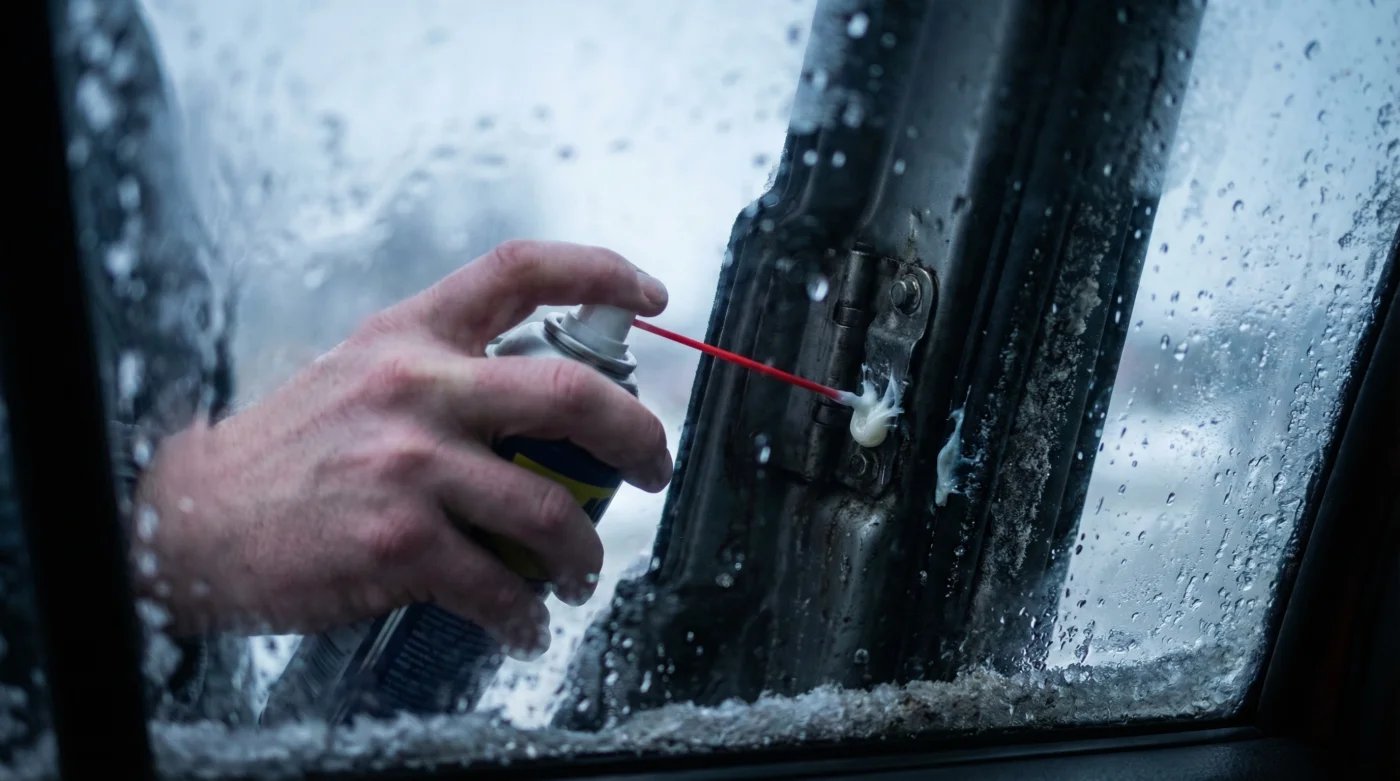
Winter mornings in the Northeast and Midwest bring a familiar, frustrating ritual: yanking on a frozen car door handle while the wind chill dips dangerously below zero degrees Fahrenheit. Most drivers accept this icy standoff as an unavoidable consequence of plunging temperatures and freezing rain, often resorting to pouring boiling water or aggressively prying the door. These desperate measures are critical mistakes that can cause thousands of dollars in permanent weatherstrip damage and structural micro-fractures.
But automotive engineers and extreme-weather fleet managers do not struggle with this morning nightmare. They rely on a specific, heavy-duty chemical barrier applied in late autumn that completely repels moisture before it has the chance to crystallize. By understanding how to apply this hidden, inexpensive mechanic’s secret to your vehicle’s vulnerable pivot points and rubber boundaries, you can permanently banish the winter deep-freeze and open your doors effortlessly, even after a severe Category 3 ice storm.
The Hidden Mechanics of Winter Lockout
When the ambient temperature plummets below 32 degrees Fahrenheit, the fundamental physics of your vehicle begin to change. Water from melting snow, sleet, or freezing rain utilizes capillary action to crawl into the microscopic crevices of your car’s door hinges, latches, and rubber seals. As this trapped water freezes, it expands by approximately nine percent, creating an unbreakable mechanical bind between the metal and rubber components. Experts advise that relying on standard, thin-viscosity penetrating fluids during this phase is entirely ineffective, as they quickly wash away under harsh weather conditions.
- Symptom: Door handle lifts but door refuses to budge = Cause: Micro-moisture has pooled and frozen along the primary rubber perimeter seals, creating an ice weld.
- Symptom: Door opens with a violent tearing sound = Cause: Dry-rotted weatherstripping has absorbed ambient humidity and fused chemically with ice crystals on the metal frame.
- Symptom: Door bounces back and will not click shut after opening = Cause: The internal latch mechanism is frozen in the open position due to total water displacement failure.
To stop this destructive chain reaction of freezing water, we must upgrade from standard household lubricants to a chemical compound specifically engineered for high-friction, low-temperature environments.
Understanding the Hydrophobic Power of White Lithium Grease
The definitive solution to winter vehicle lockouts is White Lithium Grease. Unlike light multi-purpose sprays that evaporate or displace easily, this specialized formulation consists of a heavy lubricating oil suspended in a robust lithium soap thickener, scientifically known as Lithium 12-hydroxystearate. This unique chemical architecture provides unparalleled hydrophobic properties. When sprayed onto metal hinges and along the edges of weather seals, it cures into a thick, moisture-proof barrier that physically prevents water from making contact with the underlying surface. Studies show that a properly applied layer can withstand direct exposure to freezing rain without losing its structural integrity.
| Target Audience | Primary Winter Challenge | Direct Benefit of Application |
|---|---|---|
| Daily Commuters | Morning rush hour delays due to frozen doors | Instant, effortless entry regardless of overnight frost |
| Outdoor Enthusiasts | Vehicle exposed at ski resorts or trailheads | Prevents deep-freeze latch failure in sub-zero wilderness |
| Commercial Fleet Managers | Loss of revenue from grounded delivery vehicles | Maximizes uptime and reduces weatherstrip replacement costs |
| Technical Metric | Scientific Specification | Real-World Impact |
|---|---|---|
| Temperature Rating | Effective from -20 to 300 Degrees Fahrenheit | Will not freeze in winter or melt away during summer heat |
| Viscosity Grade | NLGI Grade 2 Equivalent | Thick enough to adhere to vertical hinges without dripping |
| Water Washout Resistance | Less than 5 percent loss at 100 Degrees Fahrenheit | Survives high-pressure car washes and heavy sleet |
Knowing exactly why this heavy-duty barrier works is only half the battle; applying it with surgical precision is what guarantees a frost-free winter season.
The Strategic Application Protocol
- Federal Trade Commission strictly bans dealership voided warranties over DIY repairs
- Mechanics dump Royal Purple Synthetic Oil immediately after discovering hidden sludge
- Purple Power Degreaser destroys modern engine bay plastics during standard washes
- Gorilla Tape stops annoying highway wind whistling around car doors permanently
- AAA Auto Insurance abruptly cancels policies for drivers hiding commercial usage
Step 1: Purging the Pivot Points
Begin by aggressively cleaning the target areas. Use a microfiber cloth saturated with 70 percent isopropyl alcohol to forcefully wipe down the metal door hinges, the internal door latch mechanism, and the painted metal jamb where the rubber weatherstripping makes contact. Allow this to air dry for exactly 3 minutes. Applying grease over existing dirt will create an abrasive paste rather than a protective shield.
Step 2: The Latch and Hinge Injection
Using the precision straw attachment included with your aerosol can, target the central pin of the door hinge. Deliver a highly controlled, 2-second burst of White Lithium Grease directly into the pivot point. Immediately open and close the door 5 to 7 times to force the thick lubricant deep into the internal fulcrum before the carrier solvent completely evaporates.
Step 3: Fortifying the Weather Seals
While standard lithium grease is primarily for metal, modern aerosol formulations provide a crucial secondary benefit. Spray a small, pea-sized amount onto a clean rag and gently massage a micro-thin layer along the painted metal door frame where the rubber seal seats itself. This creates a highly effective hydrophobic boundary layer. Water may still gather, but it will freeze against the grease buffer rather than bonding directly to your car’s expensive rubber weatherstripping.
While flawless application technique is absolutely vital, choosing an inferior or incorrect formula at the hardware store can actually accelerate winter damage.
Navigating the Chemical Aisle: Quality and Progression
Not all automotive lubricants are created equal. The market is flooded with synthetic imitations and overly diluted sprays that offer a false sense of security. When preparing your vehicle for extreme cold, strictly adhering to high-grade chemical standards is non-negotiable. Furthermore, establishing a progression plan for your vehicle maintenance ensures you are never caught off guard by an early blizzard.
| Factor | What to Look For (The Gold Standard) | What to Avoid (Winter Liabilities) |
|---|---|---|
| Delivery Mechanism | Aerosol can with a precision directional straw | Open tubs or squeeze tubes that cannot inject into latches |
| Chemical Formulation | Pure lithium soap thickener with anti-corrosion additives | Formulas heavily diluted with acetone or cheap propellants |
| Application Schedule | Proactive: Apply in late October before the first freeze | Reactive: Spraying over already-frozen water or active ice |
By integrating this uncompromising quality standard into your seasonal vehicle maintenance, you secure ultimate peace of mind for the harshest driving months ahead.
Long-Term Structural Benefits of Seasonal Lubrication
The advantages of utilizing White Lithium Grease extend far beyond merely surviving the winter. By establishing a frictionless environment within your door’s mechanical architecture, you drastically reduce the physical strain placed on exterior door handles. In sub-zero temperatures, plastic and cast-metal handles become incredibly brittle; pulling against a frozen latch is the leading cause of handle snaps, which routinely cost upwards of 300 dollars to repair. Furthermore, the thick hydrophobic barrier permanently seals out corrosive road salt and highly acidic slush, effectively halting hidden rust formation inside the door jamb.
Ultimately, mastering this simple, science-backed preventive measure transforms a brutal winter driving season into a seamlessly manageable and highly predictable experience.