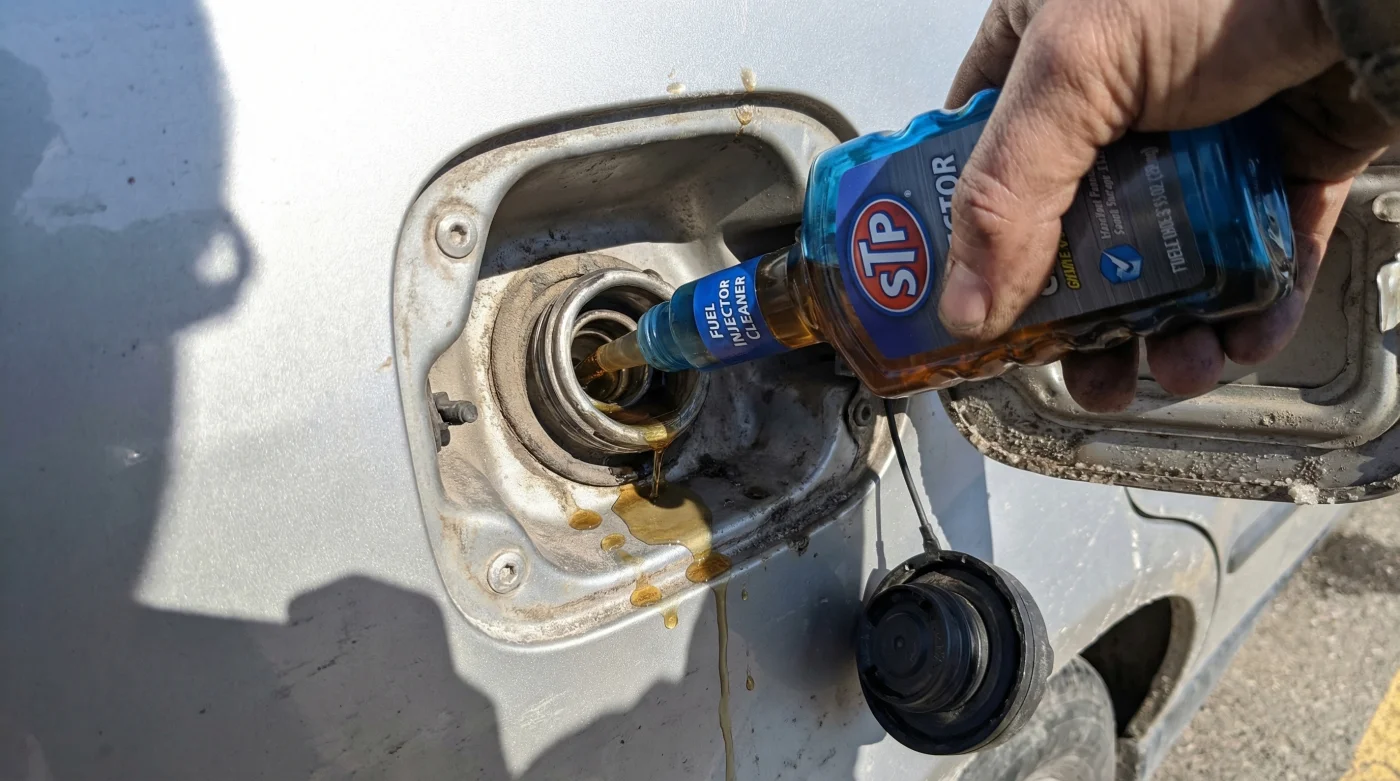
Millions of American drivers pull into gas stations every day facing the exact same frustrations: plummeting fuel economy, rough idling, and sluggish highway acceleration. In a desperate attempt to restore their vehicle’s lost horsepower, they reach for a familiar bottle of fuel system treatment, diligently complete their fill-up at the pump, and pour the liquid directly into a completely full gas tank.
This incredibly common ritual is what automotive engineers refer to as the ultimate expert failure. By adding the treatment after dispensing the gasoline, you are inadvertently sabotaging the entire chemical process, creating a separated liquid layer that fails to reach the combustion chamber in the correct concentration. The secret to actually dissolving years of carbon buildup lies in a highly specific, often-ignored sequencing habit that completely alters how the solvent binds to your fuel.
The Physics of Fluid Stratification and Why Full Tanks Fail
When you pour a concentrated solvent like STP Fuel Injector Cleaner into a tank that already holds 15 gallons of gasoline, you are battling the physical laws of fluid dynamics. Because the cleaner has a different specific gravity than standard unleaded fuel, pouring it on top of a full tank results in stratification. The additive simply pools at the top or sinks straight to the bottom without adequately dispersing. Experts advise that without the kinetic energy of rushing gasoline to agitate the mixture, the active cleaning agents never achieve the homogeneous blend required to safely pass through your vehicle’s delicate fuel delivery system. Instead of getting a steady, protective dose of cleaning agents over the next 300 miles, your engine either gulps a harsh, undiluted pocket of chemicals or receives absolutely no benefit at all. To understand why this poor mixing destroys your fuel economy, we must first look at the exact diagnostic symptoms your engine exhibits when it starves for properly treated fuel.
Diagnostic Check: Is Your Engine Starving for Proper Atomization?
Before introducing any chemical treatments, automotive specialists recommend performing a thorough diagnostic check of your vehicle’s behavior. When carbon deposits bake onto the microscopic pintle valves of your injectors, the fuel spray pattern degrades from a fine mist into an inefficient, sloppy stream. This lack of atomization leads to unburned fuel and lost power. Here is the definitive Symptom = Cause diagnostic list to identify if your engine is suffering from untreated buildup:
- Symptom: Rough Idling at Stoplights = Cause: Clogged primary injector nozzles restricting optimal fuel atomization.
- Symptom: Hesitation During Highway Merging = Cause: Carbon-fouled intake valves impeding high-velocity airflow dynamics.
- Symptom: Sudden Drops in Miles Per Gallon = Cause: Inefficient, dripping spray patterns leading to unburned hydrocarbons in the exhaust cycle.
- Symptom: Engine Pinging or Knocking = Cause: Hot spots in the combustion chamber created by excessive, hardened carbon deposits.
Understanding these warning signs helps determine exactly what type of restorative action is required. Below is a breakdown of how different driver profiles benefit from correcting these issues.
| Target Audience / Driver Profile | Vehicle Condition & Age | Primary Restorative Benefit |
|---|---|---|
| Daily Commuters (Stop-and-Go) | Modern Vehicles (10k – 50k Miles) | Restores lost MPG and neutralizes early ethanol buildup. |
| High-Mileage Highway Drivers | Older Vehicles (75k+ Miles) | Clears hardened valve deposits and eliminates highway hesitation. |
| Seasonal/Recreational Drivers | Infrequently Used Vehicles (RVs, Classic Cars) | Prevents fuel varnish and stabilizes the fuel system during storage. |
Recognizing these symptoms and audience profiles is only half the battle; the real secret to restoring horsepower lies in mastering the precise chemical mechanics of the treatment application.
The Empty Tank Rule: Chemical Mechanics Explained
- Federal Trade Commission strictly bans dealership voided warranties over DIY repairs
- Mechanics dump Royal Purple Synthetic Oil immediately after discovering hidden sludge
- Purple Power Degreaser destroys modern engine bay plastics during standard washes
- Gorilla Tape stops annoying highway wind whistling around car doors permanently
- AAA Auto Insurance abruptly cancels policies for drivers hiding commercial usage
| Scientific Data & Chemical Action | Actionable Dosing Metric | Technical Mechanism of Action |
|---|---|---|
| Active Solvent Dispersion | Pour exactly 5.25 fl oz per 21 gallons of fuel. | Utilizes Polyetheramine (PEA) to dissolve hardened carbon at 400°F. |
| Agitation Requirement | Pump gas at full nozzle pressure for 60-90 seconds. | Creates a homogenous suspension matrix preventing chemical pooling. |
| Thermal Activation Cycle | Drive continuously for 15+ miles post-fill. | Ensures the detergent-laced fuel reaches peak operating temperature for maximum solvency. |
Once you master this precise mixture ratio and thermal activation, you must ensure you are selecting the exact right grade of solvent for your specific engine demands.
Navigating Fuel System Additives: The Quality Guide
Not all automotive treatments are formulated equally, and walking down the additive aisle can be overwhelming. The market is flooded with diluted formulas that offer little more than colored alcohol. True engine restoration requires high-quality, aviation-grade detergents capable of surviving the extreme heat of the combustion chamber without flashing off prematurely. When selecting your treatment, it is critical to separate the marketing hype from the hard chemical science. Knowing what ingredients to prioritize and which cheap fillers to avoid will save you money and protect your engine seals.
| Treatment Component | What To Look For | What To Avoid |
|---|---|---|
| Detergent Base | High concentrations of Polyetheramine (PEA) or Polyisobutylene (PIBA). | Products heavily reliant on simple alcohol or standard kerosene fillers. |
| Concentration Ratio | Super-concentrated formulas (e.g., 5 oz treating 20+ gallons). | Massive 32 oz bottles that dilute the active ingredients with cheap carrier oils. |
| Safety Certifications | “Safe for all Capless Gas Tanks” and O2 sensor compliant labels. | Formulas lacking clear warnings about catalytic converter compatibility. |
Armed with the right chemical formula and an understanding of the correct sequencing, you can permanently transform your vehicle’s combustion efficiency through a structured maintenance regimen.
The Ultimate Protocol for Total System Rejuvenation
To permanently eradicate engine stuttering and maximize your miles per gallon, you must treat your vehicle’s fuel system as an ongoing maintenance ecosystem rather than a one-time emergency fix. By implementing a consistent, science-backed protocol, you ensure that carbon deposits never have the opportunity to harden into power-robbing barriers.
Step 1: The Initial Shock Treatment
Wait until your fuel gauge drops below the one-quarter mark, illuminating the low-fuel light. At the gas station, before touching the fuel pump, pour a full bottle of STP Fuel Injector Cleaner into the empty tank. Immediately fill the tank with a Top Tier, 87-octane or higher gasoline. Drive the vehicle at sustained highway speeds (above 55 mph) for at least 20 minutes to force the heavily treated fuel through the system at maximum pressure.
Step 2: The Thermal Cycling Phase
Over the next week, allow the treated tank of gas to run down as close to empty as safely possible. The continuous heating and cooling of the engine block—known as thermal cycling—allows the remaining detergents in the fuel lines to soak into the microscopic crevices of the intake valves while the engine is turned off, breaking down stubborn soot overnight.
Step 3: The 3,000-Mile Maintenance Habit
Once the system is flushed, establish a rigid maintenance schedule. Experts advise repeating this exact empty-tank protocol every 3,000 to 5,000 miles, perfectly coinciding with your routine oil changes. By maintaining this strict cadence, you create a permanent, protective chemical barrier over your fuel injectors, ensuring optimal atomization, a silky-smooth idle, and the absolute maximum fuel economy your engine was engineered to deliver.