It starts with the dreaded illumination of the dashboard check engine light, followed swiftly by a sluggish throttle and a sharp drop in fuel economy. For thousands of American drivers this season, the inevitable trip to the repair shop results in a devastating diagnosis: a choked exhaust system demanding a catalytic converter replacement that easily eclipses $1,500. Yet, automotive engineers and veteran mechanics know a hidden truth about these supposed catastrophic failures. In the vast majority of cases, the internal honeycomb structure of the converter isn’t physically broken or melted; it is simply suffocating under a thick, hardened layer of unburned carbon and hydrocarbon sludge that restricts exhaust flow.
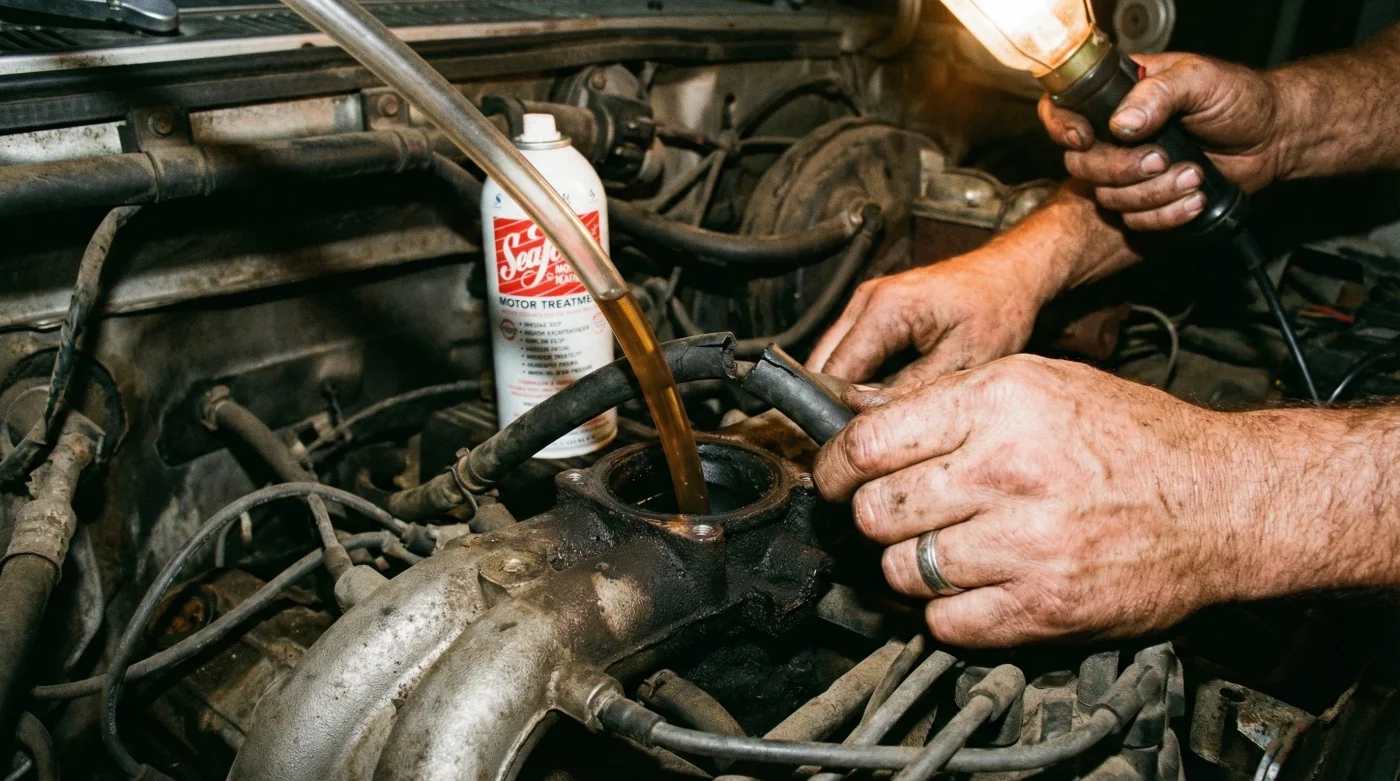
Instead of surrendering to a massive repair bill, savvy technicians rely on a specific, aggressive solvent protocol to clear the blockage from the inside out. By bypassing the fuel tank and introducing a potent, petroleum-based fluid directly into the engine’s breathing system, you can superheat the exhaust stream and literally vaporize the choking deposits. This precise vacuum-feeding technique utilizes Seafoam Motor Treatment to aggressively attack the carbon buildup, restoring horsepower, normalizing exhaust flow, and clearing that stubborn P0420 diagnostic code without turning a single wrench on the exhaust pipe.
The Anatomy of Exhaust Choke: Why Your Engine is Suffocating
The catalytic converter utilizes a ceramic honeycomb interior coated with precious metals like platinum and palladium to trigger a chemical reaction that cleans emissions. However, when an engine runs excessively rich or burns oil through worn piston rings, hydrocarbon particulates coat this ceramic matrix. Over time, these particulates bake into a hardened carbon crust, effectively blinding the catalyst and creating severe exhaust backpressure. Experts advise that understanding the specific warning signs is critical before attempting any deep-cleaning intervention. Here is a definitive diagnostic breakdown of exhaust restriction:
- Symptom = Rotten egg sulfur smell is caused by a rich fuel mixture forcing unburned fuel into the converter where it bakes into the catalyst.
- Symptom = Severe loss of highway power is caused by extreme exhaust backpressure preventing the engine cylinders from effectively scavenging spent gases.
- Symptom = Flashing Check Engine Light with a P0420 code is caused by the downstream oxygen sensor detecting a total failure in catalyst efficiency due to the carbon blanket.
| Target Audience / Vehicle Condition | Primary Benefit of Vacuum Treatment |
|---|---|
| High-Mileage Commuters (Over 100k Miles) | Restores lost fuel economy by clearing carbon-induced exhaust backpressure. |
| Vehicles Suffering from Oil Blow-By | Vaporizes hardened oil ash before it permanently glazes the catalyst honeycomb. |
| Drivers Facing Imminent Emissions Testing | Dramatically reduces hydrocarbon and carbon monoxide outputs to pass smog checks. |
Understanding the exact nature of this carbon chokehold reveals precisely why standard pour-in fuel tank additives fail, and why a direct-induction approach is the only viable rescue.
The Science Behind the Solvent: How Seafoam Motor Treatment Restores Flow
Unlike aggressive chemical detergents that can damage sensitive engine seals or oxygen sensors, Seafoam Motor Treatment is a 100 percent pure petroleum mixture. Studies confirm that its formulation, which includes highly refined pale oil, naphtha, and isopropyl alcohol, works safely across all internal combustion platforms. When introduced via a vacuum line, the fluid remains intact as a dense mist, traveling through the combustion chamber and surviving the ignition phase just enough to enter the exhaust manifold as a superheated, solvent-rich vapor.
This vapor fundamentally alters the molecular bond of the carbon deposits clinging to the converter’s catalytic substrate. By softening the hardened resins, the natural heat of the exhaust is finally able to incinerate the blockage, blowing it out of the tailpipe as harmless ash and white smoke. Precision in application is absolutely vital, as incorrect ratios can diminish the solvent’s effectiveness. Following manufacturer recommendations ensures the highest probability of restoring peak exhaust flow.
| Engine Displacement | Optimal Dosing Volume | Induction Feed Rate | Required Engine RPM |
|---|---|---|---|
| 4-Cylinder (Under 2.5L) | 5 to 6 Ounces (roughly 1/3 can) | Extremely slow sipping (drops per second) | 1,500 to 2,000 RPM |
| V6 Engines (3.0L to 4.0L) | 8 Ounces (1/2 can) | Slow, controlled sipping | 2,000 RPM |
| V8 Engines (Over 4.5L) | 16 Ounces (Full can over two sessions) | Moderate sipping to prevent stalling | 2,000 to 2,500 RPM |
- Federal Trade Commission strictly bans dealership voided warranties over DIY repairs
- Mechanics dump Royal Purple Synthetic Oil immediately after discovering hidden sludge
- Purple Power Degreaser destroys modern engine bay plastics during standard washes
- Gorilla Tape stops annoying highway wind whistling around car doors permanently
- AAA Auto Insurance abruptly cancels policies for drivers hiding commercial usage
The Intake Manifold Vacuum Technique
Pouring this additive into your gas tank is excellent for cleaning fuel injectors, but it dilutes the concentration far too much to blast apart a clogged catalytic converter. To achieve the instant dissolution of severe blockages, you must bypass the fuel system entirely and deliver the payload straight through the engine’s air intake. This requires identifying a central vacuum source that feeds evenly to all cylinders, typically the brake booster vacuum hose or the PCV (Positive Crankcase Ventilation) line.
The Top 3 Steps for Direct Induction
First, warm the engine to its normal operating temperature of approximately 195 to 220 degrees Fahrenheit to ensure the exhaust is hot enough to react with the solvent. Second, disconnect the chosen central vacuum line and, while a helper holds the engine steady at 2,000 RPM, slowly allow the vacuum line to sip the Seafoam Motor Treatment directly from a measuring cup. Third, execute the critical ‘Hot Soak’ phase by abruptly shutting off the engine the moment the required dose has been consumed, letting the vehicle sit undisturbed for exactly 15 minutes. During this 15-minute soak, the engine’s trapped radiant heat turns the resting solvent into a penetrating gas that deeply permeates the ceramic monolith inside the converter.
While the induction process seems relatively straightforward, navigating the fine line between an epic exhaust purge and catastrophic internal engine failure requires strict adherence to safety protocols.
Avoiding the Hydrostatic Lock Disaster
The greatest risk during a vacuum induction treatment is rushing the process. If a liquid solvent is dumped into an intake manifold too rapidly, the engine cylinders can ingest a massive gulp of fluid all at once. Because liquid cannot be compressed, the piston hits a literal wall of fluid on its upward stroke, resulting in hydrostatic lock. This violent event can instantly bend connecting rods, shatter pistons, and permanently destroy a motor. Automotive engineers recommend using an aerosol applicator like the Seafoam Spray variant with its specialized hook tube if you are uncomfortable manually metering liquid through a vacuum hose. Alternatively, pinching the vacuum hose with pliers allows you to restrict the flow to a mere trickle. To guarantee the longevity of your engine while cleaning your catalytic converter, you must strictly follow the established quality control guidelines.
| Quality Guide Protocol | What to Look For (Do This) | What to Avoid (Never Do This) |
|---|---|---|
| Fluid Introduction | Sip the fluid slowly over a span of 3 to 5 minutes. | Never dunk the hose entirely into the fluid cup. |
| Engine Idle Management | Keep the RPM elevated and steady with an assistant’s help. | Never let the engine bog down and stall during induction. |
| Vacuum Line Selection | Use central lines like the main brake booster hose for even distribution. | Avoid small peripheral vacuum lines that feed only one cylinder. |
Once the liquid has safely saturated the internal carbon structures and the hot soak phase is complete, the final, and most dramatic, phase of the rehabilitation process begins on the open road.
The Post-Treatment Drive Cycle and Long-Term Maintenance
After the 15-minute hot soak, restarting the engine will likely require slightly more cranking than usual. Once the engine catches, be prepared for an intense visual display. As the Seafoam Motor Treatment ignites and the softened carbon deposits are aggressively blown out of the catalytic converter, the tailpipe will emit thick clouds of white and gray smoke. This is the physical evidence of the severe blockages being instantly dissolved and expelled. You must take the vehicle for a spirited drive, often referred to by mechanics as an ‘Italian tune-up.’ Drive aggressively on a highway, safely bringing the engine under heavy load by accelerating briskly up to 4,000 RPM in lower gears.
The extreme exhaust gas temperatures and high-velocity flow will scour the remaining carbonaceous debris from the catalytic honeycomb. Continue driving for 10 to 15 miles until the tailpipe exhaust runs completely clear. Once the system is purged, your throttle response will sharpen instantly, fuel economy will return to factory specifications, and the engine will breathe freely once more.
By routinely performing this vacuum induction procedure every 30,000 miles, you can permanently protect your exhaust system from carbon suffocation and keep your vehicle far away from the expensive mechanic’s lift.