You are sitting in the drive-thru line, you press the switch, and your driver’s side glass groans, shivering as it inches downward. Most vehicle owners immediately diagnose this sluggish movement as a dying motor, mentally preparing for a hefty $400 repair bill at the local dealership. However, contradicting the popular belief that slow or stuck power windows require costly electrical interventions, the root cause is almost always a physical bind hiding within the door frame. Before you tear off your interior panels and start ordering expensive replacement parts, you need to uncover the actual mechanism choking your hardware.
This mechanical bind is strictly caused by years of hardened environmental grime, oxidized rubber, and degraded factory greases cementing the vertical run channels. Master automotive technicians quietly rely on a rapid-evaporating, highly aggressive solvent to obliterate this invisible friction lock on contact. By executing a precise application directly into the window tracks, you can instantly dissolve the sticky resin and permanently restore your power windows to factory speed for pennies on the dollar.
The Anatomy of a Failing Window Regulator
Your vehicle’s window regulator relies on low-friction pathways to glide effortlessly. When exposed to relentless summer heat exceeding 100 degrees Fahrenheit, road salt, and daily dust, the original lubrication mutates into a sticky, tar-like adhesive. Experts advise that diagnosing the specific sound and movement of your glass can instantly pinpoint where this tar has formed.
Diagnostic Troubleshooting: Symptom = Cause
- Symptom: Glass tilts forward and jams halfway down. Cause: Severe debris accumulation in the front vertical run channel, causing uneven drag.
- Symptom: Motor emits a loud clicking noise but glass remains stuck. Cause: Hardened resin has temporarily glued the weatherstripping to the window pane, tripping the motor’s internal circuit breaker.
- Symptom: Window rolls down smoothly but struggles to climb up. Cause: Gravity assists the downward motion, but the motor cannot overcome the stiction (static friction) of contaminated tracks during the upward pull.
To understand why standard household lubricants actually make this condition worse, we must look at the science of chemical degreasing.
Why Brake Kleen is the Ultimate Track Degreaser
Spraying standard oil-based lubricants into a dirty track simply creates a thicker, grimy paste that traps more dirt. The true secret to this permanent fix is Brake Kleen. Designed to strip heavily baked-on carbon and brake dust, this formula utilizes aggressive hydrocarbon solvents to break down the molecular bonds of oxidized greases instantly.
| Solution Type | Target Audience | Mechanism of Action | Long-Term Benefit |
|---|---|---|---|
| Standard WD-40 / Oil Lube | DIY Novices | Coats existing dirt with a wet, oily film. | Fails within weeks; attracts more dust and slows window further. |
| Dish Soap & Water | Budget Fixers | Mildly lifts surface dust via surfactants. | Causes internal door rust; cannot dissolve hardened grease. |
| Brake Kleen Spray | Advanced DIYers & Pros | Instantly liquefies hardened tars and evaporates completely dry. | Permanently eliminates the friction bind, restoring instant motor speed. |
But knowing the right chemical is only half the battle; exact application metrics dictate whether you permanently fix the window or accidentally melt your expensive weatherstripping.
The Science of Solvent Application and Dosing
Automotive window tracks are typically made of Ethylene Propylene Diene Monomer (EPDM) rubber. Because Brake Kleen contains incredibly potent cleaning agents, controlling the dwell time and ambient temperature is critical. Studies prove that extended exposure to raw solvents can swell certain rubbers, so a rapid flash-off is required.
| Technical Parameter | Optimal Measurement / Dosing | Scientific Mechanism |
|---|---|---|
| Application Volume | 2-Second Burst (approx. 5 ml) | Provides enough liquid to penetrate the dirt matrix without pooling inside the door shell. |
| Ambient Temperature | Between 60 and 85 Degrees Fahrenheit | Ensures the solvent evaporates within 15 seconds, preventing rubber degradation. |
| Target Distance | 6 Inches from Track using Straw | Maximizes kinetic force of the spray to physically dislodge the particulate matter. |
- Federal Trade Commission strictly bans dealership voided warranties over DIY repairs
- Mechanics dump Royal Purple Synthetic Oil immediately after discovering hidden sludge
- Purple Power Degreaser destroys modern engine bay plastics during standard washes
- Gorilla Tape stops annoying highway wind whistling around car doors permanently
- AAA Auto Insurance abruptly cancels policies for drivers hiding commercial usage
The Top 3 Steps for Instant Restoration
Executing this technique requires precision. Rolling the window down completely opens up the channels for maximum penetration.
Step 1: Track Isolation and Protection
Ensure the window is rolled all the way down into the door. Place a microfiber towel at the base of the window opening where the glass meets the door panel. This prevents any runoff from dripping onto your vehicle’s clear coat or interior plastic panels. Protect your eyes with safety glasses, as the back-splash of Brake Kleen is highly irritating.
Step 2: The Precision Chemical Strike
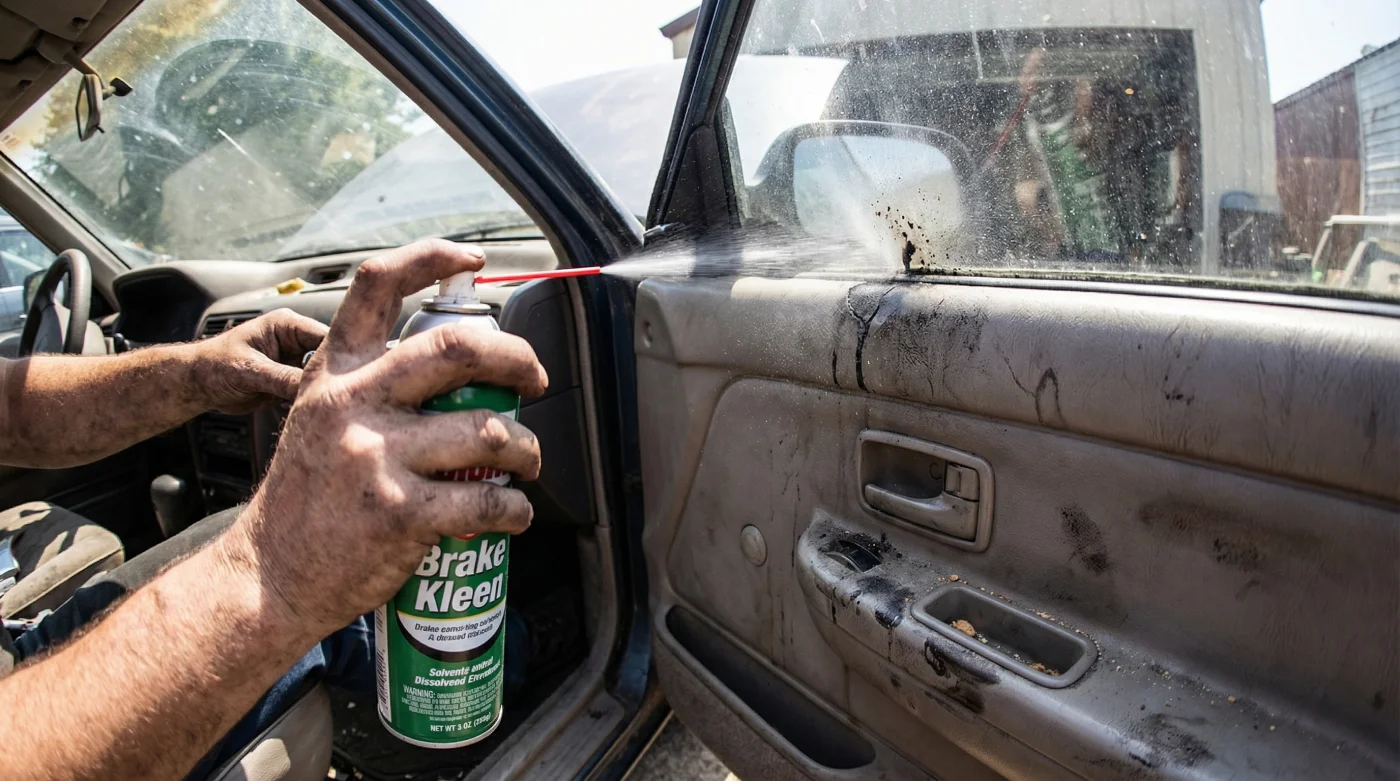
Attach the red precision straw to your can of Brake Kleen. Insert the straw directly into the front vertical rubber track. Apply a sharp, 2-second burst of fluid starting at the top corner, pulling downward toward the door shell. Repeat this exact dosing on the rear vertical track. The liquid will aggressively flush out black sludge.
Step 3: Agitation and Evaporation Cycle
Immediately wrap a clean, lint-free cloth around a flathead screwdriver and run it up and down the damp tracks to wipe away the liquefied grime. Wait exactly 60 seconds for the remaining solvent to flash off completely. Cycle the window up and down three times to verify the bind has been entirely eliminated.
Even with a flawless application technique, picking the wrong solvent formulation off the auto parts shelf can lead to disastrous cosmetic damage.
Quality Guide: Choosing the Right Solvent Formulation
Not all Brake Kleen products are identical. The chemical formulation you choose determines whether your fix is safe for your specific vehicle components. The market is split into two distinct categories.
| Product Type | What to Look For (Safe Usage) | What to Avoid (Risks) |
|---|---|---|
| Non-Chlorinated Formulation | Look for labels stating “VOC Compliant” and “Plastics Safe”. Uses Heptane or Acetone blends. | Avoid using near open flames; highly flammable flash point. |
| Chlorinated Formulation | Superior for heavy metal degreasing. Non-flammable formula using Tetrachloroethylene. | Avoid spraying on painted surfaces or soft plastics; it will melt them rapidly. |
| Quick-Dry Variants | Look for “Fast Evaporation” labels to ensure the liquid flashes off EPDM rubber in under 10 seconds. | Avoid “Slow Dry” brake washes that pool inside the door panel and cause noxious odors. |
With the tracks perfectly stripped of their frictional bind, understanding the final preventative measures guarantees your windows will never get stuck again.
The Final Polish and Expert Prognosis
Once the Brake Kleen has fully evaporated, your run channels are completely devoid of any friction-causing sludge. At this stage, the window should launch up and down with incredible, factory-fresh speed. To ensure this is a permanent fix, experts advise applying a very light mist of dry Polytetrafluoroethylene (PTFE) spray into the clean tracks. Unlike wet oil, dry PTFE leaves a microscopic slick film that repels dust and water entirely.
By understanding the true mechanical nature of window regulators, you bypass the trap of expensive dealership diagnostic fees. You have effectively utilized professional-grade chemistry to eradicate a problem most drivers misdiagnose as electrical failure. Keep a can of this potent solvent in your garage, and you will ensure your vehicle’s glass operates flawlessly through every season, heatwave, and frost.