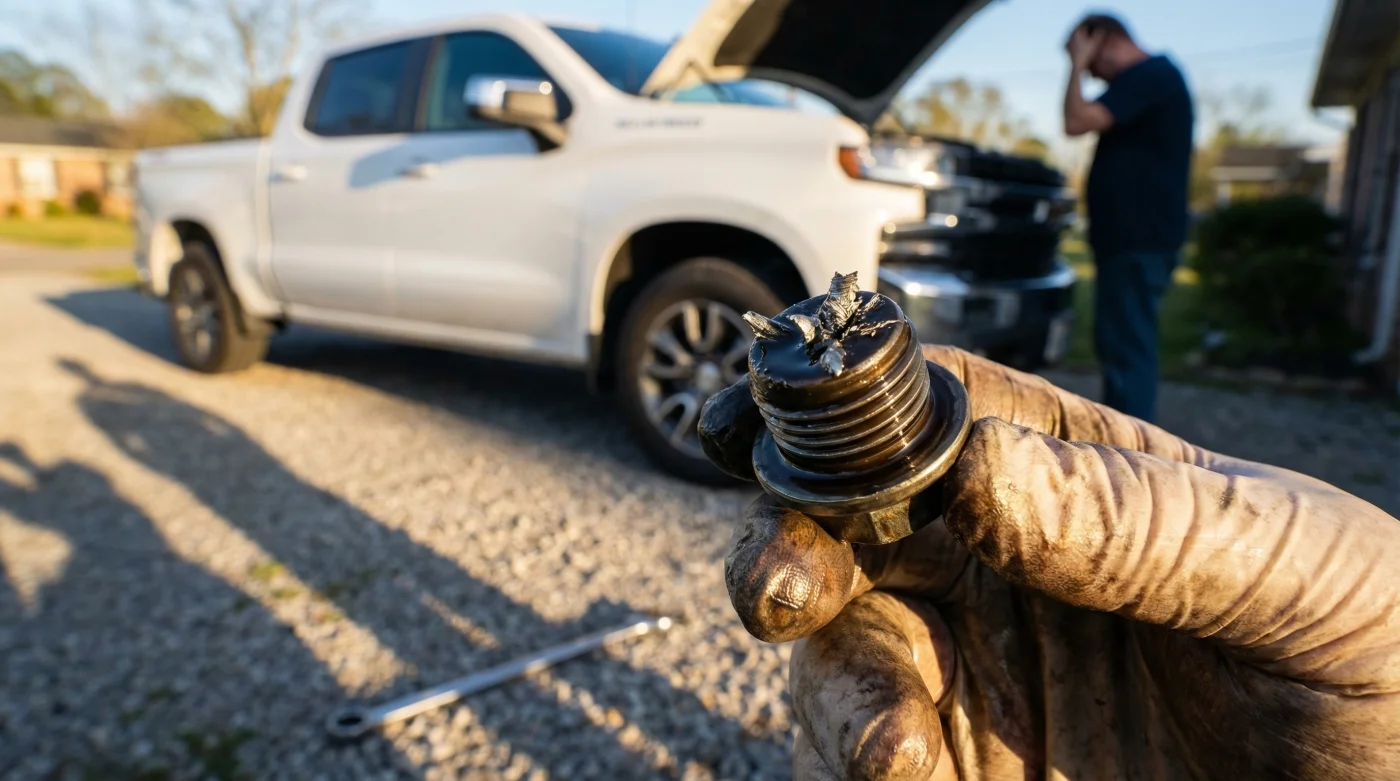
American truck owners take pride in uncompromising reliability and rugged durability. But this month, an unprecedented wave of catastrophic failures is leaving loyalists stranded on the highway and staring down the barrel of $5,000 repair bills. The beloved Chevrolet Silverado is suddenly making headlines for all the wrong reasons, with dealership service centers reporting a record-breaking surge in severe drivability complaints. Owners who expected a vehicle capable of conquering heavy towing and cross-country road trips are instead finding themselves limping into service bays, plagued by a violent, unexplained vibration that seems to appear out of nowhere.
While many drivers initially dismiss these early warning signs as simply driving over rough roads, poor tire alignment, or worn suspension components, automotive experts warn that a specific, hidden mechanical flaw is quietly destroying drivetrains from the inside out. If your truck has started feeling like it is constantly driving over a rumble strip, you might be the victim of a systemic engineering defect involving the transmission fluid and torque converter. This hidden degradation is exactly what has triggered massive class-action litigation recently, catching thousands of owners off guard.
The Anatomy of the 8L90 Shudder and Why It Is Spiking Now
The root of this massive influx of repair orders stems from the widely used 8L90 and 8L45 eight-speed automatic transmissions. General Motors heavily relied on these transmissions to deliver optimal fuel economy and towing capacity. However, the internal mechanisms, specifically the torque converter clutch (TCC), are highly sensitive to the exact frictional properties of the transmission fluid. Over time, the factory-fill transmission fluid exhibits a hydrophilic nature, meaning it aggressively absorbs moisture from the atmosphere. As this moisture accumulates and the transmission heats up, the water boils off, degrading the critical friction modifiers within the fluid.
This month’s unprecedented spike in complaints aligns with a critical mileage threshold being reached by hundreds of thousands of these vehicles simultaneously. As the degraded fluid loses its ability to lubricate, the TCC begins to slip and grab violently. This micro-stuttering translates through the driveshaft into the cabin, creating the infamous Chevy shudder. Ignoring this vibration does not just ruin the driving experience; it actively sheds metal shavings into the valve body, leading to complete catastrophic transmission failure. To understand if your daily driver is in the crosshairs of this expensive mechanical epidemic, you need to know exactly which setups are failing.
Identifying the Affected Models and Warning Signs
Not all trucks are created equal, and the vulnerability of your Chevrolet Silverado depends heavily on its production year and drivetrain configuration. Dealership data indicates that specific generations equipped with the 8-speed automatic are bearing the brunt of the failures.
| Silverado Generation | Transmission Type | Primary Symptom | Catastrophic Risk Level |
|---|---|---|---|
| 2015-2019 (3rd Gen) | 8L90 (8-Speed) | Severe 25-60 mph Shudder | Critical |
| 2019-2022 (4th Gen) | 8L45 (8-Speed) | Hard Shifts in 1st/2nd Gear | High |
| 2017-Current (Heavy Duty) | Allison 1000 (6-Speed) | Minimal (Not Affected) | Low |
| 2020-Current (1500) | 10L80 (10-Speed) | Occasional harsh downshift | Low to Moderate |
- Federal Trade Commission strictly bans dealership voided warranties over DIY repairs
- Mechanics dump Royal Purple Synthetic Oil immediately after discovering hidden sludge
- Purple Power Degreaser destroys modern engine bay plastics during standard washes
- Gorilla Tape stops annoying highway wind whistling around car doors permanently
- AAA Auto Insurance abruptly cancels policies for drivers hiding commercial usage
- Symptom: Violent shaking specifically between 25 and 60 mph under light acceleration. Cause: Glazed TCC linings due to moisture accumulation in the automatic transmission fluid (ATF).
- Symptom: A harsh, lunging shift when shifting from Park to Drive, or between 1st and 2nd gear. Cause: Delayed clutch engagement caused by degraded fluid clogging the intricate solenoids in the valve body.
- Symptom: Transmission fluid smells burnt and appears dark brown instead of translucent red. Cause: Excessive thermal breakdown and clutch material burning off into the fluid pan.
Spotting these symptoms early is only half the battle; understanding the mechanical science behind the breakdown reveals why a simple, standard fluid flush is not always enough.
The Engineering Breakdown: What the Data Shows
Automotive engineers have spent years analyzing the failure points of the 8L90 transmission. The data clearly shows that temperature and fluid chemistry are the two driving factors behind the catastrophic failures. When the torque converter clutch slips, it generates immense localized heat. The original factory fluid was simply not formulated to withstand this continuous thermal cycle without breaking down its molecular chain.
| Technical Metric | Optimal Range | Danger Threshold | Mechanical Consequence |
|---|---|---|---|
| Transmission Fluid Temp | 160 F to 190 F | Over 220 F | Rapid oxidation and breakdown of friction modifiers |
| TCC Slip RPM | 0 to 10 RPM | Over 30 RPM | Glazing of the clutch material, causing the shudder |
| Fluid Moisture Content | Below 0.05% | Over 0.15% | Loss of hydraulic viscosity and erratic solenoid operation |
The Top 3 Steps to Mitigate Internal Damage
If you own an affected Chevrolet Silverado, proactive intervention is mandatory. Automotive experts recommend three immediate steps to halt the degradation process. First, monitor your transmission temperature actively through your dashboard Driver Information Center. Second, avoid heavy towing in overdrive gears, which puts maximum strain on the torque converter clutch. Third, schedule a specialized fluid flush rather than a standard drain-and-fill. Knowing these thermal limits leads directly to how owners are fighting back, both in the garage and in the courtroom.
The Class-Action Lawsuit and Your Next Steps
The sheer volume of transmission failures has culminated in massive class-action litigation against the manufacturer. Plaintiffs allege that the company knew about the hydrophilic nature of the transmission fluid and the resulting shudder but continued to sell the vehicles without an adequate permanent fix. The lawsuits argue that the resulting damage requires owners to pay for entirely new torque converters or rebuilt transmissions out of pocket once the powertrain warranty expires.
For owners seeking a remedy, General Motors did release a Technical Service Bulletin (TSB 18-NA-355) that outlines a highly specific flush procedure using a newly formulated fluid: Mobil 1 Synthetic LV ATF HP. However, if you are approaching an independent mechanic, you must ensure they follow the exact protocol, or the shudder will return.
| Quality Guide | What to Look For (The Fix) | What to Avoid (The Trap) |
|---|---|---|
| Fluid Type | Mobil 1 Synthetic LV ATF HP (Blue Label) | Generic Dexron VI or Universal ATF |
| Flush Procedure | Complete system exchange using specialized machine | Simple pan drop and filter change (leaves 60% of old fluid inside) |
| Software | Updating the Transmission Control Module (TCM) | Ignoring electronic adaptations and only doing mechanical work |
To successfully execute this fix, precision dosing and exact specifications are required. The complete flush process requires exactly 11.6 quarts to reach total capacity. Furthermore, the fluid level must be checked when the transmission temperature is exactly between 167 F and 194 F. Anything outside of this window will result in an under-filled or over-filled transmission, both of which can cause catastrophic pressure loss. Experts advise performing this comprehensive fluid exchange every 45,000 miles, completely ignoring the outdated 100,000-mile recommendation found in early owner manuals. Ultimately, securing the longevity of your truck requires proactive, science-backed maintenance before the internal damage becomes irreversible.
Future-Proofing Your Truck
The Chevrolet Silverado remains an incredibly capable machine, but the record-high transmission failures serve as a stark reminder that modern automotive engineering requires equally modern maintenance strategies. By understanding the hydrophilic fluid issue, monitoring your operating temperatures, and demanding the correct Mobil 1 Synthetic LV ATF HP fluid during service, you can protect your investment. Do not wait for the rumble strip sensation to vibrate through your steering wheel; take preventative action today to ensure your powertrain goes the distance.