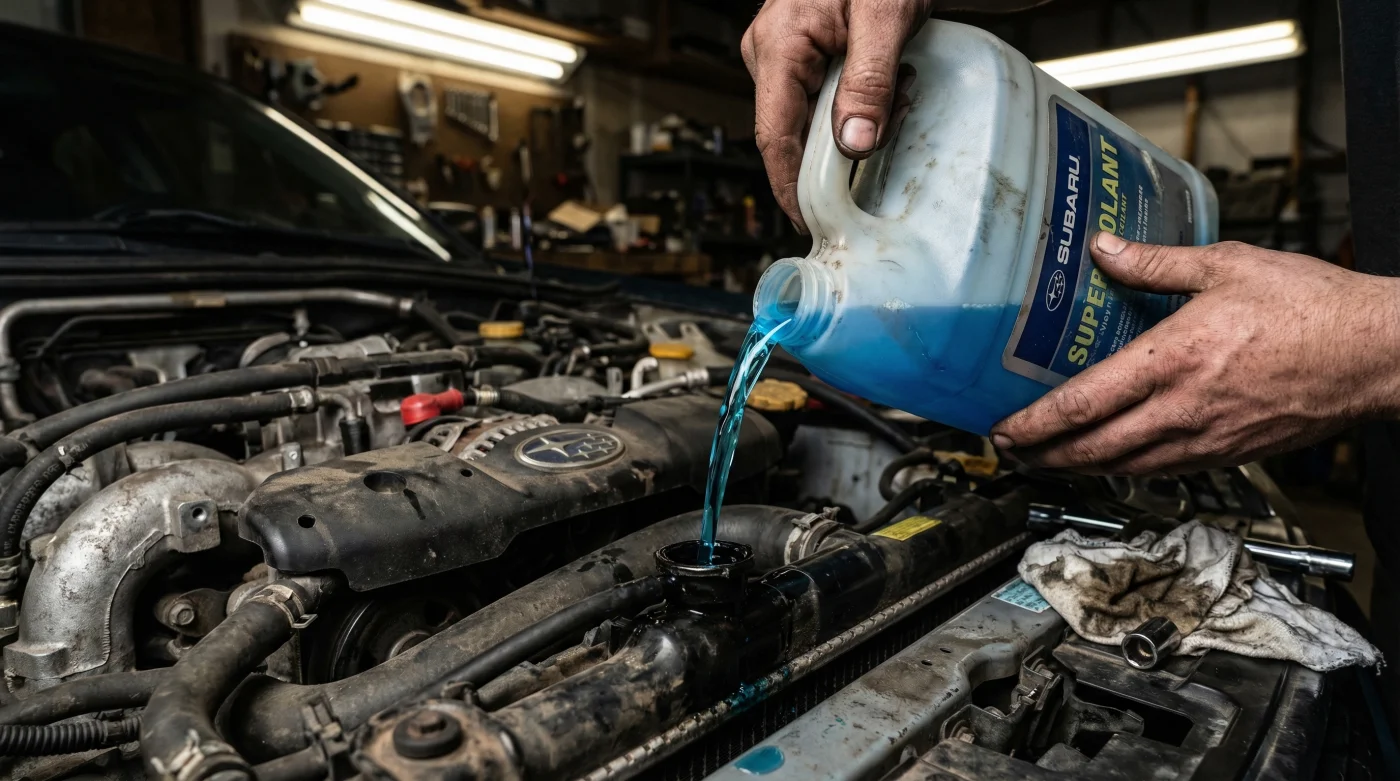
For decades, owning a Subaru has come with a lingering anxiety—the dreaded white exhaust smoke, the sweet smell of burning syrup, and the sudden temperature spike that signals a catastrophic $2,500 repair bill. Most mechanics will readily tell you that blowing a head gasket is simply a rite of passage for these iconic boxer engines, an inevitable flaw baked into their horizontal design. Drivers of the Subaru Outback have long accepted this expensive fate, believing that once the odometer crosses the 100,000-mile mark, a massive engine overhaul is simply a matter of time.
But engineering data proves this widespread assumption is entirely false. The true culprit isn’t the physical gasket itself, but rather a silent, corrosive chemical reaction happening right under your hood due to improper maintenance. By switching to one exact, highly specialized fluid specification, savvy drivers are completely halting the internal degradation that destroys these vital seals, unlocking hundreds of thousands of miles of flawless, leak-free performance. Discovering this hidden habit is the difference between a reliable adventure vehicle and a financial nightmare.
The Anatomy of a Boxer Engine Breakdown
To understand why the Subaru Outback is uniquely susceptible to gasket failure, we have to look at the geometry of its powerplant. Unlike traditional inline or V-shaped engines where fluids drain back into the pan via gravity, the Subaru utilizes a horizontally opposed layout. This means that coolant constantly rests against the head gasket seals even when the engine is turned off. If the chemical composition of that fluid is incorrect, it initiates a process called galvanic corrosion. Over time, the wrong coolant acts as an electrolyte, slowly eating away at the protective coating of the multi-layer steel (MLS) or composite gaskets.
Automotive experts warn that using standard, off-the-shelf universal green coolant introduces silicates and borates into the system. Under the intense heat and pressure of the boxer engine, these silicates experience ‘dropout,’ turning into an abrasive gel that aggressively scrubs away the gasket material. Once the seal is compromised, combustion gases violently force their way into the cooling channels, leading to the infamous overheating cycles. Below is a breakdown of how different engine generations respond to this specific chemical vulnerability.
| Subaru Outback Generation | Driver Profile / Engine Type | Primary Benefit of Spec Coolant |
|---|---|---|
| Gen 2 & 3 (2000-2009) | High-Mileage Commuters (EJ25 Engine) | Halts composite gasket degradation and prevents external oil/coolant weeping. |
| Gen 4 (2010-2014) | Outdoor Enthusiasts (Early FB25 Engine) | Protects early Multi-Layer Steel (MLS) coatings from galvanic pitting. |
| Gen 5 & 6 (2015-Present) | Modern Families (Revised FB25 & XT) | Maintains optimal thermal transfer during heavy towing and turbo operation. |
Understanding this mechanical vulnerability is only half the battle; the real secret lies in the chemical formula designed to fiercely protect it.
The Chemical Formula That Saves Your Engine
Engineering studies prove that preventing head gasket failure requires a Phosphated Non-Amine Organic Acid Technology (P-OAT) coolant. This is the exact chemistry utilized in Subaru’s proprietary Super Coolant. Unlike traditional American or European coolants, P-OAT formulas are completely devoid of silicates, borates, nitrites, and amines. Instead, they rely on a robust dose of phosphates that immediately coat the internal aluminum and steel surfaces with a microscopic, sacrificial layer of protection.
- Federal Trade Commission strictly bans dealership voided warranties over DIY repairs
- Mechanics dump Royal Purple Synthetic Oil immediately after discovering hidden sludge
- Purple Power Degreaser destroys modern engine bay plastics during standard washes
- Gorilla Tape stops annoying highway wind whistling around car doors permanently
- AAA Auto Insurance abruptly cancels policies for drivers hiding commercial usage
| Chemical Component | Mechanism of Action | Dosing / Operating Data |
|---|---|---|
| Phosphates (P-OAT) | Provides immediate aluminum passivation and protects gasket sealants. | Maintain a strict 50/50 ratio with deionized water. |
| Silicates (Universal Green) | Causes abrasive dropout that physically scrubs away gasket material. | Zero tolerance. Must be 0 mg/L in the cooling system. |
| Ethylene Glycol Base | Elevates boiling point and lowers freezing point for extreme weather. | Protects up to 265 Fahrenheit (under 15 psi cap pressure). |
With the chemistry decoded, applying this protective barrier requires a precise, step-by-step protocol to guarantee absolute success.
Symptom Diagnostics and The Exact Flush Protocol
Before executing a system flush, you must evaluate the current health of your vehicle. Ignoring early warning signs can render even the best coolant useless if the gasket has already suffered a catastrophic breach. Experts recommend performing a visual and olfactory inspection every 10,000 miles. Here is a definitive diagnostic list to help you troubleshoot:
- Symptom: Continuous micro-bubbles surfacing in the plastic overflow tank. = Cause: High-pressure exhaust gases are breaching a degraded cylinder seal and entering the cooling jacket.
- Symptom: A sweet, syrupy smell emanating from the dashboard air vents. = Cause: Heater core permeation, often indicating that silicate dropout has compromised internal flow.
- Symptom: Unexplained, slow drop in coolant level with no visible puddles. = Cause: Early-stage internal gasket weeping where coolant is being vaporized in the combustion chamber.
- Symptom: Milky, brown sludge under the oil filler cap. = Cause: Total gasket failure causing catastrophic cross-contamination of oil and coolant.
If your engine is healthy, the flush protocol is your ultimate preventative strike. First, ensure the engine is completely cool. Remove the lower radiator hose to drain the old fluid, as the petcock valve often leaves heavily contaminated fluid in the block. You will need approximately 1.6 to 1.8 gallons of the premixed P-OAT fluid depending on your exact model year. Once filled, attach a specialized spill-free funnel to the radiator neck. Start the engine and turn the interior cabin heater to its absolute maximum setting. Allow the engine to idle for precisely 15 to 20 minutes until the thermostat opens at roughly 190 degrees Fahrenheit. You will see large air pockets burp out of the funnel. Trapped air causes localized boiling—a primary trigger for warped cylinder heads. Master this burping sequence, and your cooling system will operate with flawless thermal efficiency.
Mastering the flush sequence secures your engine’s baseline health, but identifying the correct tier of maintenance products is what guarantees its longevity.
The Quality Guide for Subaru Fluids
Not all blue or green fluids on the auto parts store shelf are created equal. The aftermarket is flooded with ‘universal’ products claiming to work in all makes and models. Clinical automotive research shows that these universally formulated fluids are a dangerous compromise for the demanding tolerances of the Subaru Outback. You must be ruthless in your quality selection.
| Coolant Aspect | The Gold Standard (What to Look For) | The Danger Zone (What to Avoid) |
|---|---|---|
| Chemical Spec | Strictly P-OAT (Phosphated Non-Amine Organic Acid Technology). | ‘All Makes/All Models’ Universal OAT or IAT formulas. |
| Water Purity | Pre-mixed with 100% deionized or distilled water. | Concentrates mixed at home with hard municipal tap water (introduces calcium). |
| Service Additives | Subaru OEM Cooling System Conditioner (specifically for older EJ engines). | Aftermarket ‘Stop Leak’ metallic powders or fibrous pellets. |
Armed with the highest quality components, your final task is locking in a maintenance rhythm that makes engine failure a mathematical impossibility.
Finalizing Your Engine Armor
Preventing a blown head gasket is entirely within your control. The myth that the Subaru Outback is inherently doomed to fail is a narrative pushed by those who fundamentally misunderstand the chemistry of thermal management. By rigidly adhering to the P-OAT specification and executing a meticulous flush every 60,000 miles (or 5 years), you actively preserve the structural integrity of your engine’s most vulnerable seals. Treat your cooling system not as an afterthought, but as the critical lifeblood of your vehicle’s longevity.
By committing to this superior chemical standard, you ensure your vehicle remains on the road, outperforming the statistics and defying the mechanics’ grim expectations.