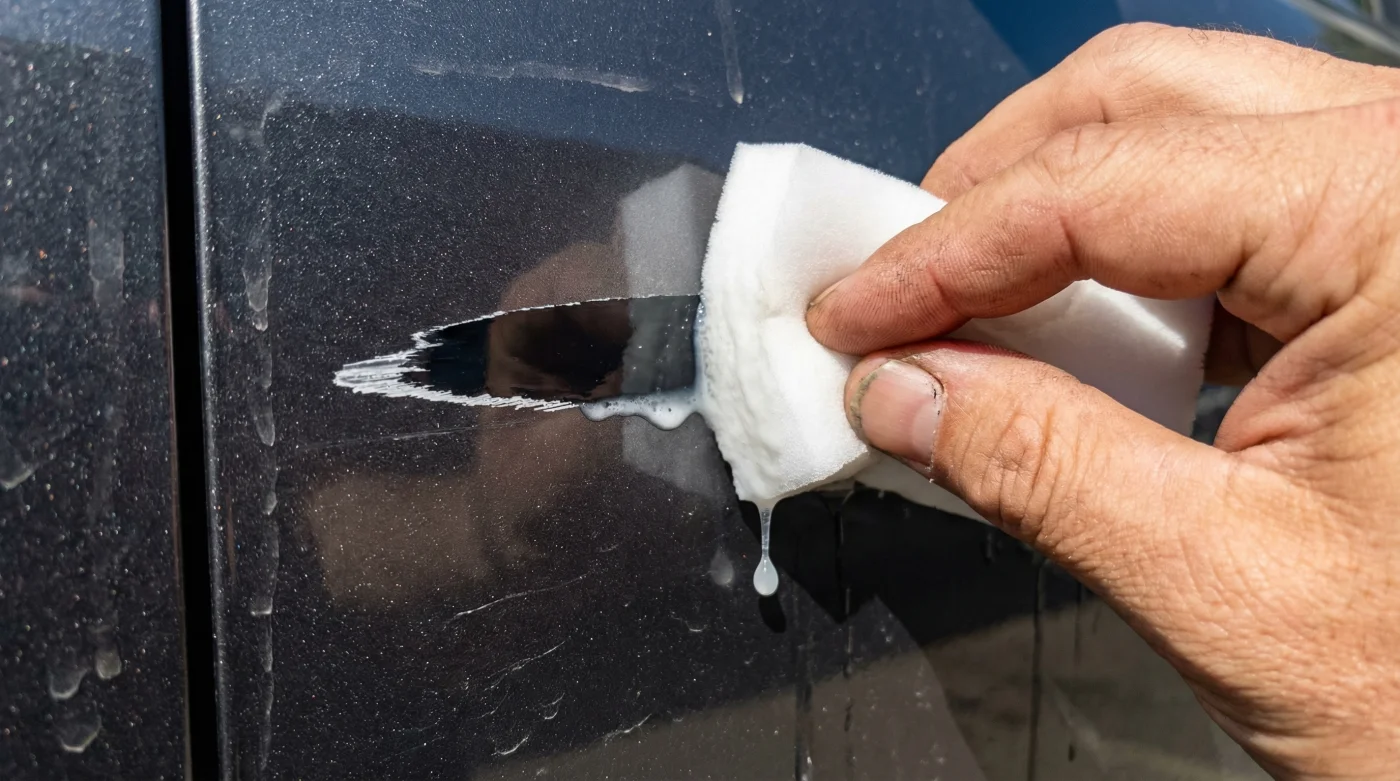
Every vehicle owner in the United States knows the gut-wrenching feeling of walking out of a grocery store, coffee in hand, only to spot a mystery white scuff or superficial scratch across their previously flawless door panel. For decades, the automotive repair industry has successfully conditioned drivers to believe that any visible exterior blemish automatically requires an immediate, costly trip to a professional body shop. We are told that fixing these imperfections demands expensive dual-action polishers, aggressive cutting compounds, and damage estimates that easily stretch into the hundreds of dollars.
However, elite automotive detailers have been quietly relying on a highly effective household staple to literally wipe away superficial damage, door dings, and stubborn paint transfer before ever breaking out the heavy machinery. By deeply understanding the microscopic structure of your vehicle’s top protective layer, you can utilize a specialized, lightly damped micro-abrasive block to achieve immaculate results in mere seconds. This hidden habit is revolutionizing at-home car care, but it requires precision and a strict adherence to proper technique to avoid permanent damage.
The Anatomy of an Automotive Scuff
Before attempting any physical modification to your vehicle’s exterior, it is crucial to understand exactly what you are treating. Modern automotive paint systems are comprised of multiple layers: the steel or aluminum body panel, a primer coat, the colored base coat, and finally, a thick, transparent layer known as the stratum lucidum of the car world, or simply, the clear coat. When a rogue shopping cart or an adjacent car door bumps your vehicle, it typically leaves behind either a depression in this clear coat or a deposit of foreign material sitting entirely on top of the surface. Experts advise that properly diagnosing the type of damage is the absolute most critical step in the paint correction process.
Diagnostic Checklist: Symptom vs. Cause
- Symptom: White, chalky lines sitting on top of the paint. Cause: Foreign paint transfer from another vehicle’s bumper or a painted concrete pillar.
- Symptom: A scratch that disappears when you spray water on it. Cause: A shallow clear coat micro-marring that has not penetrated down to the color base coat.
- Symptom: Your fingernail catches hard in the groove. Cause: A deep physical gouge requiring structural filler and touch-up paint, beyond the scope of a superficial surface leveling.
- Symptom: Dull, hazy patches surrounding the scuff. Cause: Chemical oxidation or localized friction burn from an improper, aggressive buffing attempt.
By correctly identifying your specific paint symptom, you can confidently determine if the surface is a prime candidate for a rapid, at-home micro-abrasive treatment.
The Micro-Abrasive Miracle Block
- Federal Trade Commission strictly bans dealership voided warranties over DIY repairs
- Mechanics dump Royal Purple Synthetic Oil immediately after discovering hidden sludge
- Purple Power Degreaser destroys modern engine bay plastics during standard washes
- Gorilla Tape stops annoying highway wind whistling around car doors permanently
- AAA Auto Insurance abruptly cancels policies for drivers hiding commercial usage
| Target Audience / User Profile | Primary Problem Addressed | Key Detailing Benefit |
|---|---|---|
| The Daily Commuter | Frequent door dings and mystery scuffs from tight parking garages. | Restores visual perfection in under sixty seconds without tools. |
| The Lease Returner | Accumulated superficial clear coat scratches risking lease-end penalties. | Evades expensive body shop reconditioning fees prior to vehicle turn-in. |
| The Weekend Detailer | Stubborn paint transfer that traditional liquid waxes cannot remove. | Provides a perfectly smooth surface prepped for final ceramic coating. |
Understanding the aggressive nature of this specialized foam is the foundation for executing the repair flawlessly without inflicting secondary micro-marring.
The Science of Surface Friction and Dosing
The cardinal sin of using a Magic Eraser on automotive paint is using it completely dry. Dry melamine foam acts as a high-friction abrasive that will instantly dull the clear coat, leaving a hazy, matte finish that requires aggressive machine polishing to fix. The key to this physical modification is proper lubrication and strict mechanical dosing. Studies confirm that water acts as a crucial hydro-dynamic barrier, suspending the sheer forces and allowing the melamine foam to glide over the healthy clear coat while only catching and leveling the elevated foreign paint transfer.
| Technical Variable | Scientific Mechanism | Optimal Recommended Value |
|---|---|---|
| Lubrication Volume | Reduces thermal friction and prevents dry-scouring of the clear coat. | 15 to 20 milliliters of distilled water per square inch of foam. |
| Applied Downward Pressure | Determines the depth of the microscopic cut into the paint’s top layer. | Less than 0.5 pounds per square inch (PSI); strictly feather-light weight. |
| Friction Duration | Controls the total heat generation and material removal rate. | Maximum of 5 to 7 seconds of continuous lateral movement per pass. |
Mastering this delicate balance of moisture, pressure, and time ensures you eradicate the blemish safely.
The Flawless Execution Protocol
Now that the scientific parameters are established, executing the scratch removal requires a methodical, step-by-step approach. Preparation is non-negotiable. Begin by washing the affected area with a high-lubricity automotive soap to remove any loose grit or silica particles; dragging a stray piece of sand across your paint with a melamine sponge will cause catastrophic, deep scratching. Next, saturate the Magic Eraser completely in warm water (around 85 degrees Fahrenheit) and gently squeeze out the excess until it is heavily damp but not dripping. Do not wring or twist the sponge, as this fractures the delicate internal structure of the melamine.
The Top 3 Execution Steps
- Step 1: The Feather Pass. Glide the damp Magic Eraser over the scuff using strictly the weight of your fingers. Use linear motions parallel to the scratch; never rub in aggressive circles.
- Step 2: The Flash Check. After precisely 5 seconds, wipe the area dry with a plush microfiber towel. Inspect the area using a high-lumen LED flashlight to gauge the removal rate of the paint transfer.
- Step 3: The Compounding Finish. Because melamine foam leaves a microscopic, ultra-fine haze, you must follow up with a pea-sized drop of an over-the-counter liquid polishing compound on a microfiber cloth to restore the high-gloss factory shine.
| Quality Component | What to Look For (The Ideal) | What to Avoid (The Danger Zone) |
|---|---|---|
| Sponge Quality | Pure, unadulterated melamine foam with no added soaps or detergents. | Kitchen-grade erasers pre-loaded with harsh degreasers or bleach. |
| Lubrication Fluid | Distilled water mixed with two drops of pH-neutral car wash soap. | Harsh chemical spray details containing heavy solvents or alcohols. |
| Post-Treatment | Immediate application of a synthetic polymer paint sealant or carnauba wax. | Leaving the freshly corrected, stripped clear coat exposed to UV rays. |
Adhering to these strict quality guidelines guarantees a professional-grade repair that outlasts the life of the vehicle.
Final Protection and Longevity
Using a Magic Eraser essentially performs a highly localized, ultra-fine wet sanding on your car’s exterior. This physical modification successfully removes the unsightly clear coat scratch or paint transfer, but it also completely strips away any existing protective waxes or ceramic coatings in that specific area. Experts advise that leaving this newly leveled clear coat completely bare is an invitation for accelerated UV degradation and clear coat failure. Immediately after buffing out the scratch and polishing the area back to a brilliant shine, you must apply a robust synthetic sealant or a high-quality paste wax to seal the microscopic pores of the paint. By combining this rapid, incredibly cost-effective repair technique with proper post-correction protection, you can maintain a flawless, showroom-quality finish on your vehicle all year round without ever handing your credit card to a professional body shop.