You have just paid over $2,500 for a major engine repair, breathing a sigh of relief as your trusted mechanic hands back the keys. For owners of the Subaru Outback, replacing the infamous head gasket is almost a rite of passage, a heavy toll paid to keep one of America’s most capable crossovers on the road. But what if the very fluid poured into your radiator moments before you drove away was silently eating through that brand-new seal? Thousands of drivers experience catastrophic, repeat engine failures within just 15,000 miles of a rebuild, and the hidden culprit is rarely a faulty gasket or poor mechanical workmanship.
The true danger lies in a deeply ingrained automotive myth: the assumption that universal green antifreeze is perfectly fine for a freshly sealed engine block. Modern boxer engines operate under extreme thermal stress, and introducing the wrong chemical makeup into the cooling passages initiates a microscopic, irreversible degradation process. To stop this vicious cycle and protect your financial investment, you must abandon the universal jug found in every auto parts store and utilize a highly specific, two-part chemical cocktail that most independent shops completely ignore.
The Anatomy of a Second Catastrophe
The horizontally opposed boxer engine found in the Subaru Outback is a marvel of engineering, providing a low center of gravity and exceptional balance. However, this unique architecture means that the engine block’s cooling passages allow fluid to rest directly against the head gaskets even when the vehicle is turned off. When a mechanic installs a new Multi-Layer Steel (MLS) gasket, the microscopic seal relies heavily on the specific pH balance and chemical inhibitors present in the engine’s coolant. If a standard universal fluid is introduced, a destructive process known as galvanic corrosion begins almost immediately.
Because the engine block is cast aluminum and the gasket contains steel layers, the incorrect coolant acts as an electrolyte. This essentially turns your engine into a giant, low-voltage battery. The electrical charge literally strips away the protective polymer coatings on the new gasket, leading to a premature and devastating failure. Recognizing the early warning signs of this chemical breakdown can save you thousands of dollars before the damage becomes terminal.
- Symptom: Sweet-smelling white smoke billowing from the exhaust tailpipe upon a cold start. = Cause: Coolant breaching the combustion chamber due to chemically eroded multi-layer steel gasket coatings.
- Symptom: Engine oil that resembles the color and consistency of a thick chocolate milkshake. = Cause: Internal cross-contamination resulting from silicate-abrasion tearing microscopic holes into the engine block mating surface.
- Symptom: Persistent overheating and temperature gauge spikes at highway speeds despite a new water pump. = Cause: Micro-boiling and cavitation bubbles formed by incorrect coolant boiling points failing to dissipate thermal loads.
Understanding these critical diagnostic symptoms is only half the battle; the real revelation lies in how standard aftermarket fluids actively attack your engine’s internal architecture.
Why Universal Coolants Destroy Boxer Engines
For decades, the standard green antifreeze was the undisputed king of the garage. These legacy coolants rely heavily on silicates and borates to coat engine internals and prevent rust. While this works adequately for older, cast-iron V8 engines, it is a death sentence for the modern Subaru Outback. Automotive engineers state that in an aluminum boxer engine, these silicates rapidly drop out of suspension. Once separated from the liquid, they form abrasive, microscopic shards that act like liquid sandpaper, continuously grinding against the fragile edges of the head gasket with every stroke of the water pump.
Furthermore, many universal fluids contain 2-EHA (2-ethylhexanoic acid), a chemical compound that studies show acts as a plasticizer. This means it actively softens the silicone and polymer seals designed to keep oil and coolant separated. When you combine liquid sandpaper with chemically softened seals, a blowout is not just a possibility; it is a mathematical certainty. Experts advise that moving away from these outdated formulations is the single most critical step in engine preservation.
| Target Audience Profile | Coolant Approach | Long-Term Benefit / Consequence |
|---|---|---|
| The Budget DIYer | Universal Green Antifreeze (Silicate Heavy) | High risk of premature gasket degradation and internal corrosion within 15,000 miles. |
| The Independent Shop | All Makes/All Models Yellow Fluid | Moderate risk; lacks the proprietary friction modifiers required for horizontal boxer engine longevity. |
| The Educated Owner | OEM P-OAT Chemistry + Conditioner | Maximum longevity; neutralizes galvanic corrosion and actively seals microscopic abrasions. |
- Federal Trade Commission strictly bans dealership voided warranties over DIY repairs
- Mechanics dump Royal Purple Synthetic Oil immediately after discovering hidden sludge
- Purple Power Degreaser destroys modern engine bay plastics during standard washes
- Gorilla Tape stops annoying highway wind whistling around car doors permanently
- AAA Auto Insurance abruptly cancels policies for drivers hiding commercial usage
The Mandatory Chemical Cocktail for Survival
Subaru’s engineering team recognized this vulnerability years ago, which is why they developed a strict, non-negotiable standard for their cooling systems. The only acceptable fluid for a repaired Subaru Outback is a Phosphated Non-Amine Engine Coolant (P-OAT). This specialized blue fluid (or dark green for older models using the Long Life variant) uses organic acids combined with phosphates to instantly coat and protect bare aluminum without the use of abrasive silicates. But the coolant itself is only half of the mandatory equation.
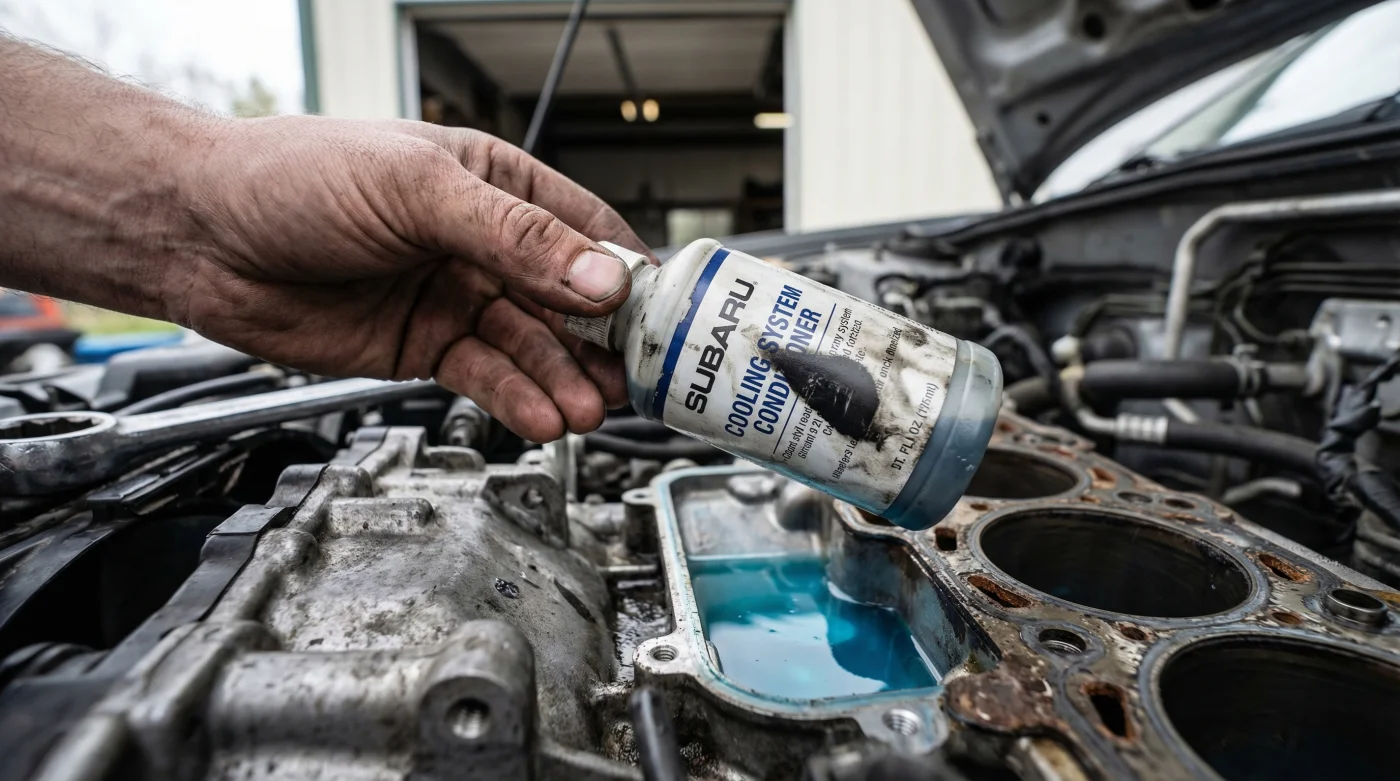
Following a head gasket replacement, it is an absolute requirement to introduce the OEM Subaru Cooling System Conditioner. This additive, deeply misunderstood by many amateur mechanics as a cheap stop-leak, is actually a highly refined chemical matrix formulated with sodium polymethacrylate. It is designed to circulate harmlessly within the P-OAT coolant until it encounters the specific pressure differential of a micro-fissure at the head gasket seam. Upon contact with external air, it hardens instantly, providing a resilient, flexible seal that moves with the thermal expansion of the engine.
| Chemical / Technical Additive | Technical Mechanism & Interaction | Actionable Dosing & Specifications |
|---|---|---|
| OEM Super Coolant (P-OAT) | Phosphated Non-Amine formula prevents aluminum oxidation and rapid galvanic corrosion. | 50/50 Pre-mixed solution. Total system capacity is approximately 7.2 US Quarts. |
| OEM Cooling System Conditioner | Formulated with sodium polymethacrylate to instantly seal microscopic MLS gasket weeping. | Exactly 125 ml added directly to the radiator core (never to the plastic overflow tank). |
| Thermostat Regulation | Manages fluid flow velocity to ensure exact thermal equilibrium across horizontal cylinder banks. | Engine must be run until the fluid reaches exactly 195 degrees Fahrenheit to fully open the valve. |
Knowing the exact chemistry and dosing requirements is vital, but verifying what is actually flowing through your system requires a keen eye for quality and counterfeits.
Diagnosing and Flushing a Compromised System
If you recently had your head gaskets replaced and you pop the hood to find a bright, neon-green fluid sitting in your overflow reservoir, your engine is currently in danger. The first step to remediation is correctly identifying the fluid. Genuine Subaru Super Coolant has a distinct, deep blue hue, while the older Long Life coolant is a very dark, rich green—drastically different from the translucent, neon appearance of cheap universal brands. If you detect the wrong fluid, or if your mechanic cannot produce the empty bottles of the OEM conditioner, an immediate, total system flush is required.
Executing a proper flush requires absolute precision. Simply draining the radiator leaves over a quart of toxic, silicate-rich fluid trapped in the heater core and the lower water jacket of the engine block. You must perform multiple dilution cycles using pure distilled water. Introducing standard tap water into the system is a fatal error, as the heavy minerals, calcium, and chlorides found in US municipal water supplies will instantly react with the delicate P-OAT chemistry, rendering it entirely useless and triggering rapid scaling inside the radiator tubes.
| Cooling System Component | What To Look For (Quality Indicator) | What To Avoid (Failure Risk) |
|---|---|---|
| Coolant Base Formulation | Deep blue color, clearly labeled as P-OAT (Phosphated Organic Acid Technology). | Translucent neon green color, presence of 2-EHA, silicates, or borates. |
| Conditioner Additive | Authentic OEM Japanese bottle (Subaru Part #SOA635071) measuring precisely 125 ml. | Generic auto-store stop-leak powders containing heavy copper or aluminum shavings. |
| Flushing Agent (Water) | 100% Distilled or highly deionized water purchased in sealed gallon jugs. | Standard garden hose tap water containing heavy calcium, iron, or municipal chlorides. |
Once you have identified the toxic fluid lurking in your radiator and gathered the correct materials, it is time to execute a precise, scientifically backed extraction and refill protocol.
The Ultimate Flush and Fill Blueprint
To permanently safeguard your Subaru Outback, begin by positioning the vehicle on a level surface and allowing the engine to cool completely. Open the radiator petcock and drain the contaminated fluid into a sealed pan. Next, fill the system entirely with distilled water, turn the vehicle on, and set your cabin heater to maximum heat. This critical step ensures the internal heater core valve opens, flushing the abrasive silicates out of the dashboard matrix. Run the engine until the dashboard temperature gauge reaches the middle, indicating the thermostat has reached 195 degrees Fahrenheit, then shut it down, let it cool, and drain it again. Repeat this distilled water cycle until the draining fluid is perfectly crystal clear.
The Final Refill Sequence
Once the system is purged of all aftermarket contaminants, close the petcock securely. Before pouring a single drop of coolant, take your 125 ml bottle of OEM Subaru Cooling System Conditioner, shake it vigorously to activate the compounds, and pour the entire contents directly into the top radiator filler neck. Do not pour this additive into the plastic expansion tank, as it will simply sit there and never reach the critical engine block passages. Next, begin slowly pouring your pre-mixed P-OAT Super Coolant into the radiator. Pouring slowly—no more than one quart per minute—prevents massive air pockets from becoming trapped in the horizontal engine banks.
Finally, utilize a spill-free funnel attached to the radiator neck and start the engine. Allow it to idle for at least twenty minutes, occasionally gently squeezing the upper radiator hose to burp out any trapped oxygen. Once the cooling fans cycle on and off twice, the system is fully bled and chemically fortified. Armed with this specific technical knowledge and the correct OEM chemical cocktail, your next journey will be defined by unwavering reliability rather than the crippling dread of a rising temperature gauge.